4D Country
About this Album
When a band like Geese releases a limited-edition companion EP to its already expansive second album, the obvious assumption is that it contains leftovers, the tracks that were not quite good enough to make the final cut.[1] The 4D Country EP, released in October 2023 exclusively through Partisan Record Club in a pressing of just 500 hand-numbered copies,[2] invites exactly that assumption. Then it refuses it.
A World Too Big for One Release
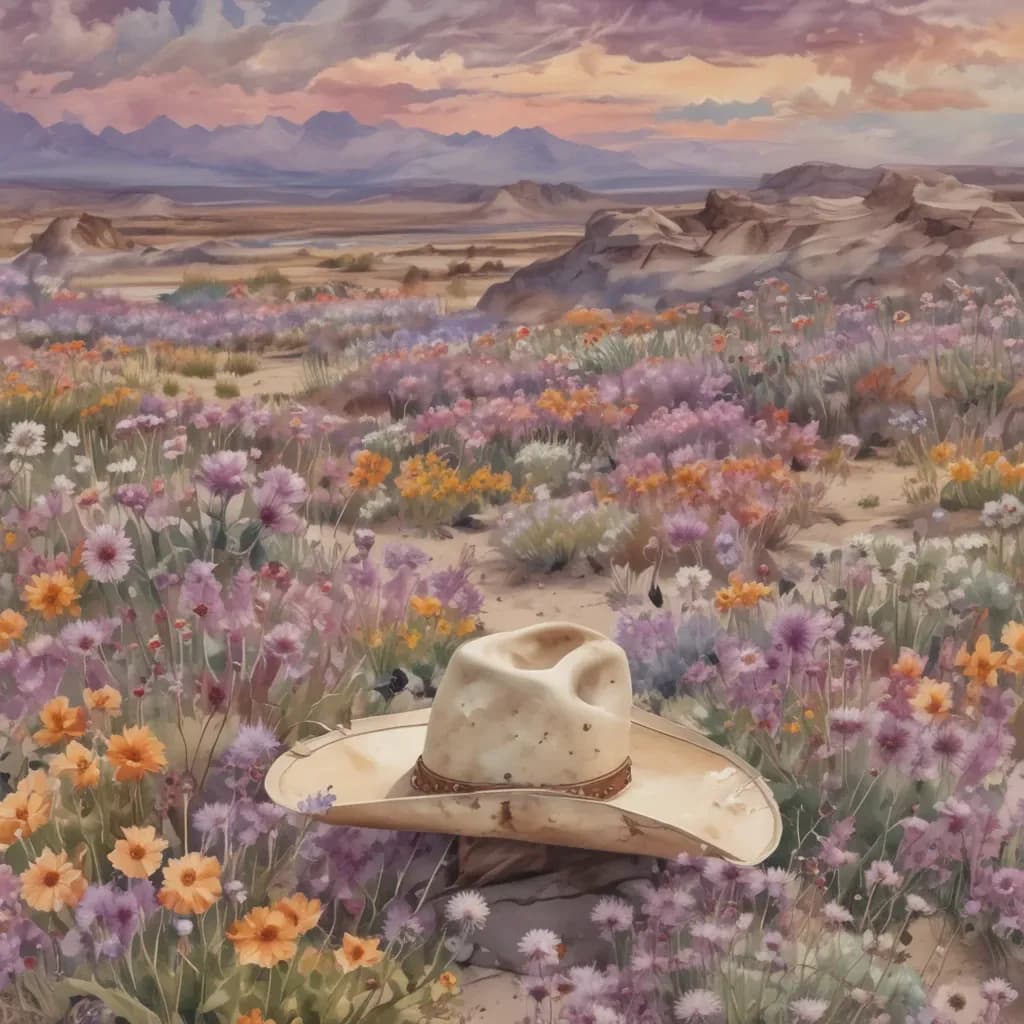
To understand 4D Country, you need some context. The EP arrives in the wake of 3D Country (June 2023), Geese's second album and the record that established this Brooklyn group as one of the most restlessly inventive young bands in American rock.[3] That album was built around a hallucinatory Western concept: an uptight cowboy ventures into the desert, takes psychedelics, and watches both his surroundings and his sense of self completely unravel.[4] The Wild West is his landscape, but dissolution is his destination.
Beneath the desert surrealism, the album was about something more immediate. Cameron Winter, the band's vocalist and primary lyricist, articulated the deeper preoccupation as what he called 'modern doom,' the ambient dread of living under the long shadow of climate change and civilizational uncertainty.[5] The response he and the band crafted was not paralysis or despair, but a form of dark comedy. Younger generations, Winter observed, have developed an ironic acceptance around the fact that catastrophe looms on the horizon, and he found something almost beautiful in that refusal to collapse.[5]
That thematic world was too large to contain in a single album. 4D Country extends it.
Adding Another Dimension
The title is worth pausing on as a conceptual statement. The band's debut, Projector (2021), was a flat, urgent blast of post-punk, images thrown against a wall.[6] 3D Country gave those images depth, converting the flat surface of American mythology into something three-dimensional and immersive. 4D Country adds another variable, whether time or creative surplus, the parts of a vision that exist outside the primary frame.
The inclusion of an extended version of the title track is the clearest signal of this intent. Stretching the album's centerpiece into new territory, it reinforces the EP's function as an afterimage: not a replacement for the main album but a longer look at what it contains.
Songs That Refused to Stay Cut
The four non-album tracks each establish their own distinct personality while remaining clearly part of the same world. 'Jesse' arrives as the collection's hardest-rocking moment, pairing propulsive guitar work with Winter's characteristically unconventional vocal delivery.[1] It channels something more direct and confrontational than much of the parent album, a reminder that beneath all the conceptual ambition lives a band with genuine command of raw rock energy. The song had already been a fixture of the band's live sets for a year before this release, and its accompanying video leaned into occult imagery, underscoring how much the EP's swagger is bound up with ritual and myth.[12].
'Art of War' moves in a different direction entirely, toward the rhythmic and the physical.[1] It is the EP's most dance-oriented track, finding groove where the album often found grandeur. The thematic territory remains similar, survival and desire and bodies moving through an indifferent world, but expressed through momentum rather than majesty.
'Space Race' drew particular attention as a standout, with critics noting it as potentially among the strongest work the band had produced to that point.[1] Its expansive reach reinforces the sense that these tracks were not omitted because they failed, but because the album could only hold so much before collapsing under its own ambition. 'Killing My Borrowed Time' rounds out the set with equal assurance, each of the five pieces holding its own rather than merely filling space. The EP itself earned its own notice separately from the parent album: Northern Transmissions gave 4D Country an 8/10, crediting the band for tightening its songcraft without losing its experimental edge, and singling out ‘Space Race’ for its “burning impassioned vocals,” a performance the review framed as part of a broader shift toward a more “supple, dulcet” side of Cameron Winter's voice.[11]
“Killing My Borrowed Time” stands out for wearing its heaviest idea the lightest. Partisan's own description of the track calls it “a delightfully off-kilter blend of glam, gospel, punk, and (naturally) a hint of country,”[2] and that blend does real work: a song about running out of time, framed by an idiom that already implies a debt coming due, arrives dressed as one of the EP's catchiest, most danceable moments. Northern Transmissions called it “the most conventional bop on the EP,”[11] but the accessibility is part of the point: an uneasy subject delivered with enough warmth that it reads as acceptance rather than dread.
The Psychedelic Frontier as Continuing Metaphor
What holds all of this material together is the consistent use of psychedelic frontier imagery as a lens for examining contemporary psychological and political reality. Geese's engagement with Americana has never been nostalgic or straightforward. The West in their hands is not a place of rugged triumph but a terrain for ego dissolution, for the confrontation that comes when familiar structures fall away.
This is what makes 4D Country valuable as a thematic document, not just as a musical curiosity. These tracks were not cut because they had nothing to say. They belong to the same conversation about how you live with dread, how you metabolize collective catastrophe into something survivable, even something funny. NME described the broader 3D Country project as a cynical take on Americana in the age of an imminent climate crisis,[3] and the EP tracks carry that same wit and force.
James Ford's production, which gave 3D Country its vast, dynamic sound (building on his prior work with acts ranging from Arctic Monkeys to Depeche Mode),[7] creates a sonic world spacious enough for the EP tracks to inhabit naturally. The same palette, blues textures, prog expansions, gospel surges, and hard pivots into pure rock energy, extends into this supplemental material without feeling diluted.
Between Two Albums
'3D Country' was widely understood as a decisive break from the post-punk sound of the debut.[6] Where Projector was grittier and more constrained, the second album announced that the band had moved well beyond being Brooklyn post-punk teenagers, into something harder to categorize. Rolling Stone called it one of the better New York rock albums in recent years;[8] NME covered it at a scale usually reserved for acts several releases further into their careers.[3]
The band's own framing of the shift was characteristically direct. Winter described their debut as teenage angst and 3D Country as newfound twenty-something arrogance,[9] a shift in register that carries through every track on 4D Country as well. The confidence here is not self-congratulatory. It is the conviction of a group that has genuinely internalized what it means to make ambitious, fully committed rock music and refuses to apologize for it.
The EP appeared just as guitarist Foster Hudson announced his departure from the band in December 2023, making it the final official document of this specific lineup. That adds a particular weight to listening now. This is a record of what was possible when a specific set of people were working together, generating more strong material than even an ambitious project could fully contain.
A Document of Overflow
Limited editions of 500 copies have a way of becoming artifacts, objects that mark a moment in a band's history that most listeners will only encounter secondhand. 4D Country deserves a wider hearing than its initial release allowed. It captures Geese at a moment of peak creative abundance, testing the limits of a conceptual framework that had already yielded one of the more audacious rock records of 2023.[2]
The psychedelic cowboy is still riding. He just hasn't finished talking yet.
Songs
References
- Featured Review: 4D Country by Geese (WUOG) — College radio review of the 4D Country EP with track-by-track observations on Jesse, Art of War, and Space Race
- Geese Release 4D Country (Partisan Records) — Official Partisan Records page for the 4D Country EP, confirming the 500-copy limited pressing
- Geese: 3D Country Review (NME) — NME review describing it as a cynical take on Americana in the age of climate crisis
- Partisan Records: 3D Country Announcement — Official label description of the 3D Country psychedelic cowboy narrative concept
- Geese: 3D Country Review (Northern Transmissions) — Review including Cameron Winter's quotes about 'modern doom' and climate anxiety
- Geese: 3D Country Review (Pitchfork) — Pitchfork review describing the evolution from post-punk debut to expansive second album
- Album Review: Geese - 3D Country (Beats Per Minute) — Review noting James Ford's production background with Arctic Monkeys and Depeche Mode
- Geese Get Bluesier, Proggier, Dancier on '3D Country' (Rolling Stone) — Rolling Stone calling it one of the better New York rock albums in recent years
- So Young Magazine: Geese Departing Post-Punk — Interview where Winter contrasts the debut's teenage angst with 3D Country's twenty-something arrogance
- How Geese Pushed Themselves to New Heights (Rolling Stone) — Rolling Stone feature on the band's background and creative approach to 3D Country
- Geese: 4D Country Review (Northern Transmissions) — Review of the 4D Country EP itself (distinct from the 3D Country review), giving it 8/10 and praising Space Race's vocal performance
- Geese - "Jesse" (Stereogum) — Coverage of the 'Jesse' single confirming its pre-release live history, James Ford co-production, and the occult-themed video by Charlotte Tampol and Grace Watts