21/04/20
Songs rarely announce their ambitions quite as precisely in their titles as this one does. Not a metaphor, not a proper noun, not a mood: just a date. April 21, 2020. A Tuesday in Bromley, South London, deep inside the first UK COVID-19 lockdown. The simplicity is a thesis statement.
Most music about crisis reaches for the epic. Kero Kero Bonito did the opposite. They picked one day and documented it with the precision of a diary entry and the composure of people who had decided, quite deliberately, not to catastrophize. The result is one of the most quietly striking songs to emerge from the pandemic period, not despite its restraint, but because of it.
The Band in the Before and After
By early 2020, Kero Kero Bonito were entering a new phase. Their 2018 album Time 'n' Place had moved them away from the bubblegum J-pop of their early work toward rawer, rockier textures. Their first Civilisation EP (released September 2019) pushed further into themes of civilizational collapse: war, wildfire, flood. This shift was catalyzed in part by the band witnessing the 2018 Camp Fire devastate Paradise, California, while on a US tour.[1] They came home changed.
Then the pandemic arrived and made everything abstract and immediate at once. The three members were separated. Gus Lobban and Jamie Bulled were each working from home setups in South London. Sarah Midori Perry, out of necessity, learned to record her own vocals for the first time.[2] The band that had spent years perfecting communal studio chemistry suddenly had to work like correspondents, passing files back and forth from separate rooms in separate buildings.
It was in this context that Civilisation II took shape. Released on April 21, 2021, exactly one year after the date embedded in the song's title, the EP represented an attempt to find meaning in the disorientation of lockdown. Not through grand statement but through the accumulation of specific, observed detail.[3]
The Bayeux Tapestry in Bromley
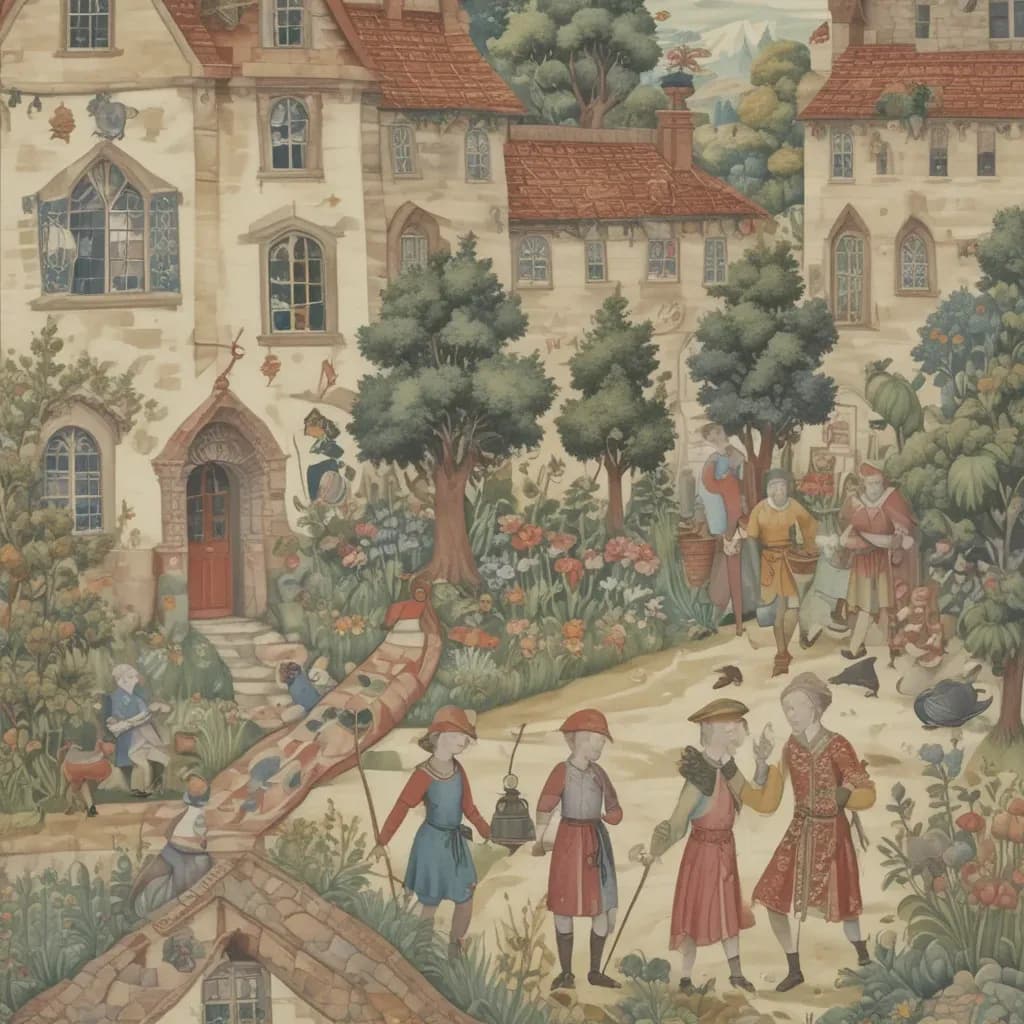
One of the most revealing things the band said about Civilisation II was that they conceived of it in relation to ancient narrative art. Gus Lobban explicitly invoked the Bayeux Tapestry and Trajan's Column as structural models.[4] These are works that document momentous historical events through sequences of observed action, without editorializing, without a narrator to tell you how to feel. The technique trusts that the accumulated weight of detail will carry the emotional freight.
"21/04/20" uses the same approach. Sarah Perry's vocal narration moves through the day's events one by one: waking late, making do with leftovers, watching insects in the garden, stepping outside, noticing an ambulance speed past, observing a child's birthday celebrated with only parents present. Each image is offered without commentary. There is no grand interpretation, no declaration of grief or fear. The song simply witnesses.
This mirrors how diaries actually work. They do not construct dramatic arcs in real time. They record. The peculiar quality of keeping a diary during a global pandemic is that days feel simultaneously momentous and crushingly banal. Most days in April 2020 were like this: heavy with context, light on incident.[5]
The Ambulance in the Distance
Within the chain of quiet observations, one moment carries particular weight. The narrator describes a private ambulance disappearing down the road. In context, this requires no explanation. By April 21, 2020, the UK had recorded close to 30,000 COVID-related deaths, then the highest toll in Europe. Private ambulances had become a feature of the landscape. The song does not linger on this or dramatize it. It simply notes it, and continues.
This is the song's most sophisticated compositional decision. By placing the ambulance sighting among observations about food and garden insects and birthday celebrations, without escalating the emotional register, the song captures something true about how people experienced that period: the coexistence of horror and routine, the way catastrophe became a background hum that never fully disappeared but also never quite consumed everything.
Critics recognized this quality immediately. Writing for Everything Is Noise, David Rodriguez called the song "exceptionally relatable," noting its ability to balance sunny hope while still contending with the weight that hung over 2020.[5] Pitchfork praised the EP for focusing on "the emotional toll of disaster with ingenuity, wit, and a warm, bright sound."[6]
Past, Present, Future
Civilisation II is a three-track EP structured around time. The opening track inhabits the past, delivering a fairy-tale narrative through the conventions of ancient storytelling. The closing track gestures toward a future that may be post-human or post-natural. "21/04/20" occupies the present tense: specific, datable, perishable.[3]
This structural positioning matters. The EP argues, implicitly, that even the most ordinary present moment is the raw material from which civilizations eventually construct their myths. The tapestries and columns of the future will be made from days like April 21, 2020, days that felt unremarkable to the people living them, days that history might later render as pivotal.
There is something hopeful and slightly vertiginous in this idea. The song asks you to see your own lockdown Tuesday as historical material, as the stuff future archivists might study. It neither glamorizes the experience nor dismisses it. It simply preserves a day.
Form and Sound
Critics noted that "21/04/20" departs from conventional pop structure. Rather than cycling through verses and choruses, the song proceeds as one long, continuous narration with almost no repeated sections, formally enacting the temporal blur of lockdown itself, when the usual rhythms of weeks lost their shape.[7]
The production, built largely around a Korg DSS-1 synthesizer,[8] gives the song a hazy, mid-afternoon warmth. It sounds unhurried. The music makes no demands. It simply keeps moving, just as the day kept moving, just as the lockdown kept stretching.
Why It Resonates
What made the song connect so widely upon release was that it offered something few pandemic-era songs did: recognition without sentimentality. It did not ask listeners to feel a certain way about the lockdown. It assembled enough specific detail, the recycled leftovers, the birthday without friends, the joggers on emptied streets, that listeners could locate their own experiences within it.[5]
This is harder to achieve than it sounds. Specificity in art usually narrows an audience; the more precise the detail, the fewer people who share it exactly. But the details in "21/04/20" operate at a level of granularity that also happens to be universal. Everyone in a UK lockdown that spring shared some version of these observations. The pasta may have been different pasta. But the basic texture of the day, the smallness, the slowness, the background hum of catastrophe, was shared.
Other Ways of Hearing It
Some listeners have read the song's studied neutrality as quietly political: a deliberate rejection of the heroic framings that dominated cultural responses to the pandemic. In a period saturated with tribute songs and solidarity anthems, "21/04/20" simply sat down and ate its leftovers.
The band's stated interest in the relationship between the mundane present and the mythologized past opens another interpretive layer. If the Bayeux Tapestry is now a primary historical source for the Norman Conquest, what will our equivalents be? The song implicitly positions itself as an artifact, something that might read very differently to someone encountering it in fifty or a hundred years.[4]
There is also a quieter cultural dimension at work. Sarah Perry's bicultural identity, shaped by her childhood in Hokkaido, Japan before relocating to the UK, informs her artistic sensibilities throughout KKB's work. The Japanese concept of mono no aware, a bittersweet attentiveness to impermanence and the passing of things, resonates with this song's emotional mode. The song attends to the specific and the transient without trying to fix or resolve them.
A Day, Preserved
"21/04/20" is a small song about a small day in a very large crisis. Its power lies in the precision of its attention and the restraint of its interpretation. It does not tell you how to feel about the pandemic. It shows you what one day looked like through one window in South London, and trusts that this is enough.
That trust turns out to be well placed. The song works simultaneously as a time capsule, a philosophical provocation, and an unusually graceful piece of pop craft. Kero Kero Bonito made music that will outlast the crisis that inspired it, not because they transcended the moment but because they looked at it very carefully and wrote down what they saw.
References
- Kero Kero Bonito on Magic Pop, Bugsnax, and the Limits of Poptimism — Interview discussing the Camp Fire as catalyst and the conceptual ambition of Civilisation
- Kero Kero Bonito: Hyper Aware (Dork) — Members discuss working apart during lockdown and Perry learning to record her own vocals
- Kero Kero Bonito - Civilisation II EP review (NME) — NME review describing the EP's past/present/future structure and its release one year after the song's date
- Kero Kero Bonito - Civilisation II interview (DIY Magazine) — Band discusses Bayeux Tapestry and Trajan's Column as structural models for the EP
- Kero Kero Bonito - Civilisation II review (Everything Is Noise) — David Rodriguez calls the song 'exceptionally relatable' and praises its balance of hope and dread
- Kero Kero Bonito - Civilisation II review (Pitchfork) — Shaad D'Souza praises the EP's ingenuity, wit, and warm sound in addressing the emotional toll of disaster
- Kero Kero Bonito - Civilisation II review (Asians in the Arts) — Notes the song's lack of repeated sections and how the structure enacts pandemic temporal blur
- Five Things That Inspired Kero Kero Bonito's Civilisation II (Dazed Digital) — Band discusses the Korg DSS-1 synthesizer and intellectual inspirations for the EP