A Pound of Feathers
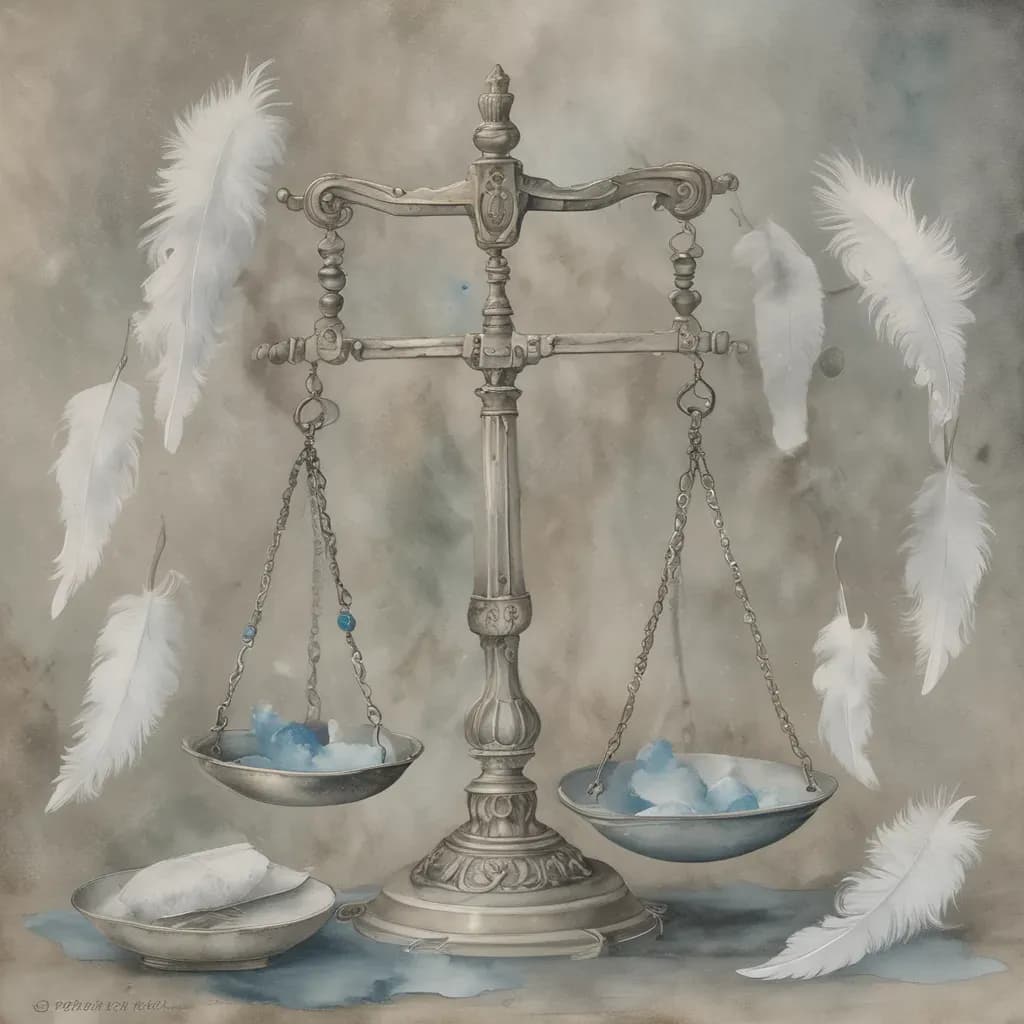
There is an old riddle that most people encounter as children: which weighs more, a pound of feathers or a pound of lead? The answer, logically, is neither. A pound is a pound, and a scale does not care what fills the pan. But the riddle endures because it exploits something deep in human perception. Feathers suggest weightlessness, grace, the freedom of things that drift and float. Lead suggests finality, density, the immovable. The same objective quantity lands entirely differently depending on what carries it.
The Black Crowes understood this when they built their tenth studio album around the metaphor, with the phrase appearing in the album's opening track, "Profane Prophecy," where it frames a fundamental question about how one chooses to move through the world. Do you carry your weight like feathers, with buoyancy and grace? Or like lead, dense, final, pressing down? The choice, in the song's telling, is not as simple as it sounds.[1]
A Long Time Coming
The Black Crowes have been carrying their own weight for a very long time. Brothers Chris Robinson (vocals) and Rich Robinson (guitar) formed the band in Marietta, Georgia in 1984, and their rise was swift and bright: the debut album Shake Your Money Maker (1990) went multi-platinum, and The Southern Harmony and Musical Companion (1992) hit number one on the Billboard 200.[2] For a moment, they were the best rock band in America.
Then the lead arrived. Success brought dysfunction. The brothers' relationship curdled under the weight of money, attention, and competing visions. Rich Robinson has been candid about this period: "Our family band dynamic was fucking toxic," he has said, "and it was toxic from the moment we started seeing success."[3] Multiple hiatuses followed over the decades. The final split was announced in January 2015.
The reunion, announced on the Howard Stern Show in November 2019, surprised many. It began as a limited anniversary tour for Shake Your Money Maker's 30th birthday. But something had genuinely shifted between the brothers. Happiness Bastards, released in March 2024, was their first studio album in over fourteen years and earned a Grammy nomination for Best Rock Album.[2] And then, barely twelve months later, came A Pound of Feathers.
The album was recorded in Nashville in roughly eight to ten days with producer Jay Joyce, who had also helmed Happiness Bastards. Only Chris, Rich, and drummer Cully Symington were in the studio.[4] By the end of the fifth day, they had nine songs completed. Rich Robinson has spoken openly about preferring this kind of urgency: "You're kind of working on the fly and you don't have time to overthink things."[5] Chris Robinson's summary was characteristic: he called the album "feral."[6]
The Weight of the Riddle
The central metaphor of "A Pound of Feathers" operates on several levels at once. At its most immediate, it is a meditation on subjective experience versus objective fact. Two things can be equal in measure while feeling utterly different. A grief that looks small from the outside can be crushing to the person who carries it. A joy that seems frivolous can sustain someone through genuine darkness.
But the deeper provocation in the opening track lies in how it frames the metaphor not as observation but as choice. The narrator does not simply note that a pound of feathers and a pound of lead are equivalent. He poses it as a genuine question about how you want to meet your life. Feathers suggest flight, grace, the acceptance of being carried. Lead suggests permanence, blunt force, perhaps a kind of violence in concentrated form. The lyric does not resolve in favor of one over the other, which is precisely its point: the weight is always the same; what differs is the substance you bring to it.[7]
This tension -- between lightness and gravity, between joy and consequence -- runs through the entire album. Chris Robinson has acknowledged that the times feel heavy. "The times are heavy, man. COVID was heavy," he said around the album's release, but he was quick to add that the band's response is not retreat.[8] Instead, they make music "because the world is chaos," because playing connects them "to something that isn't this reality." The dominant mood across most of the record is one of deliberate permission: permission to be loud and imperfect and alive, to take up space without apology.
The AV Club's Matt Melis described the album as granting listeners "permission to embrace our imperfect selves."[7] This is not naive optimism. It is something earned specifically through the band's long, difficult history, and it only makes sense against that backdrop. You do not arrive at the jubilant recklessness of this music without having first lived through the lead.
From Lead to Feathers
Rich Robinson's word for the current state of the band is telling: "Ever since we put the band back together, it's just been really light."[5] The word "light" carries obvious resonance given the album's central image. The music reflects this -- it is spontaneous, drenched in the blues-rooted Southern rock the band has always drawn from, but played with a looseness that critics have noticed.
Louder Sound awarded the album four out of five stars and singled out Rich Robinson's guitar work as "funkier than the master [Keith Richards] has been in decades."[9] Ultimate Classic Rock called it the band's "most vital-sounding since 1992."[10] These are not small claims. They suggest that something about the band's present moment -- the reconciliation, the stripped-down recording process, the absence of the old anxieties -- is producing music that sounds genuinely alive.
The album's structure reinforces this reading. The first nine tracks carry the energy of pure forward motion: high-tempo, celebratory, driven by instinct. Then the final two songs, "Eros Blues" and "Doomsday Doggerel," shift into something darker and more brooding.[1] The joy does not deny the weight. It coexists with it. The feathers and the lead are both present. They just happen to balance the same.
Cultural Reassessment
The Black Crowes have long occupied a peculiar place in rock history. Arriving in 1990 with a sound rooted unmistakably in the late 1960s and early 1970s, they were often dismissed by critics as retrograde, too derivative of the Stones and the Allman Brothers to merit serious consideration. Their commercial success was undeniable, but critical esteem was harder to come by.
Now, in 2026, they find themselves nominated for the Rock and Roll Hall of Fame for the second consecutive year.[11] Chris Robinson has responded to the nomination with characteristic understatement, calling it "super cool."[8] Whether or not they are inducted, the nominations represent a broader cultural reassessment of their contribution to American rock and roll -- a recognition that their insistence on playing the music they believed in, against the grain of trends and critical fashion, was itself a form of integrity.
A Pound of Feathers arrives in this context as something of a statement of continued purpose. The band's own Silver Arrow Records released it, giving them full control.[4] There are no compromises visible in the music, no concessions to streaming-era brevity or algorithmic palatability. It is a full-throated rock album made by people who have been playing this music for forty years and still find it worth playing.
Other Ways to Hear It
The riddle embedded in the album's title invites other readings beyond the personal. There is something worth noting about the physical reality of a pound of feathers: it is an enormous quantity, hundreds of individual feathers, requiring immense collective effort to accumulate. The work involved is vast even if each unit seems trivial. In this reading, the metaphor speaks to the invisible labor behind things that appear effortless -- the decades of craft that make a three-minute blues rock song feel natural and spontaneous.
There is also a more overtly political interpretation available. In a period when the weight of the world feels distributed with startling unfairness, the riddle's insistence that the scales balance -- that a pound is a pound regardless of what fills it -- can read as either a statement of democratic equality or a dark irony about how the same objective burden crushes some people while leaving others untouched. The song does not seem primarily interested in this dimension, but the image permits it.
What the album does seem interested in, most of all, is the question of what you choose to do with the weight you have been given. The answer the music models is loud, imperfect, generous, and alive.
The Balance
A pound is a pound, whether feathers or lead. But how you carry it, and what you carry it with, shapes everything about how the weight lands.
For The Black Crowes, the journey from lead to feathers has been long and earned. The toxicity that Rich Robinson described so candidly, the breakups and recriminations, the years when a new record seemed impossible -- all of that was the lead.[12] What they have arrived at now, in the most musically productive phase of their reunion, sounds like feathers. Not weightless -- the darkness is still in there, especially at the album's end -- but carried differently. Carried with grace.
A Pound of Feathers is a record about choosing how to engage with the weight of being alive. It chooses joy without denying the heaviness. It chooses noise and disorder and imperfect selves over the paralysis that comes from trying to get everything exactly right. The riddle is not answered; it cannot be. But in the way The Black Crowes are playing these days, it sounds very much like they have already made their choice.
References
- A Pound of Feathers – Wikipedia — Album overview, tracklist, and release details
- The Black Crowes – Wikipedia — Band biography, formation history, discography
- Guitar Player – Rich Robinson on the Toxic Dynamic — Rich Robinson's candid account of the dysfunction that plagued the band
- The Black Crowes Official Site – Album Announcement — Official press release and band statement on the album
- Loudwire – Rich Robinson Interview — Rich Robinson on the rapid recording process and the band's transformed dynamic
- Loudwire – Chris Robinson Interview — Chris Robinson on the album being 'feral' and music as escape from chaos
- AV Club – Album Review — Review noting the album grants permission to embrace imperfect selves
- Billboard – Black Crowes Album Interview — Interview with Chris Robinson on the album and current state of the band
- Louder Sound – Album Review — 4/5 star review highlighting Rich Robinson's guitar work
- Ultimate Classic Rock – Album Review — Critical assessment calling it the band's most vital work since 1992
- Live for Live Music – Rock Hall of Fame 2026 Nominees — The Black Crowes' second consecutive Rock Hall nomination
- Louder Sound – Band History Feature — In-depth feature on the band's toxic dynamic, breakups, and reunion