A Whiter Shade of Pale
Some songs arrive already finished. The first four bars of "A Whiter Shade of Pale" need no introduction: they simply begin, and something shifts in the room. That descending organ melody, stately as a church processional and vertiginously melancholy at once, was unlike anything else on British radio when Procol Harum released it in May 1967. Within two weeks it stood at number one in the UK, where it stayed for six consecutive weeks.[1] Fifty-seven years later, it remains the most-played record in the history of British broadcasting.[1]
How does a song about a drunken party feel like a meditation on mortality? That question has never been fully answered, and the uncertainty is part of the point.
Born at a Party, Built from Bach
The song began with a phrase overheard at a social gathering. Lyricist Keith Reid, the band's non-performing creative partner, heard someone at a party tell a woman that she had turned "a whiter shade of pale." He went home and wrote four verses around that image.[2] Two of those verses appeared on the released single; a third surfaces occasionally in concert performances.[3]
Reid brought those words to Gary Brooker, the band's pianist, vocalist, and primary composer. The two had begun collaborating in 1966, forming an unusual partnership in which Reid wrote poetry and Brooker set it to music. Reid never performed or played an instrument. Brooker had spent his early twenties playing R&B and soul covers with a group called The Paramounts, working out of Southend-on-Sea. By 1966 that project had run its course, and he was looking for something more ambitious.[1]
When Brooker composed the music for Reid's verses, he reached into a reservoir of deep classical training. He has described the chord movement as tracing a brief passage from Bach's "Air on the G String" before veering onto its own path.[4] He was not making an intellectual statement about Baroque music. Bach was simply inside him, part of his musical language from childhood. The combination of that classical architecture with a soulful vocal delivery (Brooker has also cited Percy Sledge's "When a Man Loves a Woman" as an emotional reference point) produced something that had no obvious precedent.[5]
The recording was made at Olympic Sound Studios in London in April 1967, produced by Denny Cordell. The lineup for the single included several session players alongside the band's core members. What gave the recording its defining character was the Hammond M-102 organ played by Matthew Fisher, routed through a Leslie speaker cabinet for its warm, rotating tone. Fisher's opening melody, drawing on the chorale-like character of Bach's orchestral suites and something of the organ textures from "Sleepers, Wake!" (BWV 140), is what listeners identify first when the track begins.[1]
For decades, Fisher received no songwriting credit for that melody. In 2005 he filed suit claiming co-authorship of the music. After a protracted legal journey through the British courts, including contradictory rulings at the High Court and Court of Appeal, the House of Lords ruled unanimously in his favor in 2009, restoring his right to future royalties.[1] Since then, the song has been officially credited to Gary Brooker, Matthew Fisher, and Keith Reid.
Surrealism at the Party
Lyrically, the song deposits the listener inside a scene that feels simultaneously mundane and mythological. A party is underway. There is dancing, drinking, and a woman who seems to be withdrawing or departing. The narrator is clearly intoxicated, perhaps to the point of losing his grip on sequence and logic.
But Reid does not write a straightforward party scene. The references spiral outward from the social gathering into Roman mythology, implied seafaring, and imagery associated with literary tradition. Reid has cited French New Wave cinema as a primary influence, particularly films by Jean-Luc Godard and Alain Resnais, which use non-linear, dream-logic narrative structures.[3] The result is a lyric that feels like a memory being reconstructed imperfectly, where real events and classical allusion become indistinguishable.
The allusion to sixteen vestal virgins is characteristic of this approach. The Vestals of ancient Rome were sacred priestesses tasked with tending an eternal flame, symbols of purity and devotion. Rome never had more than six at a time, so the number sixteen immediately signals unreality.[6] Setting them in motion toward the coast introduces a mood of collective departure, of something irretrievably leaving.
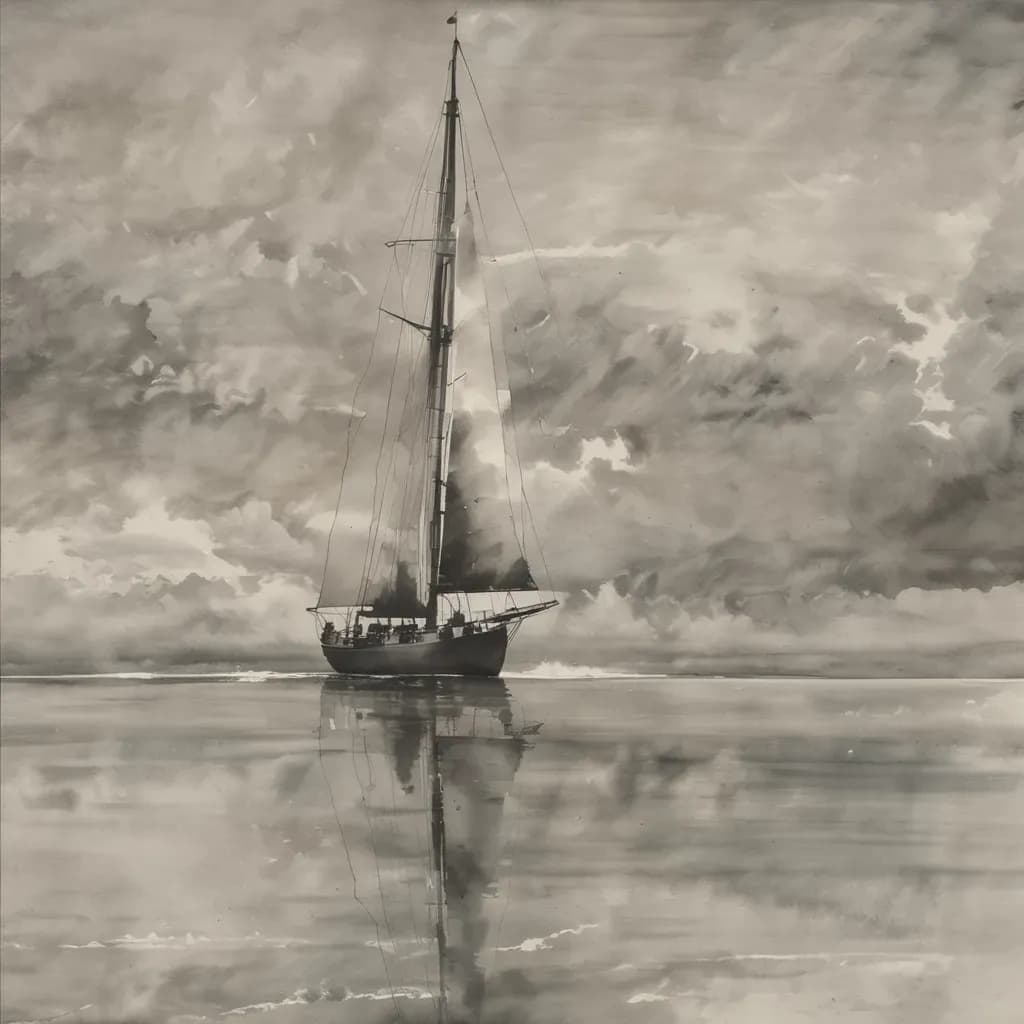
The reference that generated the most critical debate involves an image of a medieval storyteller at his craft, a phrase that inevitably calls Chaucer's Canterbury Tales to mind. The Miller's Tale, the bawdiest story in that collection, concerns infidelity and its absurd consequences, an apt enough pairing with a song about desire and departure.[6] Yet Reid himself has been explicit on the subject: "I'd never read The Miller's Tale in my life. Maybe that's something that I knew subconsciously, but it certainly wasn't a conscious idea."[3] The resonance may be accidental, but it deepened the song's cultural texture regardless.
What the Song Is Actually About
Reid's stated intention was to "conjure a mood as much as tell a straightforward, girl-leaves-boy story."[3] He was not aiming for deliberate obscurity, he has insisted. The surface narrative is recognizable: a man pursues or encounters a woman at a party, she retreats or transforms, and he is left bewildered. The phrase "a whiter shade of pale" describes something happening to her, or possibly to him, or to the atmosphere of the entire scene.
On one level the song presents a failed seduction, rendered in the language of mythology and classical literature because Reid was a young man who absorbed books rather than experiences and wrote accordingly. His father was a Holocaust survivor, a biographical fact Reid has connected to the dark undertow running through much of his work.[7] The world as an unstable place, from which things and people depart without warning, shapes his imaginative landscape.
But the song resists containment within any single reading. The quasi-sacred organ texture, borrowed from two centuries of Lutheran chorale tradition, wraps a fairly human story in something much larger. When Bach composed his cantatas, he was writing about mortality and divine grace. Fisher's organ carries all of that weight into a pop single from 1967. A scene of two people at a party, one of whom is turning pale, starts to feel like an allegory of loss on a scale that transcends the personal.
Simon Frith, the sociomusicologist, described the track as the year's most distinctive single, pointing to the friction between what he called "white soul vocal and a Bach organ exercise" as the source of its strange power.[8] The song fits no fully established genre. It is Baroque pop, psychedelic soul, proto-progressive rock, and chamber music simultaneously, and it sounds like none of those things on their own.
1967 and the Summer of Love
"A Whiter Shade of Pale" was released on 12 May 1967, weeks before the Summer of Love reached its cultural peak. It reached number one not only in the UK but across Belgium, Canada, France, Germany, the Netherlands, New Zealand, and a dozen other markets. It peaked at number five on the US Billboard Hot 100.[1] The song sold over ten million copies worldwide, placing it among fewer than thirty singles ever to cross that threshold.
The critical response matched the commercial one. Cash Box described it as "a haunting, imaginative ballad" with "a winning sound." In December 1967, NME readers voted it the Best British Disc of the Year, placing it ahead of The Beatles' "All You Need Is Love" and The Bee Gees' "Massachusetts."[5] John Lennon and Paul McCartney were reportedly among those enthralled by the record.
The song's honors have continued accumulating across the decades. In 1977 it was named joint winner of the Brit Award for Best British Pop Single of 1952 to 1977, sharing the distinction with Queen's "Bohemian Rhapsody." Both songs, as it happens, contain the word "fandango." It was inducted into the Grammy Hall of Fame in 1998,[1] ranked number 57 on Rolling Stone's 500 Greatest Songs of All Time,[8] and recognized by Phonographic Performance Limited in 2004 as the most-played record in British broadcasting over the previous 70 years. In 2018 it entered the Rock and Roll Hall of Fame in its inaugural Singles category.
The song's cultural reach extended into the language itself. The phrase "a whiter shade of pale" entered ordinary English usage, appearing in contexts entirely disconnected from the recording, used to describe a specific quality of bloodless shock or transformation.[9] Very few song titles have achieved that kind of idiomatic permanence.
Why It Still Haunts
More than a thousand cover versions of the song have been recorded, by artists ranging from Annie Lennox to Santana to Joe Cocker to Willie Nelson.[1] The song survives them all because it inhabits a particular emotional register that is almost impossible to name and apparently impossible to exhaust.
Part of this is structural. The descending bass line creates a sensation of inevitable motion, of something moving toward an outcome that cannot be stopped. The melody circles without fully resolving. The lyrics accumulate imagery without assembling it into a clear argument. Together these elements produce a feeling that is, to borrow from the song's atmosphere, faintly vertiginous: you can sense the meaning without quite grasping it, the way a piece of music can move you without your being able to explain how.
The song is also, in a sense, about the failure of language to capture experience, which is perhaps why it resonates most in moments when words are inadequate. The narrator reaches for mythology, for classical reference, for the imagery of literature, and still cannot quite explain what happened at that party or why it matters. The organ does the explaining instead.
Keith Reid, who wrote every Procol Harum lyric until 2017, died on 23 March 2023 at the age of 76.[7] Gary Brooker, who sang and composed the music, died on 19 February 2022, also aged 76.[10] Their collaboration produced something that outlasted both of them by a considerable margin and shows no signs of becoming a historical artifact. The song is still being played everywhere, still being covered, still being used in films and television to locate a very specific emotional moment: the instant at a party, or in a life, when something turns pale.
References
- A Whiter Shade of Pale - Wikipedia — Comprehensive overview including chart performance, credits, legal history, and honors
- A Whiter Shade of Pale - Songfacts — Song facts including the origin story of Reid overhearing the phrase at a party
- Keith Reid interview on songwriting - procolharum.com — Direct quotes from Keith Reid on lyrical intent, cinematic influences, and the Chaucer question
- Procol Harum: The epic story of A Whiter Shade Of Pale - Louder Sound — In-depth feature including Brooker's account of the Bach influence on the composition
- Procol Harum's 'A Whiter Shade of Pale': That Melody! - Best Classic Bands — Critical reception at release including Cash Box and NME responses
- The Curious Meaning of Procol Harum's 'A Whiter Shade of Pale' - Interesting Literature — Analysis of the Vestal Virgins reference and other mythological imagery
- What do the lyrics to 'A Whiter Shade of Pale' really mean? - Far Out Magazine — Lyric analysis and Keith Reid's biographical context including his father's history
- A Whiter Shade of Pale - Rolling Stone 500 Greatest Songs — Rolling Stone critical assessment including Simon Frith's analysis
- The Eclipsing Legacy of 'A Whiter Shade of Pale' - History of Music — Legacy analysis including the phrase entering ordinary English usage
- The story behind 'A Whiter Shade of Pale' by Procol Harum - Far Out Magazine — Background on the song's creation and Gary Brooker's biography