All Along the Watchtower
A Song That Ends Where It Begins
There is something disorienting about "All Along the Watchtower," and that disorientation is deliberate. In just three short verses, Bob Dylan constructs a compressed drama that feels both ancient and urgent, familiar and inexplicable. Two archetypal figures hold a conversation while the world outside their exchange rushes toward some unnamed but unmistakable upheaval. By the time the final image arrives, the song seems to loop back on itself, as though the dialogue has been playing out inside the watchtower's shadow all along.
It is one of the most analyzed songs in the rock canon. It has been covered by Jimi Hendrix, U2, Dave Matthews Band, Neil Young, and Eric Clapton, among dozens of others. Dylan himself has performed it live more than any other composition in his catalog.[1] And yet, for all the attention it has received, the song retains a quality of stubborn resistance to complete explanation. That resistance is not a flaw. It is the engine.
The Year of Disappearance
Dylan recorded "All Along the Watchtower" on November 6, 1967, at Columbia Studio A in Nashville.[2] The session was notable for its brevity and discipline. A drummer, a bassist, Dylan on acoustic guitar and harmonica. Five takes recorded, the third and fifth spliced together for the final version. The entire John Wesley Harding album, across three separate studio stints, required fewer than twelve hours of recording time.[3]
The recording emerged from what was then the strangest chapter of Dylan's career. In July 1966, following a grueling tour that had left him visibly depleted, he was involved in a motorcycle accident near Woodstock, New York.[4] Whether the crash was as serious as reported has been debated for decades. What is certain is that Dylan used the occasion to vanish from public life entirely.
He withdrew to his home in Woodstock with his wife, Sara Lownds, and their children. While the Summer of Love unfolded around him in 1967, while the Beatles recorded Sgt. Pepper's Lonely Hearts Club Band and the counterculture reached its cultural apex, Dylan was reading, painting, and searching for something he had lost beneath years of performance and expectation.
During the spring and summer of 1967, he collaborated informally with the musicians who would become The Band, recording over a hundred songs in the basement of a rented Saugerties house known as Big Pink.[4] Those recordings, raw and exploratory, circulated as bootlegs for years before their official release in 1975. They revealed a Dylan working his way back toward American roots music: country, folk, gospel, the vernacular tradition. By the time he traveled to Nashville by train to record John Wesley Harding, the transformation was complete. He explicitly asked for no publicity and no hype. "This was the season of hype," he later said, and he wanted none of it.[5]
The Album's Austere World
John Wesley Harding arrived on December 27, 1967, and its instrumentation was itself a declaration.[3] Dylan chose an almost campfire simplicity: Kenneth Buttrey on drums, Charlie McCoy on bass, Dylan on guitar, harmonica, and piano, with producer Bob Johnston keeping the sessions dry and unadorned. While psychedelic rock was building sonic cathedrals, Dylan was working with campfire materials.[5]
The album was saturated with biblical imagery. Scholars have identified over 60 allusions to scripture across its twelve tracks.[3] The tone throughout is parabolic: characters who seem like outlaws or wanderers carry moral weight far beyond their surface narratives. The title character himself, drawn from a real Texas outlaw whose name Dylan deliberately misspelled, is presented with an ambiguity that sets the template for the whole record. Nobody here is simply what they appear to be.
"All Along the Watchtower" sits at the album's emotional center, packing the density of a much longer composition into three economical verses. Dylan described his approach to the album's writing by saying there was no blank filler, no line you could stick your finger through. Every image carried weight because every image had to.[6]
Two Figures, One Crisis
The song's structure is almost theatrical. Two figures identified only by their archetypal roles hold a conversation with mounting urgency. The first, a joker, expresses something close to existential frustration: a sense that the social and economic order makes no moral sense, that those who do the labor are exploited by those who control the machinery, and that his own clarity in seeing this has bought him nothing.
The second figure, a thief, responds with grounded, almost pragmatic wisdom. There is no point in self-pity, he suggests. The hour is real. Talk that circles without landing will not help. What is required is clarity of vision and directness of action.
The naming of these two characters is not accidental. In medieval European tradition, jesters and fools were often the only figures permitted to speak uncomfortable truths to those in power without immediate consequence. The joker sees clearly but feels trapped in a kind of licensed ineffectuality. The thief, meanwhile, carries resonance from biblical tradition: in the New Testament, Christ predicts his own return using the metaphor of a thief arriving in the night, and in the gospel of Luke, one of the two criminals crucified alongside Jesus repents and is promised paradise.[7]
The thief's response to the joker, then, can be read as spiritual counsel that cuts through despair, not by denying reality but by insisting that reality demands a response rather than a lament. The exchange between them distills a moral argument about how to live under conditions you did not choose and cannot fully change.
Isaiah and the Approaching Riders
The most precisely documented literary source for the song is the twenty-first chapter of Isaiah, a prophetic passage about the fall of Babylon. In it, a watchman stationed on a tower observes the approach of riders on horseback and receives the message that Babylon has fallen. The imagery of vigilant sentinels, approaching horsemen, and world-historical reckoning maps directly onto the song's closing scene.[7]
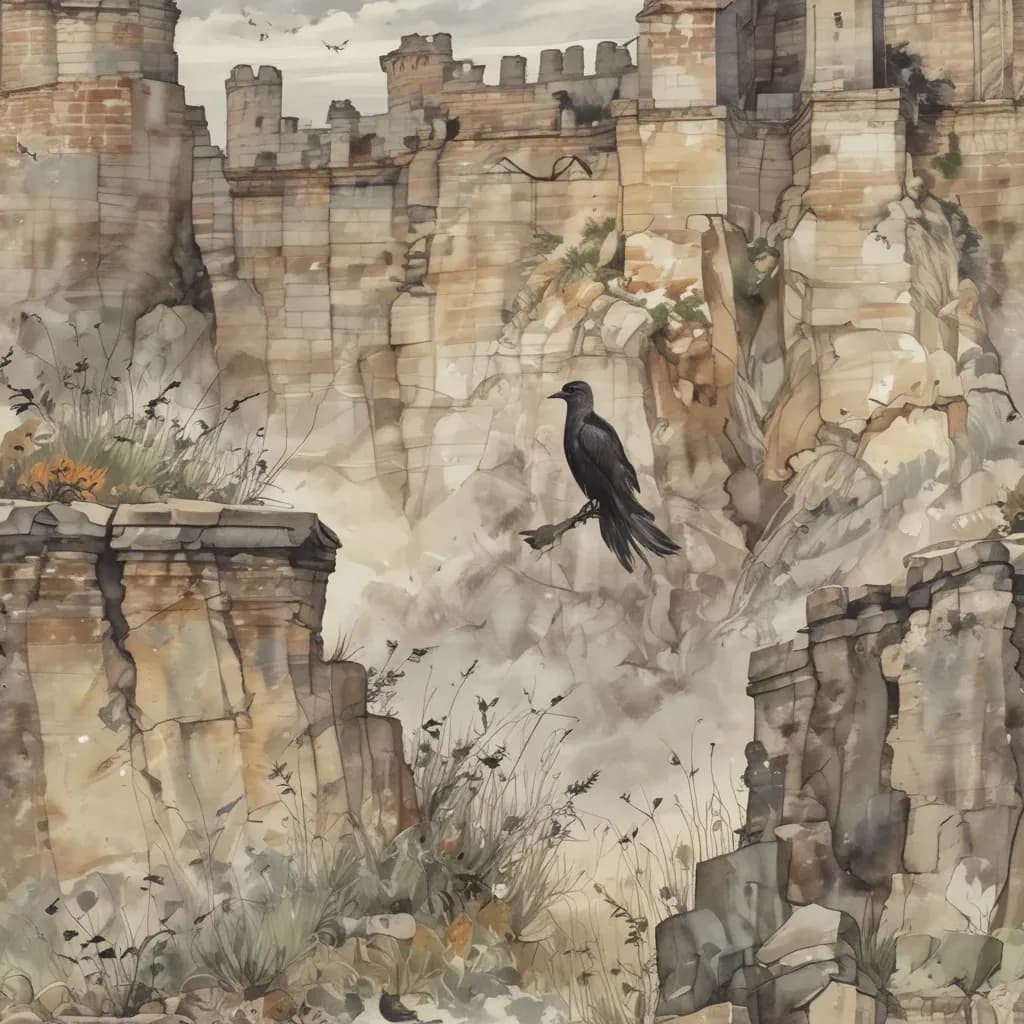
Dylan brings this panoramic image in at the end, after the intimate dialogue. The watchtower is manned. Princes observe from their post. Servants move about. Riders approach through a rising wind, and something wild calls out from the darkness nearby. The scene feels both ominous and strangely suspended, as though we are witnessing the moment before something irreversible begins.
Some literary scholars argue this structure is intentional in a specific way: the song ends at the point where the conversation between joker and thief is about to begin. The watchtower and its approaching riders are the context of the dialogue, not its aftermath. In this reading, the song is a loop, a parable that has been playing out across historical time and will continue playing out after the final note fades.[6]
The Dutch theologian Kees de Graaf has argued that the joker and the thief may represent the two criminals crucified alongside Jesus: one who repents and is promised paradise, one who does not. In this interpretation, the conversation takes place at Golgotha, and the approaching riders carry eschatological significance that only becomes fully visible when filtered through its scriptural source.[6] Whether or not Dylan intended this specific reading, the biblical frame of the album makes it a plausible one. He was working deeply in that tradition throughout 1967.
The Song Dylan No Longer Owns
Six weeks after the album's release, on January 21, 1968, Jimi Hendrix began recording his own version of the song at Olympic Studios in London.[2] The session was unconventional even by Hendrix's standards. Bassist Noel Redding disagreed with the arrangement and left early; Dave Mason of Traffic stepped in on twelve-string acoustic guitar. Producer Eddie Kramer later recalled the session beginning with acoustic instruments before Hendrix layered in the electric work that would define the final recording.[8]
Hendrix reportedly told those around him that he felt the song so deeply he sometimes thought he had written it himself.[8] What he did to it was essentially structural. Where Dylan's version was spare and taut, Hendrix's became an orchestral event in miniature: a gathering storm of electric guitar layers, dynamic contrasts between whispered passages and explosive releases, and a sense of sonic power that gave the song a completely different emotional scale. Dylan had whispered the urgency. Hendrix howled it.
The recording was released as a single in September 1968 and entered the cultural canon almost immediately. It has since been recognized by multiple publications as the greatest cover recording in rock history, and it won a Grammy Hall of Fame Award in 2001.[1]
Dylan's own response was more than admiring. In the liner notes to his 1985 Biograph box set, he wrote that Hendrix's version overwhelmed him, and that whenever he performs the song himself, it feels like a tribute to Hendrix.[9] In a 1995 statement, he went further, saying that Hendrix had found things inside the song that other people would not have thought to look for, developing them with such authority that Dylan had taken license from Hendrix's version and continued performing it that way ever since.[9]
From his 1974 return to touring onward, Dylan performed the song in what critics described as a Hendrixized arrangement. As of recent tallies, he has played it live more than 2,250 times, more than any other song in his catalog.[1] The story of a songwriter permanently adopting a cover artist's interpretation of his own composition as the definitive one is virtually without parallel in popular music.
What the Watchtower Holds
The song has appeared in films, political speeches, television dramas (including a pivotal sequence in the Battlestar Galactica reboot), and protest contexts across six decades without exhausting its resonance. Its adaptability is not accidental.[2]
Each image in the song operates at multiple frequencies simultaneously. The joker's complaint reads as a worker's lament, a prophet's frustration, or an artist's recognition that the culture profits from his output while leaving him feeling exploited and misunderstood. Any listener who has felt trapped in a system whose logic they can see through but cannot escape will find something familiar in it.
The thief's response applies equally to a friend cutting through denial, a spiritual guide demanding honest reckoning, or a biblical figure offering the only kind of comfort that requires something from the person receiving it. The approaching riders do not arrive. They only approach. The reckoning is perpetually imminent. That is exactly how catastrophe feels from inside it: always about to break, never quite breaking, and yet somehow always already underway.
Rolling Stone ranked "All Along the Watchtower" at number 40 on their 2021 updated list of the 500 greatest songs of all time.[7] That ranking places it near the top of a list populated with songs that took years or decades to secure their positions. But chart rankings miss something essential about why this particular song endures.
Dylan said once that a song is anything that can walk by itself. "All Along the Watchtower" has been walking by itself for nearly sixty years, through the deaths of most of the people who first heard it, through half a dozen political upheavals that seemed to confirm its imagery, through the transformation of popular music itself. It does not need its author's explanation. It never did. The watchtower keeps its watch. The riders keep approaching. And somewhere in the gathering dark, the conversation between the joker and the thief keeps beginning.
References
- All Along the Watchtower - Songfacts — Live performance count, Grammy Hall of Fame recognition, and cultural usage
- All Along the Watchtower - Wikipedia — Comprehensive overview of recording history, Hendrix cover, chart performance, and legacy
- John Wesley Harding - Wikipedia — Album recording context, personnel, critical reception, and biblical themes
- When Bob Dylan Took a Rootsy Turn on John Wesley Harding - Ultimate Classic Rock — Dylan's retreat to Woodstock, basement recordings with The Band, and the album's creation
- How Bob Dylan Crafted a Minimal New Sound on John Wesley Harding - Rolling Stone — Account of the Nashville sessions, Dylan's stated intentions, and the album's place in his career
- What is Bob Dylan's All Along the Watchtower Actually About? - Far Out Magazine — Critical analysis including biblical interpretations and Kees de Graaf's reading
- The Meaning of All Along the Watchtower - American Songwriter — Thematic analysis of the joker-thief dialogue and Isaiah connection, Rolling Stone ranking
- How Jimi Hendrix's Cover of All Along the Watchtower Overwhelmed Bob Dylan - American Songwriter — Details of Hendrix's January 1968 recording session and Dylan's reaction
- What Did Bob Dylan Think of Jimi Hendrix's Version of All Along the Watchtower? - Far Out Magazine — Dylan's Biograph liner notes and later statements about Hendrix's transformative interpretation