All Of My Friends
The Voice in the Room Everyone Ignores
There is a particular kind of heartbreak that has nothing to do with loss. It comes from the moment when every person who loves you tells you the same thing, and you nod along, and you understand exactly what they mean, and then you do it anyway. "All Of My Friends," from Jack Harlow's fourth studio album Monica, is a song built entirely around that moment. It is not a story about romantic failure. It is a story about the warning that precedes it, delivered by a chorus of people who have watched this same scene play out before.
A Gamble Born from Creative Exhaustion
Monica arrived on March 13, 2026, Jack Harlow's 28th birthday, and nothing about it was accidental.[1] The album was not an evolution of his earlier rap records but a full rejection of them. No rapping, no bravado-soaked verses, no trap rhythms. In their place: jazz-flecked neo-soul, intimate melodies, and the sound of a young man in a new city trying to figure out who he is when no one is watching the chart numbers.
The story behind the album begins with two years of material Harlow scrapped entirely. He had been recording a follow-up to 2023's Jackman, and somewhere along the way, going to the studio started to feel like a burden rather than a release. In a widely circulated interview, he described reaching the point where he was dreading studio sessions, and deciding to ask himself what would genuinely excite him rather than what was expected.[2] The answer took him to Electric Lady Studios in Greenwich Village, a room soaked in decades of soul and R&B history, and pointed him toward a kind of music he described as pleasant and egoless, something to be enjoyed passively rather than consumed competitively.[2]
The result was nine tracks of warmly produced, Stevie Wonder-adjacent soul that landed Harlow in the middle of one of the more complicated cultural conversations of 2026. But before all of that came "All Of My Friends," a song that works whether or not you know anything about the context surrounding it.
The Greek Chorus Around the Narrator
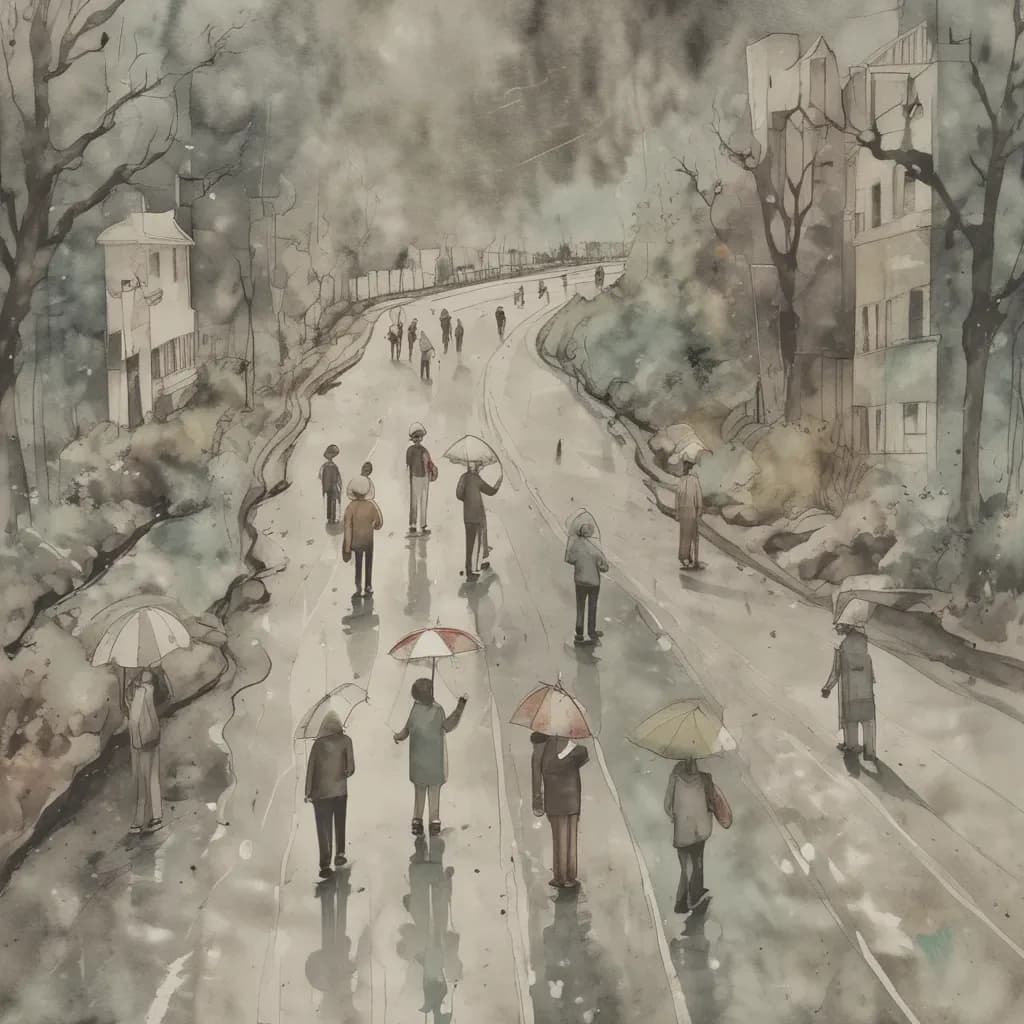
What makes "All Of My Friends" structurally compelling is its use of perspective. The narrator is not alone on stage. Surrounding him is a circle of people who collectively function as a mirror, reflecting back behavior that he is too close to see clearly. They observe that he moves too fast, falls too hard too quickly, that there is a pattern he keeps repeating and keeps dressing up as something new.
This is a device as old as storytelling. The Greek chorus exists precisely to name the thing the protagonist cannot. What the song does with it is both timeless and specifically modern. The friends are not enemies or critics. They are people who care about the narrator. Their concern is gentle, perhaps even fond, which makes it all the more impossible to dismiss. And yet it gets dismissed anyway.
The emotional core of the song is not the friends' warning. It is the narrator's response to it: the insistence that this time is different. The specificity of that self-deception is what makes the song land. Not a blanket dismissal of the advice, but a genuine belief, held against all available evidence, that the current situation falls outside the pattern. It is the logic of every person who has ever fallen for someone who was probably not right for them. It is familiar to the point of being almost painful.
The song sits in the middle of Monica, and its placement is telling.[1] The album follows a loose narrative arc of romantic obsession. By the time "All Of My Friends" arrives, the listener has already been introduced to the narrator's preoccupations. The warning comes mid-story, before the inevitable conclusion. The album keeps going after the warning, just as the narrator does. The structure itself illustrates the pattern.
Ravyn Lenae and the Architecture of the Track
One of the most discussed elements of "All Of My Friends" is the contribution of Ravyn Lenae, whose vocals elevate the track in ways that critics widely noted.[3] She is an established neo-soul voice, an artist who has spent her own career building credibility in the genre Harlow is visiting for the first time. Her willingness to appear on the record functions as something like an endorsement, and her presence brings a warmth and assurance that grounds the song's vulnerability.
Harlow's own voice is a subject of ongoing discussion. He is a rapper first, by his own admission,[2] and several reviewers noted that his vocal range has real limits.[4] What the production around "All Of My Friends" does, and what Lenae's contribution amplifies, is turn that limitation into texture. The song is warm and unhurried. It does not demand a powerhouse performance. It asks for something closer to confession, which is what it gets.
Stereogum's reviewer described the effect as evoking a version of Drake that never became cynical: warm, seductive, and bathed in soft light.[3] That is a particular kind of compliment, and it points toward what the song is going for: the emotional intelligence and sonic intimacy of contemporary R&B without the calculated distance that sometimes comes with it.
The 'Got Blacker' Conversation
It would be impossible to write about Monica without acknowledging the controversy that surrounded its release, and "All Of My Friends" sits near the center of that conversation by virtue of being the album's most celebrated track. When Harlow said, in a widely circulated interview, that making this album meant he got Blacker at a time when other white rappers were moving toward country or pop-punk, the reaction was swift and polarized.[5]
For his critics, the comment illustrated exactly the problem with a white artist staking his identity in Black music, particularly when the framing made it sound like a personal achievement. For his defenders, the comment was context for a genuine artistic decision, made at real commercial cost, to make music that mattered to him rather than music designed to stay safe. Stereogum argued the backlash was largely reflexive, noting that the album demonstrated genuine artistic intention rather than pastiche.[3]
"All Of My Friends," specifically, does not feel like genre tourism. It is too focused, too emotionally coherent, too carefully constructed around its own central metaphor. Whether that is enough to resolve the larger questions about Harlow's place in Black musical spaces is a different conversation, and one the song itself wisely refuses to have. The song is about love and blindness and the gap between knowing and changing. It stays there.
Self-Awareness as Both Shield and Prison
The most interesting question the song raises is not whether the narrator is right or wrong about this particular relationship. It is what his self-awareness actually costs him.
He knows the pattern. His friends have named it clearly. He can articulate it. And still he moves forward. This creates a character who is simultaneously more sympathetic and more frustrating than someone who is simply oblivious. Obliviousness is forgivable because it is innocent. What the narrator has is something harder: clarity without the will to act on it.
This is, arguably, the defining emotional terrain of a particular kind of young adulthood: the period when you know who you are in ways you did not before, but have not yet built the architecture to change. The knowledge comes first. The change, if it comes at all, takes longer. "All Of My Friends" documents the gap between those two things with a kind of sympathetic precision that is more honest than most songs on the subject.
An alternative reading of the song is more generous to the narrator. Maybe this time actually is different. Maybe the pattern-recognition of the friends is its own kind of trap, a way of seeing novelty as repetition and closing off genuine possibility. The song does not resolve this question, which is part of why it works. It is not a verdict. It is a moment caught in the middle of someone deciding.
Why the Song Holds
Monica received mixed reviews overall, with critics divided sharply on whether Harlow's pivot was credible or merely ambitious. Pitchfork was particularly dismissive. Rolling Stone found the album polished and occasionally moving.[1][6] But across nearly every review, "All Of My Friends" was singled out as the record's high point, the moment where the album's ambitions and its execution most fully aligned.
Part of what makes it the strongest track on the record is its restraint. It does not oversell the emotion. It does not build toward a cathartic release. It settles into its central tension and stays there. The narrator loves too quickly and knows it and is going to do it again. The friends are right and will be ignored. The music is warm and slightly aching. That is the whole song. It is enough.
For listeners who have ever ignored good advice from people who were clearly right, which is most people, the song is uncomfortably recognizable. That recognition is what art is supposed to produce. The fact that it arrives wrapped in jazz-inflected neo-soul from a rapper who scrapped two years of work to make it adds context, but the song would hold without any of that backstory. It works because it names something true about the way people move through the world when they are in love with love itself.
The most generous reading of Jack Harlow's Monica project, and the one the album earns at its best, is that it is a document of someone trying to become a different kind of artist at significant personal and commercial cost. "All Of My Friends" is where that ambition most fully succeeds. It is a song about the limits of self-knowledge. By that logic, it is also a document of a musician standing at the edge of his own.
References
- Monica (album) - Wikipedia — Album context, tracklist, release date, critical reception overview, and track sequencing
- Jack Harlow Talks Singing on New Album 'Monica' - Power 106.9 — Harlow discussing dreading studio sessions and the pivot to soul music, recorded at Electric Lady Studios
- Jack Harlow 'Monica' Album Review - Stereogum — Stereogum's positive review, Drake comparison, analysis of Ravyn Lenae's contribution, and defense against backlash
- Album Review: Monica by Jack Harlow - Shatter the Standards — Critical assessment noting Harlow's vocal limitations and the album's mixed reception
- Jack Harlow Explains Why He 'Got Blacker' On New Album 'Monica' - HotNewHipHop — Harlow's controversial interview comments about his musical direction and Black music influences
- Jack Harlow's 'Monica' Review - Rolling Stone — Rolling Stone review describing the album as polished and occasionally moving