BEAUTY AND THE BEAST
There are artists who define themselves through confrontation, whose careers become synonymous with the friction they generate. Kanye West has long been one of them. So when the opening notes of "BEAUTY AND THE BEAST" arrived at a listening event in Haikou, China in September 2024, there was something genuinely disorienting about what followed: not a provocation, not a maximalist statement, but a quiet, searching piece of music built from vintage soul samples and an entirely sung vocal performance. It was a side of West that had been largely dormant for years.
The song does not resolve the contradictions of its creator. But in its strange, melancholy grace, it demonstrates why West's musical instincts continue to outrun his public persona, and why the question of what to do with his art remains so persistently complicated.
A Song Years in the Making
"BEAUTY AND THE BEAST" was first previewed at that Haikou announcement event in September 2024, where West revealed his twelfth studio album BULLY to a live audience[1][2]. But the song had actually been gestating for much longer. Producer Mike Dean confirmed that the track was first conceived during sessions for West's 2021 album Donda, making it a relic of an earlier creative period that found its way into a very different moment[3]. That origin matters because Donda was West's most explicitly personal album to that point, a sprawling meditation on grief, his mother's death, and spiritual identity. The sensibility that generated "BEAUTY AND THE BEAST" was therefore shaped by that extended, emotionally raw creative period, even if the song eventually landed in a context shaped by entirely different pressures.
The path from conception to listener was characteristically turbulent. The track was briefly posted to Apple Music and West's Instagram in October 2024, then pulled down days later[3]. An updated version was subsequently shared[4] before the song eventually received an official release as a promotional single through the Yeezy website in February 2025, then reached streaming platforms as part of a three-track EP alongside "Preacher Man" and "Damn"[5]. This stop-and-start emergence mirrors the fractured circumstances of the album itself, recorded largely in a Tokyo hotel room as West lived in isolation from most of his former collaborators[6]. West signaled the song's incremental development in the metadata he attached to early releases, framing it as something originated in China and later reworked in Japan[7].
The Sound of Chipmunk Soul Revisited
What makes "BEAUTY AND THE BEAST" notable on purely musical terms begins with its production philosophy. West built the track using the Ensoniq ASR-10 and SP-1200, vintage samplers directly associated with the chipmunk soul style that defined his early career on The College Dropout and Late Registration. He centered the production around a sample from "Don't Have to Shop Around" by the Mad Lads, a 1960s R&B vocal group whose warmth and vintage register give the track an intimate, almost nostalgic emotional texture[3][4]. The result sounds borrowed from somebody's memory rather than engineered for the present moment.
Equally striking is the vocal approach. Unlike nearly everything in West's catalog, "BEAUTY AND THE BEAST" is sung entirely rather than rapped. There is no verse-hook structure in the conventional sense, no flow that connects the song to hip-hop's rhythmic traditions. West plants himself in the melody and stays there throughout, a choice that strips away his usual rhetorical armor. When West raps, he positions himself in relation to the world, shaping arguments, scoring points, building personas. When he sings, as he does here, something more undefended is present[8].
Vibe noted that the track's downtempo production created conditions for West to inhabit a more meditative register than he had occupied in years, the lyrics pensive rather than declarative[9]. Critics noted that the song's return to chipmunk soul textures represented one of the album's genuine moments of artistic clarity[8]. On an album where other tracks drew criticism for heavy reliance on AI-generated vocals, "BEAUTY AND THE BEAST" sounds deliberate and human, the product of someone who still knows how to identify a sample that carries emotional freight and construct something careful around it.
The Double Portrait
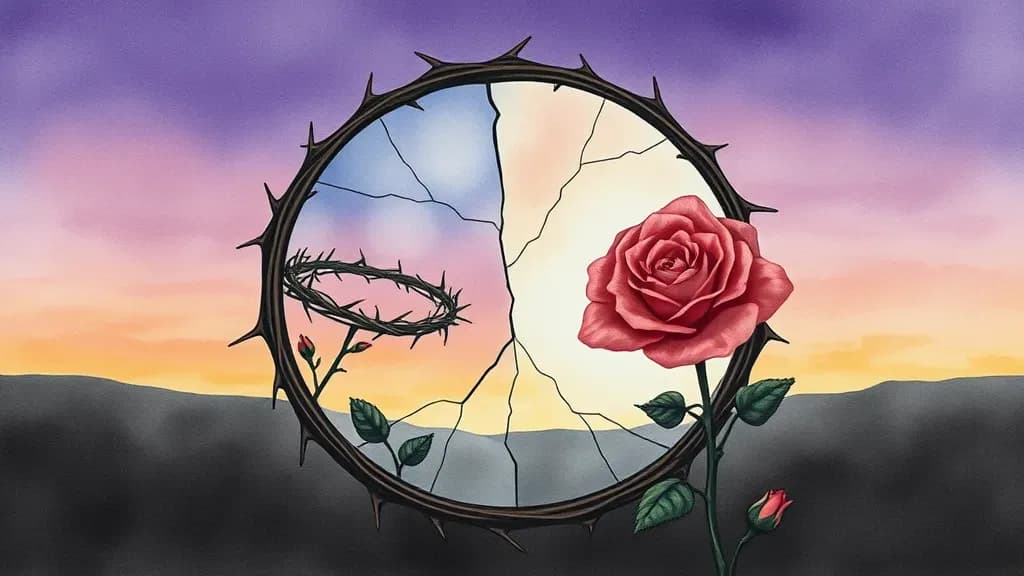
The title is not a fairy tale reference, or at least not primarily. It is a self-portrait in two words. The song's lyrical focus is on West's relationship with the music industry and his own standing within it: the strange dual nature of being both celebrated and feared, both beloved and reviled. He reflects on how his career has been transformed, how the industry has changed around him, and how his original connection to listeners now exists in complicated relationship to everything that has followed[8].
The song does not position its narrator simply as a victim. But it does ask the listener to sit with the question of how identity gets distorted by the machinery of fame, and how the gap between a public image and a private self can grow into something almost unbridgeable. West has returned to this theme throughout his career, from the anxiety about authenticity on The College Dropout to the explicit megalomania and self-critique of Yeezus and The Life of Pablo. Here, the treatment is stripped of those albums' bombast. The enormity of the gap is acknowledged quietly, set against music that sounds like it comes from a more innocent moment.
There is a deliberate and affecting tension between the song's sonic warmth and its emotional temperature. The production draws on soul music traditions that carry connotations of community and shared feeling. But the lyrical posture is that of someone observing that community from a significant distance. This quality, of music that reaches out while acknowledging how far the distance has grown, gives the song much of its power. It is not self-pity. It is something closer to reckoning.
The Impossible Context
The question that hangs over "BEAUTY AND THE BEAST" is the question that increasingly surrounds all of West's recent work: how do you assess the art when the artist has become such a destabilizing presence? The antisemitic statements and behavior that dominated West's public life in 2023 and 2024 were not a one-time incident. They constituted a sustained pattern that included promoting swastika imagery, posting Holocaust-denying content, and making public statements expressing admiration for Adolf Hitler[10]. In January 2026, West took out a full-page apology in The Wall Street Journal, attributing his behavior to a prolonged manic episode connected to his bipolar disorder diagnosis[11]. Whether that apology is sufficient, or how it should reshape our engagement with his art, is a question each listener must navigate individually.
What is clear is that "BEAUTY AND THE BEAST" arrived within that context and found an audience willing to engage with it on musical terms. Rolling Stone's review of BULLY, while expressing substantial reservations about engaging with West's work given his off-record conduct, acknowledged that the album showed genuine vitality relative to his recent output[12]. The Loyola Phoenix's assessment was sharper in its skepticism, reading the song's apparent gestures toward accountability as damage control that lacked the sincerity to register as genuine contrition[13]. For a song conceived in the Donda era and released into the wreckage of 2025, the range of that response from cautious recognition to active rejection is itself a measure of how much the terrain around West's work has shifted.
The song also functions as a statement about artistic continuity. The chipmunk soul textures that originally distinguished West from his peers in the early 2000s were not just a stylistic choice. They reflected a particular sensibility: an ear for emotional resonance over technical virtuosity, a preference for warmth over cool, a belief that sampling the past was a way of honoring the roots from which new music grows. To hear those textures return in a period defined by controversy and geographic isolation suggests that the core musical personality has not been entirely consumed by the public spectacle[8].
Other Ways of Hearing It
Not every listener reads the song primarily as self-portraiture. Some have engaged with it as a relationship piece, its tension between beauty and monstrousness mapped onto romantic dynamics rather than the artist's public life. That reading has real support in the song's musical DNA. Soul music has always been a vehicle for exploring the intimacy and volatility of personal relationships, and the Mad Lads sample points explicitly toward that tradition. West's marriage to Bianca Censori, which attracted intense public scrutiny throughout this period, provides biographical material that a relationship-focused reading might draw on.
A third reading situates the song within a longer narrative of West as an artist who has always framed himself as a dual figure: creative visionary and social liability, prophet and provocateur. Going back as far as Graduation and 808s and Heartbreak, West has returned repeatedly to the idea that his gifts and his flaws are not separate but intertwined, that the same qualities that make him capable of extraordinary music also make him difficult to contain or account for. "BEAUTY AND THE BEAST" can be heard as the most spare and direct expression of that self-understanding that he has yet offered.
What Persists
"BEAUTY AND THE BEAST" will not settle any of the debates that surround Kanye West. It is not a redemptive moment in any conventional sense, and it does not pretend to be. What it offers instead is something rarer: a quiet, carefully made piece of music that communicates something true about loneliness, about legacy, and about the persistence of artistic instinct even when everything else is in disorder.
The song arrived at a listening party, circulated briefly online, disappeared, resurfaced through unofficial channels, and eventually found its way to streaming platforms through an unconventional release strategy[5]. Its chaotic, indirect path to the listener makes some sense given its creator. But the music itself is focused and warm. In a career defined by grand gestures and maximalist ambition, "BEAUTY AND THE BEAST" achieves something small and precise. It finds West at his most exposed, working in the genre he helped shape, trying to say something honest.
Whether that honesty is enough, or what it is worth alongside everything else, is something listeners will continue to argue. But the argument itself is evidence that the song landed. And in an era when much of West's output has struggled to generate anything beyond spectacle, landing is something.
References
- Kanye West Announces New Album 'Bully,' Debuts Song 'Beauty and the Beast' — Variety coverage of the Haikou announcement and song debut
- Kanye West Announces New Album 'Bully' And Debuts Song At China Listening Event — NME coverage of the Haikou listening event and live debut
- Beauty and the Beast (Kanye West song) - Wikipedia — Detailed song history including production credits, sample info, and release timeline
- Ye Shares Updated Version Of 'BEAUTY AND THE BEAST' And Confirms 'BULLY' Is Coming — Rap-Up on the updated version of the song and the Mad Lads sample
- Ye Shares New Song 'Beauty & the Beast,' Says Album 'Bully' Is Coming — Billboard reporting on the song's initial release and streaming details
- A Look Inside Kanye West's New Album Bully — Overview of the album's production context including Tokyo hotel recording
- Kanye West Debuts New Song 'Beauty & The Beast,' Gives Update On 'Bully' Album — HipHopDX on the song's dual-location recording credits and concept album announcement
- Kanye West - BULLY Review — Critical review noting the chipmunk soul roots of Beauty and the Beast and its vocal approach
- Ye Shares New Single 'Beauty & The Beast,' Teases 'Bully' Album — Vibe on the song's meditative production and vulnerable vocal register
- Bully (album) - Wikipedia — Full album context including recording circumstances, tracklist, and controversy background
- Ye apologizes for antisemitism in Wall Street Journal ad — NPR reporting on West's January 2026 public apology and bipolar disorder context
- Despite Himself, Kanye West Almost Made a Half Decent Album — Rolling Stone review of BULLY with critical assessment of West's current era
- Ye's 'BULLY V1' Fights For Relevance — Loyola Phoenix review criticizing the chorus as lacking sincerity and reading as damage control