Black Quarterback
The title hits like a coaching decision handed down by committee. Three words that carry centuries of American contradiction, delivered by Death Grips with the force of something that should not need explaining but somehow still does. "Black Quarterback" is not a celebration or a tragedy. It is a diagnosis.
The song lands third on Niggas on the Moon, the first disc of Death Grips' sprawling 2015 double album The Powers That B. Everything about its placement feels intentional. The production buzzes and crackles around processed Bjork vocal samples that Zach Hill re-arranged entirely using a Roland V-Drum kit. The result sits somewhere between war drum and encrypted transmission.
Born From Declared Ruin
By the time Niggas on the Moon dropped as a surprise free download on June 8, 2014, Death Grips were operating in a state of cultivated chaos.[1] Weeks later, the band announced their breakup via a handwritten Facebook note, canceling all tour dates and stating, in characteristically cryptic terms, that they were at their best and therefore finished.[2] The remaining disc of The Powers That B would eventually be completed and released, but the band had declared itself over.
Bjork, whose voice is processed and sampled across every track on the disc, confirmed her involvement publicly the day after the album dropped.[3] She expressed genuine enthusiasm and credited Death Grips as a group she admired. Rolling Stone reported that the collaboration had roots in Death Grips' earlier work on her 2012 remix album Bastards.[4] The album credits her not as a featured artist but as a "found object," a designation that accurately describes how her vocals are used: not as performances but as raw sonic material to be dismantled and rebuilt.[1]
The context of 2014 matters. The album arrived in a summer when debates about racial justice, police violence, and Black visibility in American institutions were reaching a pitch the country hadn't seen in decades. Death Grips does not editorialize. But "Black Quarterback" was made in a world where the question of who gets to hold authority, and at what cost, was impossible to ignore.
The Position and Its Price
The title functions as the song's entire thesis, stripped of qualification. It is a position, an identity, a challenge. In American football's long history, the quarterback role was systematically withheld from Black players through a practice known as racial stacking, in which Black athletes were steered toward positions coded as physical rather than those coded as requiring intellect and leadership.[5] Research has documented that even in the modern era, Black quarterbacks were statistically more likely to be benched than their white counterparts with comparable performance levels, and that broadcasters consistently attributed their success to athleticism rather than intelligence.[6]
Death Grips takes this history and scales it outward. The "black quarterback" in this song is not a specific athlete. It is a symbol for the condition of excelling within any system that was designed to exclude you. MC Ride's lyrics circle around a central tension: what does freedom mean when achieving it requires working within structures that limit your full humanity? The song frames this as a stark binary. Comfort means accepting the role the system has made available. Freedom means refusal, which carries its own cost.
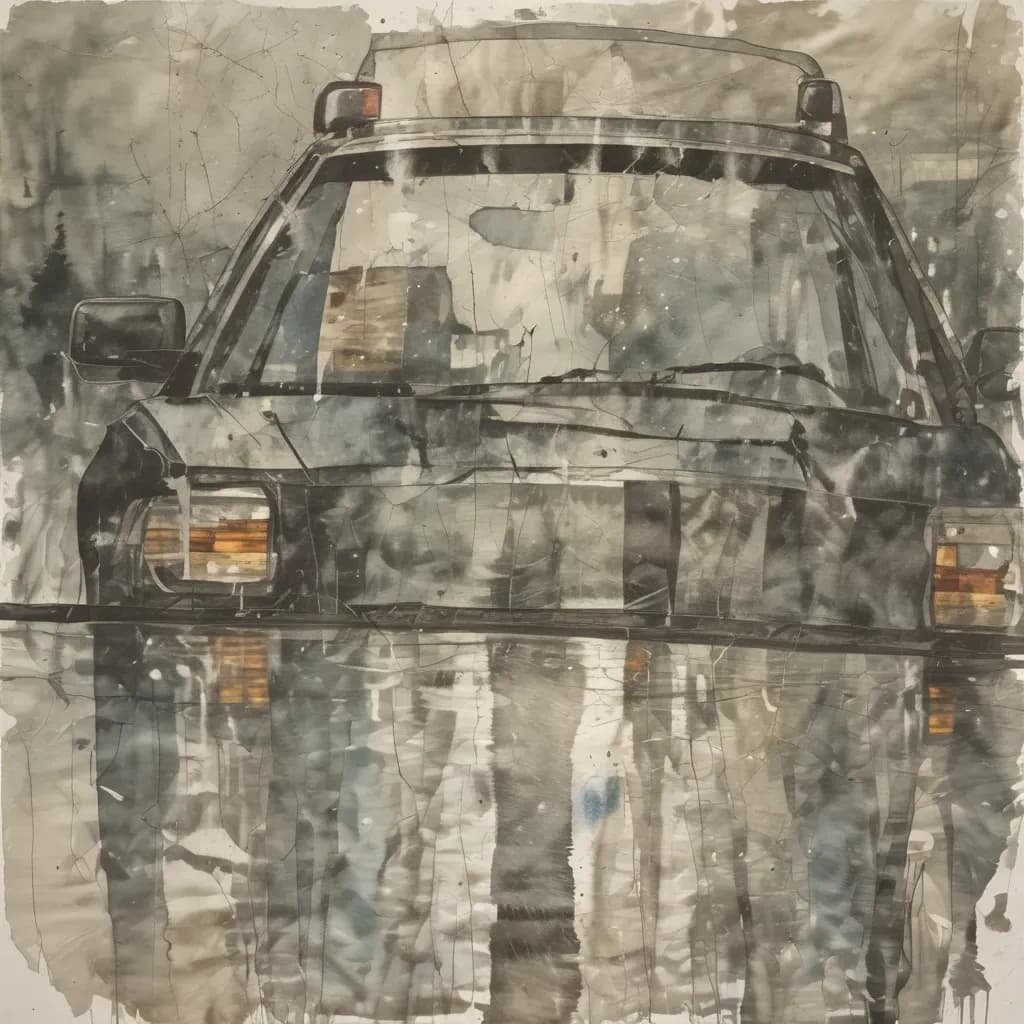
The song anchors this abstract argument in lived experience. One of its most striking sequences involves a traffic stop, rendered with enough specificity to feel documentary and enough compression to feel universal. Whatever authority the "black quarterback" holds within the game, the rules change the moment he steps outside it. The arena and the street exist in completely different moral economies, and the song refuses to let you pretend otherwise.
Sonic Pressure as Argument
The production on Niggas on the Moon is unlike anything Death Grips had attempted before. Zach Hill performed every instrument on the album using only a Roland V-Drum kit.[7] The Bjork samples are processed to the point of abstraction, providing a substrate of controlled dissonance beneath every track. "Black Quarterback" rides this unease with particular intensity. The drums push forward without concession. The track does not relax into a conventional hook. There is no safe landing zone in the music.
This sonic pressure is not accidental. Death Grips builds environments that force engagement. The discomfort of the production mirrors the discomfort of the lyrical subject: occupying a position of visibility and achievement without ever arriving at safety or rest. The music does not let you resolve the tension any more than the quarterback can resolve his.
The song's repetition of the title phrase takes on a ritualistic quality over its three minutes. What begins as a statement becomes a chant, then a pressure, then something harder to name. MC Ride's delivery shifts registers within short bursts, moving between declaration and exposure, confidence and exhaustion. The listener is not positioned as an outside observer. The production pulls you into the middle of the argument.
A Charged Cultural Moment
The song's release coincided with a particularly fraught period in American football's racial politics. The 2013 and 2014 NFL seasons featured Black quarterbacks navigating a media environment that treated their successes as exceptions and their failures as confirmation of a narrative about who naturally belongs in command. Debates about Colin Kaepernick, Cam Newton, and the racial politics of the franchise quarterback role were unfolding in public as Death Grips put the finishing touches on this album.[6]
Death Grips names none of these players. The generality is the point. The song describes a structural position rather than a personal story, examining what it feels like to inhabit it: visibility without protection, authority without safety, excellence that does not translate once the performance ends.
The phrase "black quarterback" carries decades of compressed cultural meaning that listeners bring to it without instruction. This is a technique Death Grips uses across their work, loading a phrase or image with enough potential meaning that the listener completes the final assembly. The song trusts its audience to know what it is pointing at.
The album's title track, also analyzed on this site, operates in similar territory, exploring what power looks like when it is held by those the system has designated as outside it. The two songs in conversation across the double album create a kind of argument that neither makes entirely on its own.
Open Readings
Some listeners have read the song as primarily a statement of self-positioning. On this reading, MC Ride is the black quarterback of underground music: a figure who has seized a commanding role in a genre, experimental hip-hop, that has historically been anchored in and celebrated by white avant-garde aesthetics.[8] The title, on this reading, is triumphant. "Black Quarterback" becomes an assertion of arrival.
Others hear the unresolved tension as the actual subject. The song does not celebrate occupying the position. It interrogates the position's costs and limits. The comfort-versus-freedom binary has no clean answer because the premise is already compromised: the supposedly "free" choice still operates within a system designed to constrain the options available to Black people in authority.
These readings are not competing. Death Grips builds work that functions as a kind of Rorschach test, presenting images and phrases charged with meaning and letting the listener do the final interpretation. The song's refusal to explain itself is not a withholding. It reflects the band's consistent position: that the experience of the music is the argument, not simply a delivery vehicle for an argument they could have made in prose.
The Game Continues
"Black Quarterback" runs under three minutes. But it carries the density of something much longer: a compressed argument about race, authority, visibility, and what it means to succeed on terms that someone else set.
The album it anchors was released in full during a period when Death Grips had supposedly already ended.[1] [2] That context adds another layer: the band making their most politically charged and ambitious statement at the exact moment they had declared themselves finished. The black quarterback playing his best game while the league is already trying to move on.
MC Ride never explains the song. That silence is consistent with everything Death Grips has communicated and withheld about their work over the years. The meaning is not kept back to be coy. It is kept back because the experience of the song, the relentless production, the confrontation of the title, the refusal to offer comfort, is the meaning.
The black quarterback takes the field. The crowd watches. The game runs on terms designed by someone else. And yet the position is taken.
References
- The Powers That B - Wikipedia — Release timeline, recording details, Bjork collaboration credits, and critical reception
- Death Grips Break Up - Spin — Coverage of the band's handwritten breakup announcement and tour cancellations in July 2014
- Bjork Thrilled to Feature on Death Grips Album - Spin — Bjork's public statement confirming and celebrating her involvement with Niggas on the Moon
- Death Grips Enlist Bjork for Surprise New Album - Rolling Stone — Rolling Stone coverage of the Bjork collaboration and its roots in the Bastards remix album
- Racial Issues Faced by Black Quarterbacks - Wikipedia — History and documentation of racial stacking, media bias, and systemic exclusion of Black players from the quarterback position
- Decadeslong Struggle to Break the NFL's Quarterback Color Barrier - ABC News — Statistics and historical context on the underrepresentation and differential treatment of Black quarterbacks
- Death Grips - Niggas on the Moon Review - RapReviews — Critical review documenting the Roland V-Drum production approach and the album's reception
- Death Grips - Wikipedia — Band history, discography, and the cultural position of Death Grips in experimental hip-hop