Blowin in the Wind
There is something peculiar about a song that answers every question it raises with a riddle. Most protest songs point fingers. Most anthems offer certainty. "Blowin' in the Wind" does neither, and that is precisely what makes it the most enduring question mark in the American songbook.
Written in Ten Minutes, Heard for Decades
Dylan wrote the song in the spring of 1962, at around twenty years old, during his first full year living in New York City.[1] Eyewitness accounts placed him at or near Gerde's Folk City in Greenwich Village one afternoon when he pulled out a notebook and guitar and sketched the entire song in roughly ten minutes.[2] The figure sounds mythological but comes from multiple contemporaneous sources.
The first public performance came on April 16, 1962, in the basement of Gerde's Folk City.[3] Gil Turner, editor of Broadside Magazine, reportedly learned the song on the spot and was performing it for audiences within days. The lyrics and sheet music appeared in the May 1962 issue of Broadside, the journal of the topical song movement, where editors noted the twenty-year-old Dylan was "the nearest composer we have had to Woody Guthrie in recent years."[1]
The studio recording was made on July 9, 1962, at Columbia Records Studio A in New York.[3] It would not reach the public until May 27, 1963, when it opened The Freewheelin' Bob Dylan, his second album, alongside "Masters of War," "A Hard Rain's a-Gonna Fall," and "Don't Think Twice, It's All Right."[4]
The context matters. This was a country at a turning point. The Civil Rights Movement was accelerating, with Freedom Riders testing desegregation laws across the South. The Cuban Missile Crisis was just months away. Young Americans were beginning to feel that the postwar optimism they had inherited was fraying at its edges. Dylan absorbed all of it and turned it into questions.
A Melody Borrowed from History
The song did not arrive without roots. Dylan drew its melody directly from "No More Auction Block," a Reconstruction-era spiritual born from the experience of formerly enslaved people in the years after the Civil War.[1] Pete Seeger was the first to publicly identify the connection. Dylan confirmed it himself in 1978, telling journalist Marc Rowland that the song "has always been a spiritual" and that he took it off that earlier song because it followed "the same feeling."[2]
By borrowing that melody, whether consciously or instinctively, Dylan anchored his questions about equality in a tradition of suffering and resistance that stretched back a century before he wrote a word. The questions about human dignity were not new. Only the voice asking them was.
Three Verses, Three Domains
The song works through a series of rhetorical questions organized into three verses, each covering a different dimension of the same problem: the failure of human civilization to live up to its stated values.[5]
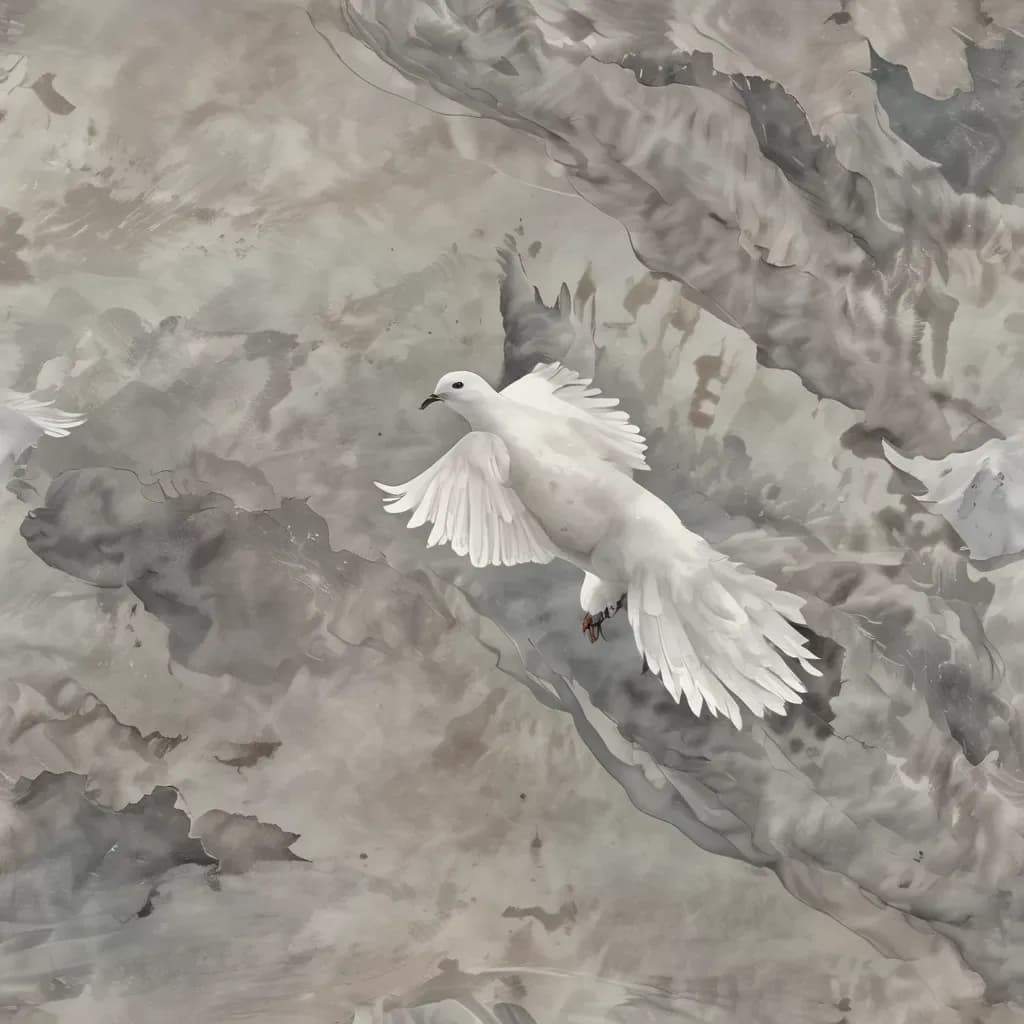
The first verse addresses human dignity and recognition. It asks when a person will be acknowledged as fully human by the society around them, and how long a classical symbol of peace must wander before it finds a place to rest. The questions were immediately understood as speaking to the Civil Rights Movement's central demands, and the melody's roots in a slave spiritual made that connection even more resonant.[5]
The second verse scales up to war and mass death. Dylan chose an ancient weapon as his central image, deliberately. The point is that this is not about any single modern conflict but about a problem as old as organized violence itself. He asks how many times weapons must fly and how many people must die before the powerful accept that armed conflict is not a solution.[5]
The third verse is arguably the sharpest. It turns its attention not to the architects of injustice but to bystanders: the people who look away, who pretend not to see what is in plain sight. Dylan said in interviews that he believed some of the worst criminals were those who turned their heads from wrongs they recognized.[2] This verse implicates the audience directly. The crime is not only harm done but harm ignored.
The Riddle in the Refrain
Then there is the refrain, which is the song's beating heart and its most debated feature. The answer, Dylan tells us, is blowin' in the wind.
Critics and listeners have never agreed on what this means, and that ambiguity is probably the song's greatest achievement. One reading holds that the answer is obvious: it is drifting past us constantly, visible to anyone paying attention, ignored only through willful blindness. Another reading takes a more existentialist view: answers drift away like wind, perpetually out of reach, suggesting that humanity's deepest questions may never be resolved.[5]
Dylan's own statements lean toward the first reading. When he introduced the song at its first performance, he told the audience he was not writing a protest song but simply saying something that needed to be said. In 1962 interviews he said the answer was not to be found in any book or debate: it was simply "in the wind."[1]
The song has attracted religious interpretation as well. When Dylan confirmed its roots in a spiritual tradition, he opened a theological reading: in the Hebrew and Greek scriptures, wind and spirit share the same word (ruah and pneuma respectively). Pope John Paul II reportedly suggested the answer the song sought was "in the wind of the spirit."[6] The song has been sung in both civil rights marches and Sunday morning church services, which tells you something about how much it contains.
A Song That Moved a Movement
The song's trajectory from Village basement to national conversation was remarkably fast. Peter, Paul and Mary released their cover just three weeks after The Freewheelin' Bob Dylan came out in June 1963, and it became the fastest-moving single in Warner Brothers' brief history, selling 320,000 copies in eight days.[1] It reached number 2 on the Billboard Hot 100 and won two Grammy Awards in 1964. That cover introduced Dylan's words to millions of Americans who had never heard of him.
By August 1963, the song was being performed on the steps of the Lincoln Memorial at the March on Washington, just hours before Martin Luther King Jr. delivered his "I Have a Dream" speech.[7] Dylan himself had sung it at a voter registration rally in Greenwood, Mississippi that spring. The song moved between the microphone and the march route in a way few songs ever have.
The song reportedly inspired Sam Cooke to write "A Change Is Gonna Come," one of the most important records of the Civil Rights era.[1] That lineage, from a Reconstruction-era spiritual to a twenty-year-old songwriter from Minnesota to a gospel legend's masterpiece, traces a remarkable arc of American musical and moral history.
Rolling Stone ranked the song number 14 on its 2004 "500 Greatest Songs of All Time" list.[8] It was inducted into the Grammy Hall of Fame in 1994. In 2022, a newly recorded version on a one-of-a-kind analog disc format sold at Christie's in London for approximately $1.78 million.[9]
The Rumor That Would Not Die
A 1963 Newsweek article claimed the song had actually been written by a New Jersey high school student named Lorre Wyatt, who had sold it to Dylan. The allegation shadowed him throughout his early career. In 1974, Wyatt admitted to New Times magazine that he had fabricated the claim entirely, having learned the lyrics from Sing Out! magazine and falsely told his bandmates he wrote them to cover for having no original material of his own.[10] The song has been documented as Dylan's since its first Broadside publication in May 1962.
A Song Covered Hundreds of Times Over
The song's afterlife has been shaped almost as much by other people's voices as by Dylan's own. Stevie Wonder recorded a soul arrangement in 1966 that reached number one on the Billboard R&B chart and cracked the pop top ten, introducing the song to an audience that had little connection to the Greenwich Village folk scene where it was born.[11] That crossover mattered. It showed the song could shed its original context entirely, moving from acoustic protest anthem to orchestrated pop single, and still carry its questions intact. In the decades since, it has been recorded in dozens of languages by artists across genres, from gospel choirs to punk bands, each version testing whether the questions still hold their weight outside the specific moment that produced them. They always have.
Still Open
"Blowin' in the Wind" endures because it refuses to close. Other songs from this era were eventually retired by the victories or defeats of specific causes. This one stays open. It asks the same questions now that it asked in 1962, which says something uncomfortable about how far we have and have not traveled.
Dylan was twenty years old when he wrote it. He called it "just another song." Gil Turner called it the best new song he had heard in years. Both were probably right.
What is remarkable is not just the song's durability but its versatility. It has been sung in churches and at protests, in folk clubs and on stadium stages, in languages Dylan probably never imagined. It has outlasted the specific causes it was written near. The questions it asks have not been answered, and so the song keeps asking them.
References
- Blowin' in the Wind - Wikipedia — Comprehensive history including first performance, Broadside publication, melody origins, Peter Paul and Mary cover, and cultural impact
- American Songwriter - The Story Behind 'Blowin' in the Wind' — Composition story including 10-minute writing claim, Dylan's own statements, and Lorre Wyatt plagiarism rumor
- History.com - Bob Dylan Records 'Blowin' in the Wind' — Recording date and studio details
- The Freewheelin' Bob Dylan - Wikipedia — Album recording history, track listing, and critical reception
- LitCharts - 'Blowin' in the Wind' Thematic Analysis — Detailed analysis of imagery, symbols, and thematic structure
- Institute of World Politics - 'Blowin' in the Wind' — Philosophical and spiritual interpretations of the refrain, including Pope John Paul II's commentary
- Rolling Stone - The Freewheelin' Bob Dylan: Inside His First Classic — Album context, March on Washington performance, and cultural legacy
- Rolling Stone - 500 Greatest Songs: Bob Dylan, 'Blowin' in the Wind' — Rolling Stone's ranking and critical assessment of the song
- Variety - 'Blowin' in the Wind' 60th Anniversary — 2022 Christie's auction sale and anniversary context
- Snopes - Did Bob Dylan Steal 'Blowin' in the Wind'? — Fact-check debunking the Lorre Wyatt plagiarism claim
- It Was 50 Years Ago Today: 'Blowin' in the Wind' by Stevie Wonder - REBEAT Magazine — Details on Stevie Wonder's 1966 cover version, its chart performance, and crossover impact