Blue Disco
There is a particular kind of beauty that only appears after the music stops. When the speakers quiet and the crowd thins and you are left with the residue of the night, ordinary life reasserts itself in small, undeniable ways. Arlo Parks understood this instinctively when she chose to open Ambiguous Desire, her third studio album, not with a club anthem or a declaration of longing, but with something closer to its aftermath: a soft-edged song built around the debris of a party winding down and the quiet discovery waiting inside it.
"Blue Disco" is that song. And for all its gentleness, it may be the most revealing thing Parks has recorded.
A New City, A New Self
Arlo Parks came to Ambiguous Desire through a period of genuine transformation. After finishing a tour in New York City at the start of 2024, she found herself drawn into the city's nightlife, falling in love both with the city itself and with someone who lived there.[1] She had relocated from London to Los Angeles. She pushed herself into nocturnal spaces, absorbing the textures of underground clubs, the specific emotional grammar of the dancefloor, the way a night out can compress an entire emotional life into a few hours.
In interviews, Parks described desire as an engine, the animating force behind the record's explorations of longing, self-acceptance, and the hard, hopeful work of learning to be fully present in your own life.[2] The album that emerged from this period is a significant sonic departure: where her Mercury Prize-winning debut Collapsed in Sunbeams (2021) worked in acoustic intimacy and confessional delicacy, Ambiguous Desire incorporates breakbeats, modular synthesizers, and production shaped by club culture, drawing on touchstones from Burial to LCD Soundsystem to Theo Parrish.[3]
She also disclosed something quieter: that this album represented the first time she had been able to embrace stillness since she was seventeen.[4] For someone whose career has been defined by constant motion, that admission carries weight. "Blue Disco" opens the album. It is, structurally and emotionally, the door.
The Mundane as Sacred
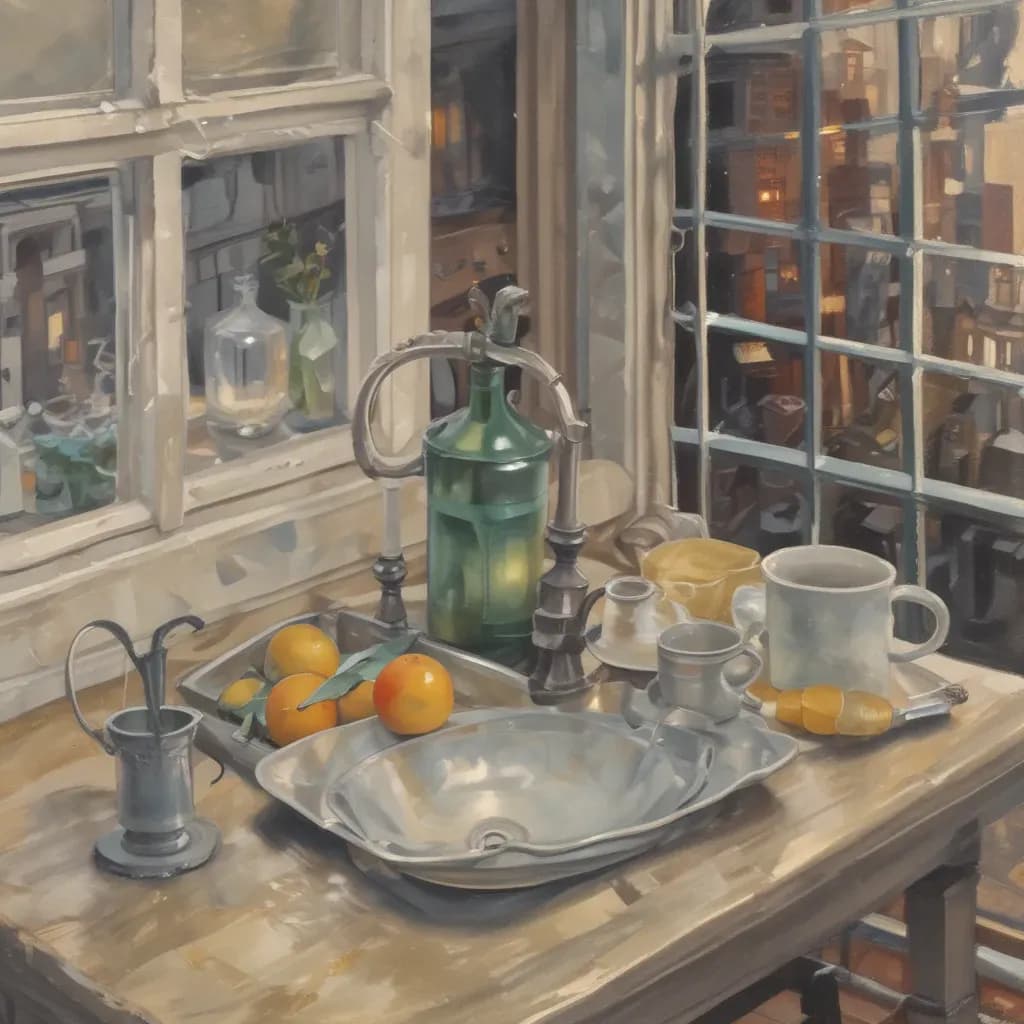
The song takes place not at the height of a night out but in its aftermath. Parks fills the scene with the kind of details that might ordinarily go unremarked: dishes being washed, guests drifting toward the exit, the sensory residue of an evening fully inhabited, someone outside in a rough state, the smell and scuff of a flat that has held too many people for too many hours.[5] These are not glamorous images. They are, deliberately, the opposite of glamorous.
There is a long tradition in art of finding the sacred in the unglamorous, of insisting that the real meaning of an experience often hides not in its peak moments but in its ordinary periphery. Parks is working in that tradition here. The person outside the back, the walls showing their wear, the domestic smell of a space that has hosted a night: these details are not there for comic effect or ironic deflation. They are the texture of real life, and by placing them at the center of a song about desire and discovery, Parks is making an argument about where genuine feeling actually lives.
The emotional core of "Blue Disco" is a declaration of recognition. Across the song, Parks returns again and again to the same essential idea: that she always knew she would find this. Find what, exactly, is the ambiguity the album title promises. A person. A feeling. A version of herself. The "you" the song addresses remains productively unresolved, which is part of why the song functions as an opening rather than a statement. It poses a question the rest of the album will spend its runtime exploring.
Stillness at the Center
What is unusual about "Blue Disco" in the context of an album about nocturnal desire is how still it is. The production is restrained: soft electric guitar drifting above a gentle drum pattern, space used deliberately, nothing overcrowded or overwhelming.[5] For a record that will later push into electronic textures and breakbeat rhythms, the opening track pulls back. It breathes.
This choice seems directly connected to Parks' admission about stillness. The album begins not in the rush of desire but in its quiet aftermath, because that is where Parks found herself able to think clearly for the first time in years. The party is winding down, the people are leaving, and in the calm that remains, something true becomes visible.
Critics have described "Blue Disco" as the most offhand party song Parks has recorded.[6] That reading is accurate but perhaps undersells what the offhandedness is doing. The looseness of the song, its refusal to perform intensity, is itself a kind of statement. This is what it sounds like when you are no longer performing desire and can simply experience it. The distance between those two states is one of the album's core subjects.
The Body as Evidence
Ambiguous Desire is deeply interested in the physical experience of nocturnal spaces, and "Blue Disco" establishes that interest from its opening seconds. The song is saturated with sensory information: what the room smells like, what the walls look like, who is where and in what condition. Parks has always been a writer who grounds emotional experience in specific physical detail, but this song makes the body's evidence the entire argument.
By foregrounding the unglamorous physical reality of a night coming to its end, Parks implicitly pushes back against a certain romantic mythology of the dancefloor. In that mythology, the club is pure transcendence, pure escape, pure feeling, a space outside of ordinary time and consequence. "Blue Disco" insists on something more complicated and ultimately more generous: that the real texture of experience includes the mess and the rough edges and the people in various states of disrepair, and that these things do not diminish desire but complete it.[7]
The song asks us to find the beautiful in the actual, not in some idealized version of the night that erases its costs.
Between Blue and Disco
"Blue Disco" arrives at a moment when a whole generation of artists has been reckoning seriously with the emotional and spiritual weight of club culture. From Burial's atomized urban solitude to LCD Soundsystem's communal euphoria to Jamie xx's meditations on collective joy, the dance space has become a site of significant artistic inquiry. Parks is bringing her distinctly literary sensibility to this territory, and the song represents the intersection of two tendencies: the intimate confessional lyric and the club-inflected sound.[3]
What Parks adds that is specific to her is the queer domestic intimacy woven into the song's fabric. The afterparty as a space, the people gathered without anywhere to be, the coming-down that is also a coming-closer: these are images with particular resonance in queer social histories, where informal domestic gathering often carried meanings that more public, official spaces could not contain. Parks, who is openly queer and has been widely recognized for her significance as a Black queer artist in British mainstream pop, is working in a tradition even as she is reshaping it.[8]
The word "Blue" in the title works in at least two directions simultaneously. It evokes the color and aesthetic of a certain kind of nightlife: cool, nocturnal, interior. And it names a mood: the blue that follows an intensity of feeling, the emotional register of the morning after, the particular shade of feeling that sits between sadness and relief. By fusing those two meanings, Parks names the song's essential territory before the music has begun.
Who Is the "You"?
One reading of "Blue Disco" situates it as a love song, with the unnamed addressee being a specific person Parks encountered during the period of writing and recording. Given what she has shared publicly about falling in love in New York during this time, that reading has clear biographical support.[1]
But a more expansive interpretation treats the song as Parks addressing a version of herself she had not yet met: the self that was capable of stillness, that was willing to stop moving long enough to actually feel something. Parks has spoken about this album as a record of healing and self-acceptance, and "Blue Disco" could be read as the moment of recognition that makes that acceptance possible.[2] The repeated declaration of certain recognition becomes, in this light, not a message to a lover but a letter to a future self.
These two readings do not cancel each other out. The song's power is that it holds both simultaneously, which is what the best writing about desire usually does. Longing for another person and longing for a fuller version of yourself are not entirely different things, and Parks has always understood that.
An Opener That Opens More Than an Album
"Blue Disco" works as an opening track because it does what all the best album openers do: it establishes the emotional register without fully resolving it, creates the question the record will spend its time answering, and offers the listener a way in that feels honest rather than spectacular. Critics who have assessed Ambiguous Desire as Parks' most vividly realized body of work tend to note exactly this quality: that the album earns its larger emotional statements because it grounds them in specific, unguarded moments.[9]
It is a quiet song about loud feelings. A domestic song about transcendence. A party song that finds its meaning in the moment after the party ends. Parks has said that Ambiguous Desire represents the first time she has been able to embrace stillness, and "Blue Disco" is what that stillness sounds like: unhurried, attentive, certain in its feeling even when uncertain about its object.[4]
The dishes need doing. Someone is outside, in rough shape. The walls show everything the evening cost. And in the middle of it, the narrator is certain: she always knew she would find this.
That certainty, arrived at through mess and noise and ordinariness, is what makes "Blue Disco" the kind of song that opens more than an album. It opens a way of seeing.
References
- Arlo Parks Interview: Love, Healing, and New Album 'Ambiguous Desire' - Rolling Stone — Parks discusses falling in love in NYC, healing, self-acceptance, and the high-profile relationship and breakup that preceded the album
- Arlo Parks on New Album 'Ambiguous Desire' - Billboard — Parks describes desire as an engine and discusses the album's themes of healing, putting words to feelings, and self-acceptance
- Arlo Parks: Nocturnal Awakening - Rolling Stone UK — Parks discusses Paradise Garage influence, Burial and LCD Soundsystem touchstones, and the production process
- On 'Ambiguous Desire', Arlo Parks turns fleeting nocturnal moments into lasting songs - NME — Parks discusses embracing stillness for the first time since age 17, nocturnal spaces, and the album's emotional core
- Arlo Parks - Ambiguous Desire - FLOOD Magazine — Album review including analysis of Blue Disco's production, opening track role, and offhand party song quality
- Arlo Parks - Ambiguous Desire Album Review - Paste Magazine — Critical reception and assessment of the album including standout tracks
- Arlo Parks is Taking Her Storytelling to the Dancefloor - RANGE Magazine — Parks on the album's emotional balance, the dancefloor as a site of genuine feeling rather than pure escapism
- Arlo Parks is Taking Her Storytelling to the Dancefloor - Dork — Parks on holding onto storytelling and warmer sounds in the context of the album's club-inflected production
- Arlo Parks - Ambiguous Desire: A Melancholic-Soaked Masterpiece - The Indie Scene — Review calling the album Parks' most vividly realized body of work, noting the album's euphoria and comedown tension