Break
Most pop songs are about wanting more. More love, more recognition, more of whatever keeps the narrator chasing the horizon. “Break” by Kero Kero Bonito is, remarkably, about wanting less. Specifically, it is about wanting to sit down, stop moving, and let the world continue its frantic spinning without you. It is one of the gentlest and most cheerfully subversive songs in the band’s catalog.
Set against a buoyant, sauntering beat drawn from the J-pop tradition the band loves, the song offers its narrator’s stillness not as a failure to keep up but as a considered, even joyful, choice. There is no crisis here, no breakdown. Just the quiet decision to take a seat while everything else keeps moving.
A Single Before the Album
Released on June 13, 2016, several months before Bonito Generation arrived that October, “Break” was one of six singles the band released to introduce the record.[1] The advance-single strategy reflected the album’s unusual density. Nearly every track on the record had the structural confidence of a standalone single, and critics noted the band had essentially perfected a quick-fix formula, throwing a dozen would-be hits across the album without obvious filler.[2]
Kero Kero Bonito formed in London in 2011 when producers Gus Lobban and Jamie Bulled, who grew up together in Bromley, posted an advertisement on MixB, an online community for Japanese expatriates living in the UK, searching for a bilingual vocalist.[3] Sarah Midori Perry, of mixed British and Japanese heritage, responded. She had no professional singing experience at the time, having previously focused on visual art and writing, but the chemistry was immediate. By the time the trio recorded Bonito Generation, they had refined the rougher edges of their 2014 mixtape Intro Bonito into something tighter and more polished, a maximalist pop architecture built around J-pop structure, video game music textures, and the bubblegum compression of the PC Music scene.[3]
Rest as the Subject
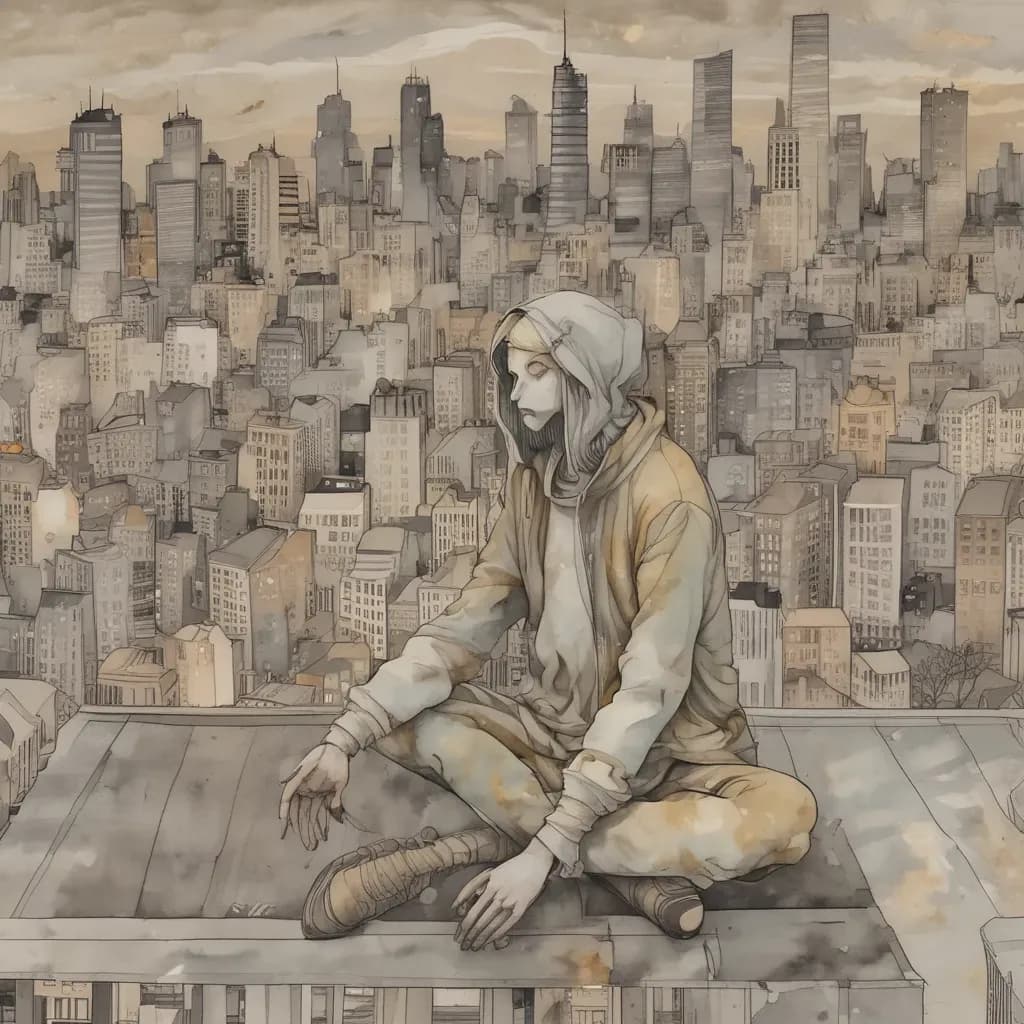
What “Break” is about is deceptively obvious: rest. The song’s narrator advocates for stopping, sitting down, and being still while the world rushes past. What makes this interesting is the particular tone the band brings to the premise. The narrator is not exhausted or burned out in any dramatic way. She is simply choosing, with cheerful deliberateness, to opt out of the general busyness for a moment.
The song’s bilingual English and Japanese structure gives this thesis an additional layer. A Japanese lyric midway through the track describes, in translation, the world spinning past in a blur, a vivid snapshot of the pace of modern life seen from a point of deliberate stillness. The fact that the observation comes in Japanese, embedded in a song otherwise sung in English, is itself part of the point: Perry’s dual cultural identity places her slightly outside any single frame of reference. From that vantage point, the busyness looks a little absurd.
This connects to the broader emotional landscape of Bonito Generation. The album traces the anxieties and minor triumphs of millennial early adulthood: graduating, applying for jobs, navigating city life, maintaining friendships across distances. These are not catastrophic subjects, but the album understands them as genuinely tiring. “Break” is the record’s explicit acknowledgment that sometimes the correct response to all of it is to take a seat.
The Music Video: Stillness in Motion
The official music video, released alongside the single on June 13, 2016, literalizes the song’s central image with deadpan precision.[4] It shows Perry sitting completely motionless in a plastic chair, placed in various busy public spaces across London and on tour. Crowds move around her. Traffic passes. Passersby look confused. She does not move.
The humor comes from the contrast between her absolute stillness and the energy surrounding her, and from the unwavering, almost beatific calm she radiates throughout. The video never breaks its conceit and never tries to explain itself.[5] Like the song, it trusts that the idea is strong enough to carry the weight without elaboration.
Radical Positivity and Its Complications
Around the time of Bonito Generation, Kero Kero Bonito were frequently described as practitioners of what journalists called “radical positivity.” In a 2016 Stereogum profile, the band pushed back gently on the idea that their brightness was either naive or ironic. They insisted it was sincere, even while acknowledging the effort it sometimes required to sustain.[6]
“Break” sits within this framework in an interesting way. It is not an exercise in relentless optimism. It is not cheering you toward anything. If anything, it represents the quieter wing of the radical positivity platform: the argument that choosing stillness is as valid and as cheerful as any act of striving. The song does not ask you to push harder or feel more. It gives you permission to stop.
A Subtle Act of Resistance
It is worth noting the cultural moment in which the song arrived. By 2016, the rhetoric of productivity had become pervasive, embedded in career advice, self-help content, and social media feeds aimed at young adults. The pressure to optimize, hustle, and keep moving was not merely ambient; it was prescriptive. Against this backdrop, a chirpy two-minute song about the joys of sitting down and doing nothing reads as quietly but genuinely subversive.
In their 2016 DIY Magazine interview, the band described their work as speaking for a generation navigating a world that felt simultaneously exciting and overwhelming.[7] “Break” is perhaps the clearest single-song distillation of that ambivalence: the world is full of possibility and it is also a lot, and sometimes the sanest response is to put your feet up.
Alternative Readings
If the song’s primary register is comedy, it also has room for something more melancholy. The image of a person sitting completely still while everything rushes past is not only funny. It can read as a portrait of dissociation, of someone who has not so much chosen stillness as retreated into it because the pace has become genuinely unmanageable.
The song does not push in this direction, and there is no evidence the band intended it. But music lives in listeners as much as it lives in its creators, and for anyone who has experienced real exhaustion or anxiety, the narrator’s cheerful immobility might carry a heavier charge than the bright, bouncy arrangement suggests.
“Break” is not one of the towering moments on Bonito Generation. It does not have the anthemic sweep of “Graduation” or the nervous forward energy of “Picture This.” What it has is something rarer: a very specific, very funny, and very true idea, executed with exactly the right lightness of touch.
It says that doing nothing is sometimes the right move. It says this with warmth, with wit, and with a beat that makes you want to sit down and nod along. In a catalog increasingly defined by its range and ambition, “Break” remains a small gem: the song that argues, convincingly, for the value of the pause.
References
- Bonito Generation - Wikipedia — Album history, track listing, singles, and release details
- Kero Kero Bonito - Bonito Generation Review - DIY Magazine — Album review noting the density of would-be singles and quick-fix formula
- Kero Kero Bonito - Wikipedia — Band formation history, members, and biographical context
- Kero Kero Bonito "Break" Video - Stereogum — Video premiere coverage and description of the visual conceit
- Kero Kero Bonito Take a Much-Deserved 'Break' - SPIN — Single and music video announcement
- Kero Kero Bonito's Radical Positivity Pop - Stereogum — In-depth 2016 interview on the band's philosophy of radical positivity
- My Generation: Kero Kero Bonito - DIY Magazine — 2016 interview discussing generational themes and the album's worldview