Camper
There is a specific kind of American freedom that does not look like freedom at all. It looks like sleeping in your jeans. It looks like stars wheeling overhead through the scratched rear window of a truck, the engine cold, parked somewhere between a show you just played and a state line you have not yet crossed. It is the life of the perpetually in-between, and "Camper," a spare, unguarded track from Zach Bryan's 2026 album With Heaven On Top, makes that life feel both beautiful and relentlessly honest.
The song runs barely two minutes. It does not announce itself. It arrives and departs like a mile marker on a highway you are not certain you will see again. But for those two minutes, Bryan captures something that the rest of the 25-track album, for all its ambition, cannot quite replicate: the unedited truth of a particular kind of existence, narrated entirely from inside it.
A Record at the Crossroads
With Heaven On Top arrived on January 9, 2026, debuting at No. 1 on the US Billboard 200 with 134,000 album-equivalent units[1], making it Bryan's second consecutive chart-topping record. At 25 tracks and roughly 78 minutes, it was his most sprawling release to date, and by most accounts the work of a man in the middle of a profound personal reckoning.
The period leading into the album had been turbulent. Bryan's public relationship with Barstool Sports podcaster Brianna LaPaglia ended messily in late 2024, followed by serious public allegations about the nature of that relationship[2]. He pursued sobriety, stepped back from the relentless release schedule that had made him one of the fastest-rising names in American music, and then, in a private ceremony in San Sebastian, Spain, married Samantha Leonard[2]. The album maps all of it: the toxicity, the clearing out, the new beginning.
Geographically, the record spans an enormous territory: a Manhattan apartment in winter, the backroads of Kansas City, Colorado mountains, the American Southwest, Brooklyn, and even the running of the bulls in Pamplona, Spain. Rolling Stone described Bryan as "less interested in making something tidy or palatable than he is in telling the truth as it exists right now[3]." It is an album with political edges in "Bad News," grief at its center in "DeAnn's Denim," and a new tenderness in "Slicked Back," widely understood as a tribute to Leonard[2].
"Camper" occupies none of those center lanes. Track 23 of 25, it surfaces near the album's end with something almost incidental about it: a song about a lifestyle rather than a reckoning, about where you sleep rather than why you wake. That incidental quality, it turns out, is exactly what makes it worth examining.
The Road as the Thing Itself
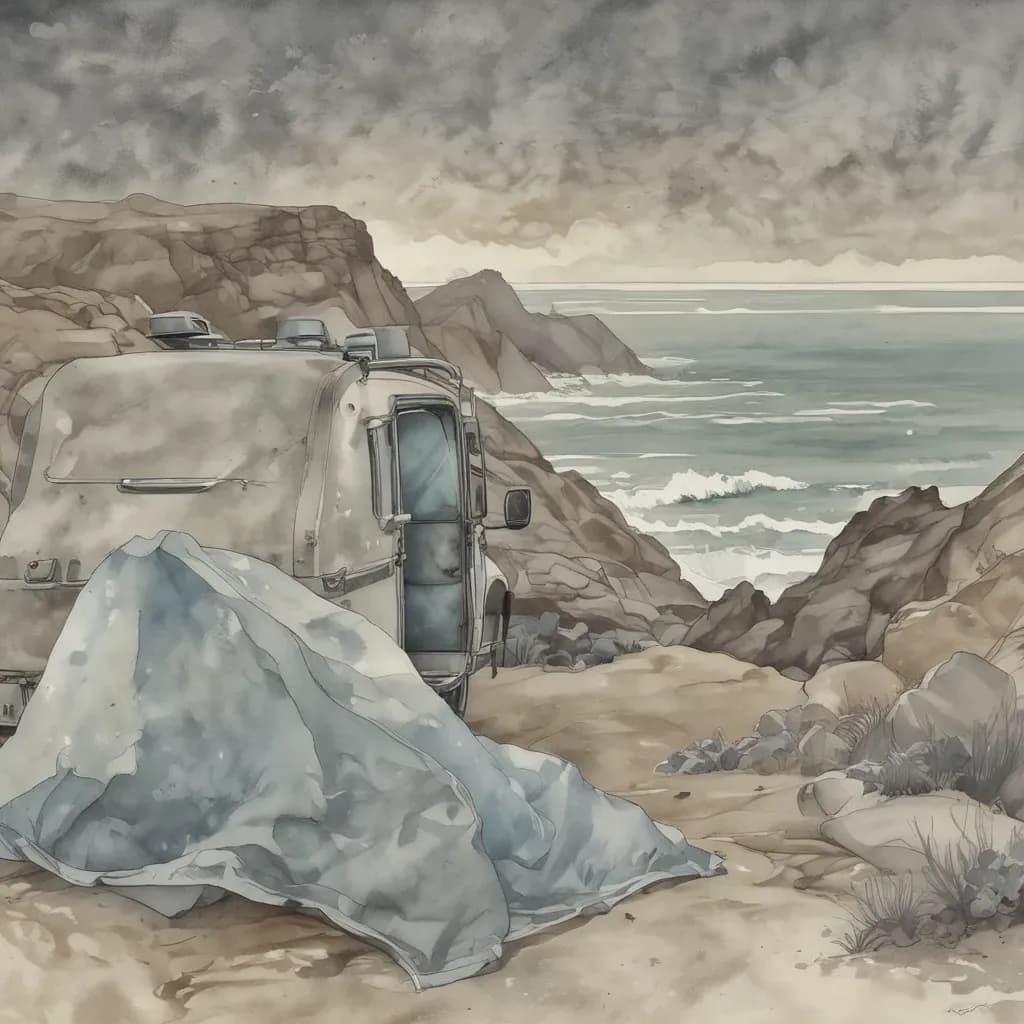
At the heart of the song is a specific kind of dwelling: a camper shell on the back of a truck, a vehicle-as-home that implies neither permanence nor destitution but a deliberate choice to live between places. Bryan frames the camper as the natural habitat of the touring musician, someone who sleeps in his clothes because the next road begins before sunrise[4]. The song's details are precise and unpretentious. No one chooses a camper because it is romantic. They choose it because the alternative is a motel they cannot afford or a city they will never see again.
This is not romanticization borrowed for effect. Bryan actually lived this life. He recorded music on an iPhone outside his Navy barracks[5], then spent years on the road before becoming one of the largest acts in American country music. The camper, in that context, is not a metaphor. It is a memory. When the song describes sleeping under a brilliant desert sky, the narrator is not imagining that sky. He is reporting it.
One of the song's most arresting gestures is its direct address to California. The narrator questions whether the state, so mythologized, so associated with arrival and reinvention, has ever truly known the particular darkness of the open road, the silence of a night without city lights, the exposure that comes with sleeping far from any fixed address[6]. This is a fascinating inversion of the standard California mythology.
In American literature and song, California is almost always the endpoint: the promised land toward which Steinbeck's Joads staggered and Kerouac's Dean Moriarty raced. Bryan's narrator approaches it from the opposite angle, as someone who has lived the journey long enough to wonder whether the destination has earned its reputation. The road, in this telling, is not a means to an end but the thing itself. You do not sleep in a camper to get somewhere. You sleep in a camper because that is where you actually are, and being honest about where you actually are is what the song demands.
Woven through the road imagery is the trace of a relationship. A woman has attached herself to a wandering figure described in the idiom of the American cowboy, and the narrator is trying to understand why: what draws someone to a person who lives in perpetual motion, who has no fixed address to offer, whose commitments are always at least partly conditional on where the music takes him[6]. The song does not resolve this question. It is comfortable with the ambiguity, which is perhaps the only honest response. Some attachments resist explanation. Some people are inexplicably drawn to someone who will be gone by morning, and the song does not pretend to know why any more than the narrator does.
Saving Country Music observed that "the point of the song remains a bit ambiguous. But like many Zach Bryan songs, it captures a moment of a life in transition"[6]. That capture, of a specific feeling inside a specific kind of life, is the song's real achievement. It is not trying to explain anything. It is trying to record something before it disappears.
The Kerouac Inheritance
"Camper" participates in a long tradition of American road art. Kerouac's On the Road gave the 20th century its dominant mythology of restless, cross-country searching. Steinbeck gave the same mythology a working-class infrastructure. Springsteen gave it an electric guitar. Bryan comes at it from the country and Americana tradition, but the lineage is unmistakable, and his relationship to it is not casual.
In March 2026, Bryan reportedly purchased the original scroll manuscript of On the Road at Christie's for $12.1 million[7], his second major Kerouac acquisition after buying the Saint Jean Baptiste Church in Lowell, Massachusetts, to build a Jack Kerouac cultural center[8]. For a man who started recording songs on a phone outside a Navy barracks, this is a statement about artistic inheritance, about who you consider your people and what tradition you are trying to extend. The road in "Camper" is not borrowed atmosphere. It is a philosophical commitment.
The truck camper is the 21st-century equivalent of the hitchhike or the boxcar: a way of being in the American landscape without being settled by it. By placing this kind of song on a record that also includes stadium anthems and political commentary and grief meditations, Bryan is insisting that the small, honest moment is worth documenting alongside the large, dramatic one[9]. The Consequence of Sound review noted the album's recurring concern with what memory and movement cost a person over time[9]. "Camper" is one answer to that concern: you pay with your sleep, your stability, your ability to answer "where do you live?" But the stars are very bright out there.
There is also a productive irony in the song's existence that cannot be ignored. In September 2025, Bryan set a US record for the largest ticketed solo headlining concert in American history, drawing 112,408 fans to Michigan Stadium in Ann Arbor[5]. The man who once slept in his clothes by the side of a highway is now the man who fills a football stadium larger than any previous solo act has managed. "Camper" does not resolve that irony. It holds it quietly, a reminder of where the road actually started and what it looked like before the lights came on.
A Backward Glance
The most interesting alternative reading of "Camper" places it not as autobiography in the present tense but as elegy, a song about a version of Bryan that no longer fully exists. From this angle, the camper is not a home he still inhabits but one he is memorializing, and the song becomes a farewell to a life that fame has made inaccessible.
The California question takes on additional resonance in this reading. Is he asking whether California has ever known this darkness, or is he asking whether he still knows it? Whether the life he is describing remains available to him now that he has crossed whatever threshold separates "emerging artist" from "record-breaking stadium act"? The tone of the song, spare and slightly wistful, supports this interpretation without insisting on it.
Country Central noted that "Camper" belongs to a group of songs on the album where the imagery does not always cohere into a clean thematic point[4]. That criticism is fair if you are measuring the song against a standard of lyrical argument. But if you read it as elegy, the inconclusiveness is the point. You cannot neatly summarize a life you are no longer quite living. The song ends before it resolves because that is what it feels like to look back at something you cannot fully return to.
The title track of the album, which appears earlier and which the site has explored separately, confronts similar questions about the cost of arrival, the gap between what you dreamed and what the dream actually costs. "Camper" approaches the same territory from the other end: not from the top looking down, but from the road looking backward.
Two Minutes, No Apologies
A 25-track album has to earn its shorter songs. "Camper" earns its two minutes not through spectacle or ambition but through specificity. It knows exactly what it is: a song about sleeping under desert stars in a truck, about questioning whether California understands what it means to live on the road rather than at the end of one, about the strange loyalty that attaches itself to a person in perpetual motion.
In the context of With Heaven On Top, a record built on large feelings and large gestures, "Camper" functions as a recalibration. It insists that the small, worn-in truth of a road life is worth setting down alongside everything else. It is not trying to change anyone's mind or land an emotional punch. It is trying to be accurate about what a particular life feels like from inside it.
Bryan started writing songs because he needed to record moments before they disappeared. The iPhone outside the barracks. The shows in small rooms. The nights when a camper shell was the ceiling and the stars were outside it. "Camper" is one of those recordings: a reminder that the road precedes the record deal, that the person sleeping in his jeans is the same person filling the stadium, and that some truths are worth two minutes even on an album that contains twenty-five.
References
- With Heaven on Top - Wikipedia — Album overview, chart performance, tracklist, and critical reception summary
- Messy Breakups and That ICE Song: 5 Takeaways From Zach Bryan's New Album - Rolling Stone — Biographical context including LaPaglia split, sobriety, and marriage to Samantha Leonard
- Zach Bryan Swings Bigger Than Ever on 'With Heaven on Top' - Rolling Stone — Critical album review with thematic analysis and quotes about Bryan's artistic ambition
- Zach Bryan 'With Heaven On Top' Album Review - Country Central — Critical review noting autobiographical elements of 'Camper' including playing shows and sleeping in clothes
- Zach Bryan - Wikipedia — Biographical details including Navy service, Michigan Stadium record, and career overview
- Album Review: Zach Bryan's 'With Heaven on Top' - Saving Country Music — Track-by-track review including specific analysis of 'Camper' as capturing a life in transition
- Zach Bryan Reportedly Purchases Jack Kerouac's 'On the Road' Scroll for $12.1 Million - Whiskey Riff — Reports on Bryan's $12.1 million purchase of the original On the Road scroll manuscript
- Zach Bryan Buys Jack Kerouac's 'On the Road' Scroll - Far Out Magazine — Coverage of Bryan's Kerouac acquisitions including the Saint Jean Baptiste Church in Lowell, MA
- Zach Bryan's With Heaven on Top Review - Consequence of Sound — Album review noting the recurring theme of what memory and movement cost over time