Can't Blame a Girl for Trying
There is a particular kind of embarrassment that belongs exclusively to teenage romance: the moment you realize you have said too much, moved too fast, revealed more of yourself than the situation called for. It is not quite humiliation, because the intention behind it was entirely pure. It is something softer and more complicated, a mix of vulnerability and stubborn optimism, the feeling of having reached for something beautiful and not quite catching it. That emotional territory is exactly where Sabrina Carpenter planted her flag at age fourteen with her debut single.
A Song Written Before Its Singer Was Born (Almost)
The story of how this song came to exist is itself a minor piece of pop history. "Can't Blame a Girl for Trying" was written by Meghan Trainor, Al Anderson, and Chris Gelbuda, with Trainor performing it at the Durango Songwriter's Expo in 2012 before it was passed along rather than released on her own record.[1] The timing is remarkable: at that point, Trainor was herself an unknown working songwriter, a full two years away from breaking through with "All About That Bass." The song she handed off would become someone else's beginning.
Hollywood Records matched the song to Carpenter, who recorded it in 2014 as the lead single from her debut EP of the same name.[2] She was fourteen years old. Four tracks from that EP were later carried onto her full debut album, Eyes Wide Open, released on April 14, 2015 through Hollywood Records.[3] The song that launched everything was not written by Carpenter herself, yet she has described it as feeling uncannily suited to her: a song, in her words, that perfectly described being a thirteen-year-old girl, being foolishly in love.[4]
The Disney Pipeline and the Girl in the Middle of It
Carpenter had been building toward this moment for years. Born in Quakertown, Pennsylvania, and homeschooled in East Greenville alongside three older sisters,[5] she had been posting vocal covers online from the time she was around ten years old, had entered a talent competition called "The Next Miley Cyrus Project" in 2009, and had relocated to Los Angeles with her family to pursue the work in earnest. By early 2013, she had landed the role of Maya Hart on Disney Channel's Girl Meets World, the long-awaited sequel series to Boy Meets World, which premiered in June 2014.[5]
The Disney Channel music pipeline of the 2010s had a particular character: it cultivated young artists in a hothouse environment, gave them label deals through Hollywood Records, and packaged their music for Radio Disney audiences. The results were often dismissed as factory product, but they were also frequently made with genuine care. Carpenter's debut single arrived via Radio Disney a day before its general release,[2] premiered to an audience primed for exactly the emotional register the song occupies.
What separated Carpenter from many of her peers in that ecosystem was evident even then: a vocal quality that carried genuine feeling, and a gravitational pull toward songs with real emotional architecture. Her stated influences were not the usual Disney-adjacent names but Adele, Christina Aguilera, Rihanna, and Beyonce.[5] These were artists who wore their emotional lives in their voices. That sensibility came through even in an acoustic folk-pop song written by someone else.
What the Song Is Actually About
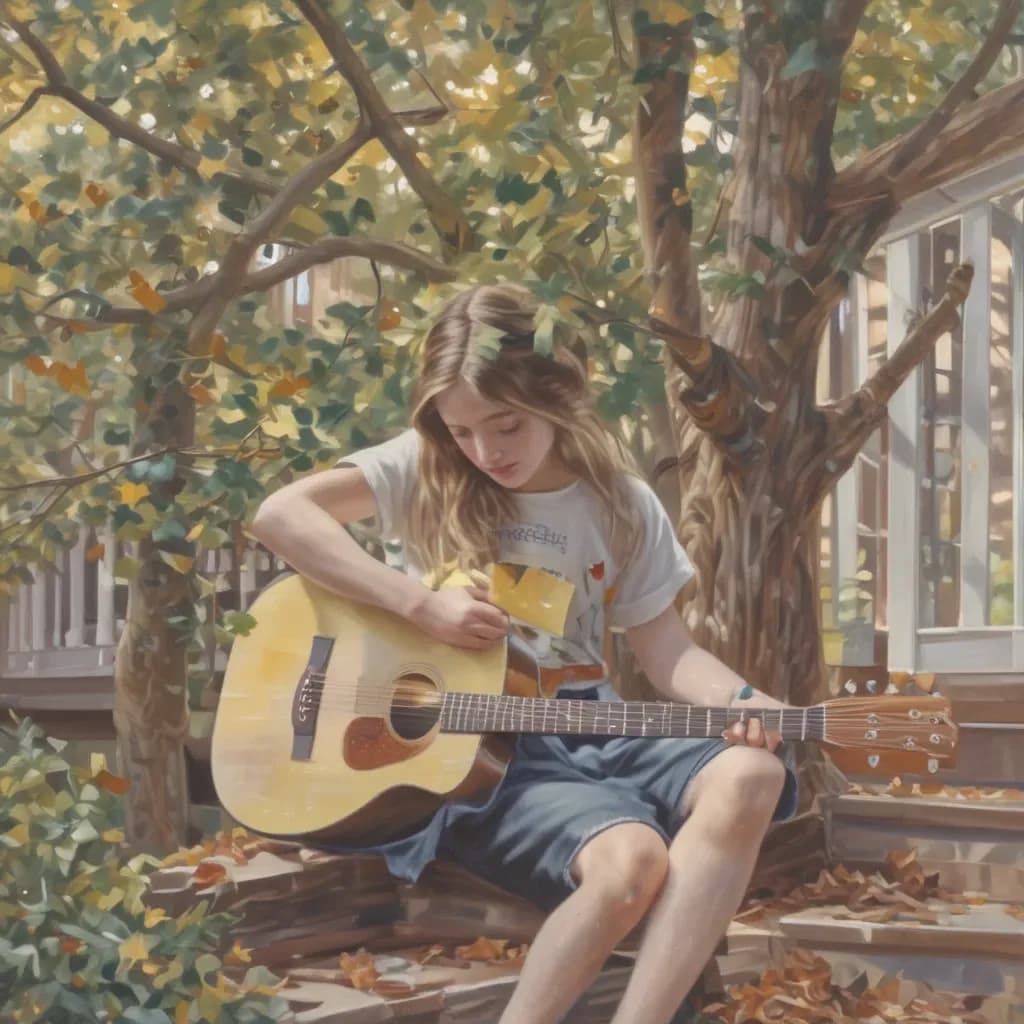
The song is built on an acoustic guitar, unhurried in its pacing, warm in its instrumentation. Produced by Brian Malouf,[2] it strips away the kind of production embellishment that might have distanced the listener from the song's emotional core. The result is something that feels intimate, almost confessional, even when it is not being confessional in a literal sense.
The narrative is essentially a one-sided conversation a young woman is having with herself after a romantic interaction has gone a bit sideways. She has gotten too excited, too demonstrative, perhaps too honest about her feelings too quickly. The person she likes now knows exactly how she feels, and that exposure carries risk. There is a palpable anxiety in the setup, the kind that only makes sense when you are still learning the social calculus of attraction and have not yet developed the armor that years of experience eventually provide.
But the song refuses to dwell in shame. The title itself functions as its moral center: you cannot blame someone for trying. The willingness to be vulnerable, to go all-in emotionally even at the risk of embarrassment, is reframed not as a failing but as a kind of courage. The narrator is simultaneously chagrined and unrepentant, which is a tricky emotional double helix to pull off, and the songwriters manage it with considerable grace.[6]
The song's emotional arc moves from self-conscious oversharing to a quiet self-acceptance. The narrator acknowledges that she probably said more than she should have, that her feelings ran ahead of the situation, that she may have inadvertently given the other person a lot of power over her happiness. And then she shrugs, warmly, not dismissively. She tried. She cannot be blamed for that.
Folk Pop as Emotional Honesty
The genre choice matters here. The folk-pop arrangement, centered on acoustic guitar with understated drums and piano, signals authenticity to a listener. This is not a song dressed up in the sonic armor of club-ready pop. It is a song that arrives with its hands out, palms up. The production style makes a promise: there is nothing here being hidden or amplified beyond its natural shape.
That choice aligns with the song's thematic argument. If the narrator is advocating for emotional openness, for the value of trying even at the risk of exposure, then the music has to model that openness. A heavily produced track would have worked against the message. The sparse acoustic sound is itself an act of sincerity.
Carpenter's voice, even at fourteen, carries a warmth that suits this approach. She does not oversell the emotion. The vocal performance is grounded, conversational at moments, rising only when the song's structure calls for it. It is the kind of singing that asks to be believed.
The Album and the Bigger Picture
Eyes Wide Open was recorded between 2013 and 2015, primarily in Los Angeles studios, and debuted at number 43 on the Billboard 200 with first-week sales of over 12,000 copies.[3] It was a credible start for a fifteen-year-old with a television platform but no prior album, and it established the tone Carpenter would work within and gradually push against over the following decade.
The album's twelve tracks blend folk-pop and teen pop with acoustic and country-influenced arrangements. Carpenter co-wrote four of them herself, a notable detail: even at this stage, she was not purely a vehicle for other people's visions. The album received generally positive notices. Brian Cantor of Headline Planet described it as "decidedly loose in construct but rich in personality,"[3] a phrase that captures something real about the record's appeal. The personality outweighs the polish.
The title track, "Eyes Wide Open," won the 2016 Radio Disney Music Award for Best Anthem.[3] The debut single took the XOXO Award for Best Crush Song at the 2015 ceremony.[1] Within its ecosystem, the album landed with exactly the force it needed to.
Alternative Readings
The song is most naturally read as a romantic narrative, but its emotional logic applies well beyond that frame. The experience of caring about something so much that you act before you have thought it through, of putting yourself out there before you are sure the ground is solid, is not specific to romance. It fits friendship, ambition, creative work, any situation where the heart outruns the strategy.
For Carpenter herself, in 2014, the song could be read as a metaphor for her own debut. Releasing music at fourteen, stepping into a public identity as a recording artist while simultaneously navigating a television career, requires exactly the quality the song describes: a willingness to try without any guarantee of how it will land. You cannot blame a girl for trying. The phrase works as pop song punchline and as a young artist's quiet manifesto.
A Beginning That Has Aged Well
In 2024, as Carpenter became one of the most talked-about pop artists in the world on the strength of "Espresso" and "Please Please Please," her early catalog experienced the kind of reassessment that accompanies sudden mainstream arrival. Fans who had discovered her through the later records went looking for the beginning, and what they found was a fourteen-year-old with an acoustic guitar and a song about being too in love to be embarrassed.[1]
The continuity is striking. The Carpenter who built a career on wit, emotional intelligence, and a complete refusal to be diminished by unflattering attention started here: with a song that argued, gently but firmly, that vulnerability is not a flaw. Trying is not a liability. The quality that makes you reach too far in the direction of something you want is also the quality that, given time and craft, gets you somewhere worth being.
Meghan Trainor wrote the song without knowing who would eventually sing it.[1] What she wrote was a portrait of a girl in the middle of the universal experience of wanting something so much it makes you a little reckless, and choosing, at the end of it, not to be ashamed of that. As origin stories go, it is a remarkably fitting one.
References
- Can't Blame a Girl for Trying - Sabrina Carpenter Wiki (Fandom) — Detailed song background, Meghan Trainor's original version, and awards
- Can't Blame a Girl for Trying - Wikipedia — Song history, songwriting credits, chart performance, and release details
- Eyes Wide Open (Sabrina Carpenter album) - Wikipedia — Album context, recording history, critical reception, and chart performance
- Can't Blame a Girl for Trying - Songfacts — Songwriting background and Carpenter's statements about the song
- Sabrina Carpenter - Wikipedia — Biographical information and career timeline
- The Meaning Behind The Song: Can't Blame a Girl for Trying - Musician Wages — Thematic analysis and contextual interpretation of the song