Centuries of Damn
There is a particular kind of exhaustion that has no clean beginning, one that feels as though it has been building not just across a lifetime but across generations. "Centuries of Damn" is Death Grips at their most atmospheric and historically conscious, a five-and-a-half-minute meditation on the weight of accumulated struggle that functions as one of the most emotionally resonant pieces in their catalog. It arrived at the tail end of a double album released by a band that had officially announced its own death, and the circumstances of its existence are inseparable from what it is trying to say.
The Album That Broke Everything and Reassembled It
To understand "Centuries of Damn," you have to understand the chaos from which it emerged. In July 2014, Death Grips announced their breakup via a photograph of a napkin posted to Facebook, canceling a planned tour with Nine Inch Nails and Soundgarden and leaving fans and critics uncertain whether they were witnessing performance art or a genuine dissolution.[1][2] The band had been operating at a pitch of controlled chaos since 2011, releasing music through unconventional channels, abandoning label obligations, and cultivating an image of radical self-determination that often shaded into open provocation.
The track appeared on Jenny Death, the second disc of The Powers That B, Death Grips' first and only double album.[3] While disc one, Niggas on the Moon, leaned into abstraction and electronics, disc two pivoted sharply toward punk and rock, recorded at Sunset Sound Studios in Los Angeles with guest musician Nick Reinhart of the math-rock band Tera Melos contributing guitar.[3] The result was not two separate projects stitched together but two emotional poles of the same psyche placed in conversation.
Jenny Death leaked online on March 19, 2015, with an official release on March 31.[3] The band that had announced its own death barely eight months earlier was suddenly, undeniably present again, and the music they brought with them was among the most emotionally direct they had ever made.
The Weight That Has No Expiration
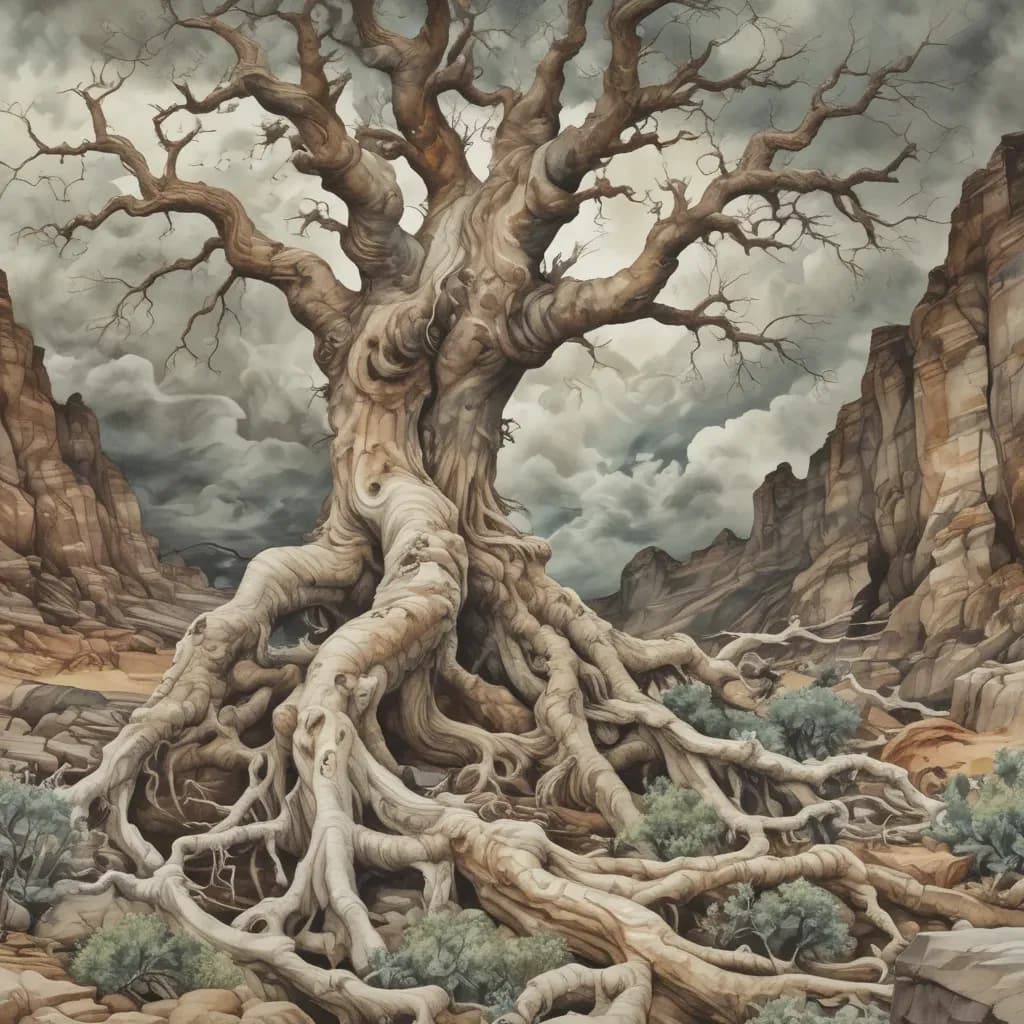
"Centuries of Damn" opens by rejecting something most people take as a natural given: the sun. This is not a casual dismissal but a visceral one, a statement of fundamental opposition to the rhythms of ordinary life, the productive daylight, and the social obligations that daylight implies. The rejection operates on multiple levels. On its surface it reads as profound alienation, the narrator positioning himself outside the ordinary cycle of waking and participating. Read with the album's larger context in mind, it functions as a refusal of surveillance, of visibility, of the expectation that one will show up and perform.
A recurring image in the song is the act of pulling oneself upright only partially, of achieving a fractional wakefulness rather than full consciousness. There is something deliberately unresolved about this. The narrator is not paralyzed exactly, but functioning at a diminished capacity, perpetually suspended between collapse and effort.[4] This is not the language of someone soliciting sympathy. It has the quality of a report from the field, delivered flatly, without particular distress. That tonal flatness is itself a form of menace.
The song's most emotionally complex territory arrives when MC Ride places extreme hostility and something resembling love in direct proximity, aimed at the same target. This pairing does not resolve into irony or absurdity. It lands as a genuine expression of the way intense feeling collapses categories, of how hatred and attachment are not opposites but gradations of the same intensity. For a band frequently described as operating in a register of pure aggression, this is a rare moment of emotional complication.
The title phrase itself does significant conceptual work. "Centuries of damn" suggests not a personal grievance but an inherited one, a condition passed down across generations. This reading connects the song's personal emotional landscape to something much larger: the historical accumulation of oppression and resistance, and the toll both take on those caught inside them.[1] Death Grips rarely make this kind of gesture explicitly, but the song's imagery of persistent struggle against forces that diminish and numb sits comfortably within a long tradition of Black American art that treats generational trauma not as backdrop but as living material.
Rock Without a Safety Net
Reviewers at Scene Point Blank noted the song's desert guitar quality, a drifting, sun-scorched texture borrowed more from post-rock and shoegaze than from hip-hop.[5] Nick Reinhart's contributions to Jenny Death are particularly legible here: the guitar does not simply accompany the electronics but pushes against them, creating a friction that keeps the song from settling into a groove. Critics at The Boar praised the way heavy distorted riffs weave between pulsating electronics and Zach Hill's intense drumming, contributing to an intimate and immersive atmosphere.[6]
The song runs over five minutes, which by Death Grips' typically compressed standards qualifies as an extended meditation. Consequence of Sound took a skeptical view, arguing that the track's length outpaces its content, comparing it to other lengthy jams in the album's latter half that fail to fully justify their runtime.[7] Bearded Gentlemen Music offered a similar assessment, placing it among the record's weaker moments.[8] These are fair observations if one approaches the song looking for the band's characteristic jagged efficiency. But the sprawl is arguably the point. The exhaustion the song describes is itself sprawling and unresolvable, and a tightly edited two-minute version would undermine what the track is actually doing.
What the song does clearly, regardless of where one lands on its pacing, is demonstrate what Death Grips might sound like if they were purely a rock band: a thought experiment their catalog occasionally permits but never fully indulges.
Before the End
"Centuries of Damn" occupies a crucial structural position on Jenny Death, sitting in the penultimate stretch before the album closes with "On GP," which reviewers widely considered the emotional core of the entire double album.[5][4] In this context, the song functions as a holding chamber, a space in which the album's accumulated tensions are allowed to breathe before they resolve. Its semi-psychedelic quality and rock-band texture provide a moment of decompression before the rawer, more personal statement that closes the record.
Pitchfork awarded Jenny Death an 8.1 out of 10, describing it as the band's strongest material in some time, while the combined release received a Metacritic score of 73 out of 100.[3] What strikes critics reflecting on the album a decade later is how much its emotional range exceeded what anyone had reason to expect from a group that spent most of 2014 performing its own annihilation. The breakup announcement turned out to be either a genuine moment of fracture that was survived or a performance of fracture that was never entirely real. Nobody, possibly including Death Grips themselves, is entirely certain which.
Other Readings
A purely autobiographical reading of the song locates its narrator as MC Ride himself, someone living through the specific turbulence of the band's most chaotic period, speaking about creative and personal disillusionment from the inside. This reading has obvious appeal and is probably partially correct.
But the song also sustains a reading rooted in systemic critique, in which the centuries of accumulated harm referenced in the title belong not to any individual but to entire communities ground down by forces that operate indifferently across generations. In this frame, the narrator's half-awake, half-alive condition is not personal pathology but a rational response to irrational conditions: a survival mode rather than a failure of will.
The two readings do not cancel each other. Death Grips have always operated at the intersection of the personal and the structural, and the ambiguity here is almost certainly intentional.
A Reckoning With Time
"Centuries of Damn" does not offer catharsis. It does not resolve. It ends, which is different. In the context of an album that was itself supposedly never going to exist, released by a band that had officially ceased to exist, this feels appropriate. The song describes a condition of persistent, inherited exhaustion that outlasts the people who carry it.
What the song offers instead of comfort is recognition: a precise articulation of what it feels like to be suspended in struggle without a clear exit, to operate at partial capacity not from weakness but under the particular weight accumulated across time. For a band consistently dismissed as noise or provocation, this is patient, complicated work. It deserves more careful attention than it often receives.
References
- Death Grips - Wikipedia — Band history, breakup announcement, and biographical context
- Death Grips Break Up - Spin — Coverage of the July 2014 breakup announcement and tour cancellations
- The Powers That B - Wikipedia — Release timeline, recording details, and critical reception for the album
- The Powers That B Review - Spectrum Pulse — Thematic arc analysis of the double album and Jenny Death's emotional climax
- Jenny Death Review - Scene Point Blank — Detailed track analysis including desert guitar quality of Centuries of Damn
- The Powers That B Review - The Boar — Praise for the guitar-driven final stretch of Jenny Death
- Jenny Death Review - Consequence of Sound — Critical reception of Jenny Death, including assessment of track lengths
- Jenny Death Review - Bearded Gentlemen Music — Critical assessment noting Centuries of Damn among the album's weaker moments