Come Up and Get Me
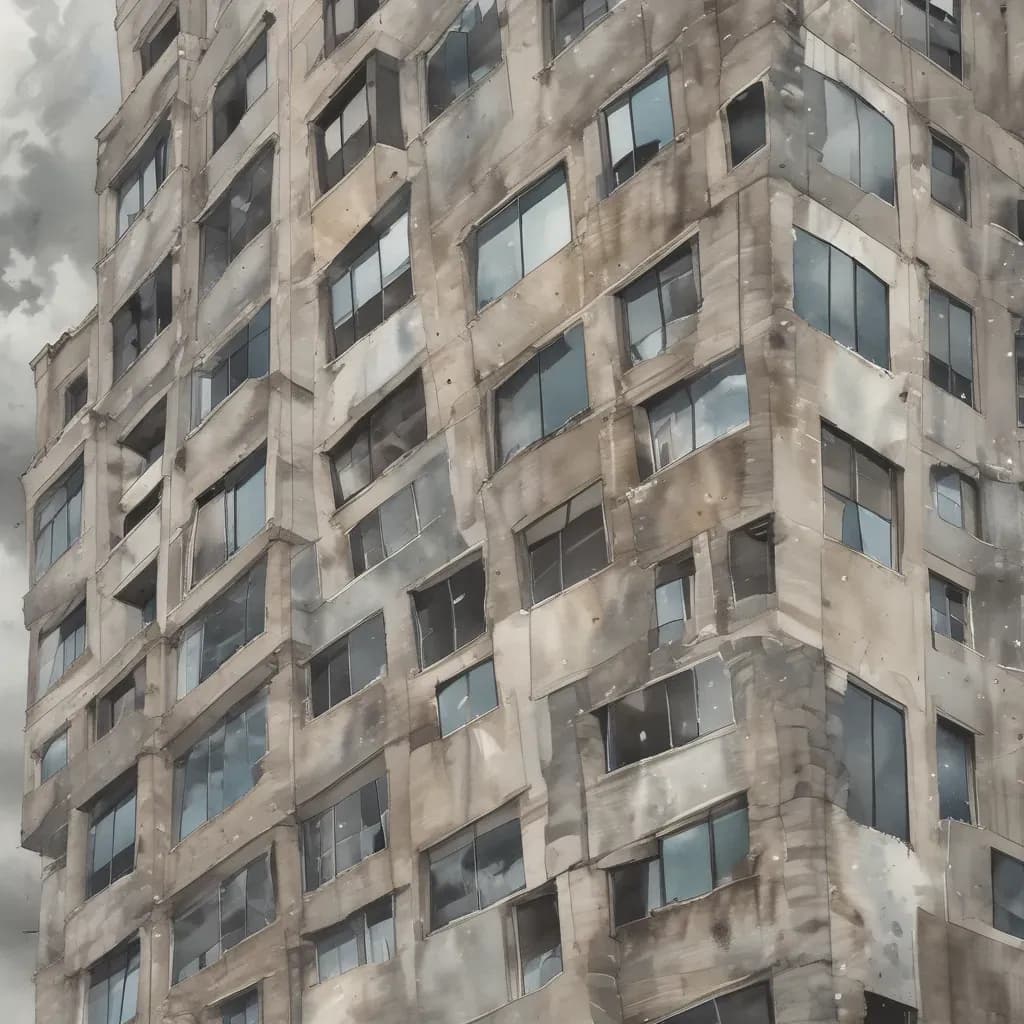
The opening track of any album announces its intentions. With "Come Up and Get Me," Death Grips do not announce so much as detonate. The song opens on a single premise: a lone figure has barricaded himself somewhere inside a decaying structure with blacked-out windows, and rather than flee whatever is closing in, he has decided to dare it forward. It is an act of territorial defiance so absolute it crosses into something resembling a death wish.
This is the song that sets the terms for all of No Love Deep Web, and those terms are: siege, isolation, and the strange power that comes from having nothing left to protect.
A Record Made Under Pressure
No Love Deep Web was recorded between May and August 2012 at the Sacramento apartment MC Ride and Zach Hill shared at the time.[1] The band had cancelled their supporting tour for The Money Store to retreat and make this record. Zach Hill played every beat live on a Roland electronic V-drum kit or acoustic drums, with no manually programmed sequences anywhere on the album. The result is a visceral, physical percussion that sounds more like a body under stress than a machine keeping time.[1]
The circumstances of the record's release are inseparable from its content. Death Grips had signed to Epic Records (a Sony subsidiary) earlier that year. When Epic refused to authorize a release date and pushed the album toward 2013 without the band's approval, Death Grips responded on October 1, 2012 by releasing the album for free themselves, announcing that the label would be hearing it for the first time alongside everyone else.[2] It was downloaded more than 34 million times via BitTorrent in its first weeks. Epic issued a cease-and-desist. Death Grips published the label's private emails on Facebook. By November, they had been dropped.[1]
The first thing listeners heard as they discovered what the band had done was "Come Up and Get Me": a narrator barricaded in a building, taunting his enemies to enter. The timing was not accidental.
The Chateau Marmont Equation
The music video for "Come Up and Get Me" was filmed at the Chateau Marmont, a legendary luxury hotel in Los Angeles where rooms run at several hundred dollars per night.[3] Death Grips had spent a significant portion of their Epic advance living there. Zach Hill explained the choice in deliberately clear terms: they stayed at the Chateau Marmont to mirror the people they were working with and learn about the culture that was, in his words, "somewhat in control of our destiny at that point."[3]
This was infiltration as methodology. The band embedded themselves in the exact milieu of the industry executives and entertainment class they resented, studying the environment with the eye of people who intended to use what they learned. The footage they shot there, self-directed by Burnett and Hill, became a 13-minute short film released in January 2013.[4]
The video runs almost entirely in silence for its first several minutes. It depicts MC Ride in his hotel room: smoking, eating flowers, climbing on balconies, hanging upside down in hallways, balancing furniture on a bed. The imagery is quietly surreal, shot in black and white, with the particular unease of a surveillance feed. One reviewer compared its visual register to The Ring. The track itself does not enter until approximately the eight-minute mark, arriving as an eruption into the silence.[4]
The conceptual inversion is precise. The Chateau Marmont, a place associated with celebrity comfort and industry deal-making, becomes the stage for behavior that makes it strange and threatening. The luxury hotel suite is the abandoned building. The suite is the barricade. The narrator who dares his pursuers to come and get him is simultaneously the band member burning through label money in a hotel that belongs to the people who control him.
Isolation as Sovereignty
The central imaginative act of the song is the transformation of isolation into a kind of sovereign territory. The narrator has withdrawn from any conventional social framework. He has made wherever he is a fortress. Rather than waiting for the threat to breach it, he goads it forward.
The song's imagery of schizophrenic internal states blurs the line between external threat and internal dissolution.[5] The adversaries closing in may be institutional forces (the label, the industry, the surveillance apparatus of the state) or they may be projections of a fragmenting mind. The song refuses to resolve this ambiguity. Both readings are available simultaneously. The narrator is a man under real siege and a consciousness consuming itself, and the song does not let you distinguish between them.
What makes the song's posture unusual is the specific quality of its defiance. This is not a triumphalist track. The narrator does not claim to be winning or to have a plan. He is simply refusing to move. The act of choosing where he stands has converted the location from a trap into a stronghold. The dare at the center of the song belongs to someone who has given up on survival as a goal. Come and get me means: you will not find someone afraid.
MC Ride's vocal performance throughout the track reinforces this reading. Critics and listeners consistently note that the delivery sounds less like a performance than like authentic emotional fracture, someone who has actually lost the distance between themselves and the material.[5] Whether or not that is literally true, it is what the recording conveys. The listener cannot determine, from inside the song, whether the narrator is a visionary or a casualty.
Before the Vocabulary Existed
"Come Up and Get Me" arrived in October 2012, roughly eight months before Edward Snowden's NSA revelations would make government surveillance an unavoidable subject of mainstream conversation. No Love Deep Web as a whole, and this track in particular, feels pre-cognizant of that cultural moment. The album's deep web imagery, its references to being monitored, its claustrophobic paranoia about tracked movement and compromised communications, all arrived before the general public had the vocabulary to describe what it feared.[6]
The World Socialist Web Site's review of the album highlighted its authentic capture of information-age alienation, describing the record as reflecting how trapped and powerless young people felt within systems of corporate and governmental surveillance, while also noting that Death Grips offered no constructive framework for understanding or moving beyond the conditions they described.[6] That criticism is fair in its way. "Come Up and Get Me" does not offer a solution. It offers a posture. Whether a posture is sufficient is a question the song declines to answer.
A 2022 retrospective on the album's tenth anniversary called the self-leak "probably the most blatant subversion of a major label in the digital age" and described the record as a pure distillation of the band's essence, noting it was chronically undervalued even within Death Grips' own catalog.[7] As an opening track, "Come Up and Get Me" bears a particular weight in that context. It is not only the first song on the album but the first statement of what the album costs to make.
Hero or Casualty
The most lasting tension in the song is whether its narrator is heroic or broken. The defiant reading places him in a long tradition of resistors and refuseniks, people who chose the dignity of refusal over the humiliation of compliance. The psychological reading sees someone in the grip of a paranoid episode, constructing an adversary to give form to internal chaos, interpreting ordinary threats as existential invasions.
Death Grips, characteristically, offer no guidance on which reading to apply. The song does not frame its narrator as pathetic, nor does it celebrate him as a hero. It simply stays inside his perspective, which is the most disorienting choice available. The listener inhabits a mind that may be the last man standing or the last man standing before the end, and the song sees no reason to specify which.
This indeterminacy is arguably the track's most significant formal achievement. A song that resolved into either triumph or tragedy would be easier to consume and easier to forget. By leaving the question open, "Come Up and Get Me" remains genuinely uncomfortable to sit with, which is precisely what makes it worth returning to.
The Invitation That Opens Everything
"Come Up and Get Me" opens No Love Deep Web like a declaration of terms. It establishes who the narrator is, what he has given up, and what he is willing to face. Everything that follows in the album flows from the position staked out here.
That this song was recorded in a Sacramento apartment, filmed in a luxury hotel on someone else's money, and released in an act of deliberate contract-breaking, makes it one of the more coherent pieces of conceptual work to emerge from early 2010s independent music.[8] The form and content are not separable. The album's opening dare is simultaneously its creation story.
Whatever is coming for the narrator has been invited to arrive. That is the entirety of the song's argument, and it is enough.
References
- No Love Deep Web - Wikipedia — Recording context, release controversy, and critical reception
- Death Grips Leak 'NO LOVE DEEP WEB' - Vice — Contemporaneous coverage of the self-leak and Epic Records conflict
- Death Grips Film 'Come Up and Get Me' at Chateau Marmont - SPIN — Zach Hill's statement on the Chateau Marmont residency and the short film
- Death Grips 'Come Up And Get Me' Short Film - Stereogum — Coverage and description of the 13-minute self-directed short film
- Come Up And Get Me - Death Grips Wiki (Fandom) — Song-specific thematic breakdown and lyrical imagery analysis
- Death Grips: No Love Deep Web - A Terminally Destructive Message - World Socialist Web Site — Cultural analysis of the album's paranoia, alienation, and pre-Snowden surveillance themes
- Ten Years Of No Love Deep Web - Boiler Rhapsody — 10th anniversary retrospective on the album's legacy
- Death Grips - Wikipedia — Band biography, discography, and career context