Dancing in the Street
Few records sound as much like an open door as this one. Within seconds a pounding beat, a bright horn line and a voice with no interest in whispering all tell you the same thing: leave the house, the party is outside. It is one of the most joyful singles Motown ever released, and it is also one of the most argued over, because a song that invites an entire country to move together can be heard in more than one way.
A fire hydrant, a tire iron and a secretary
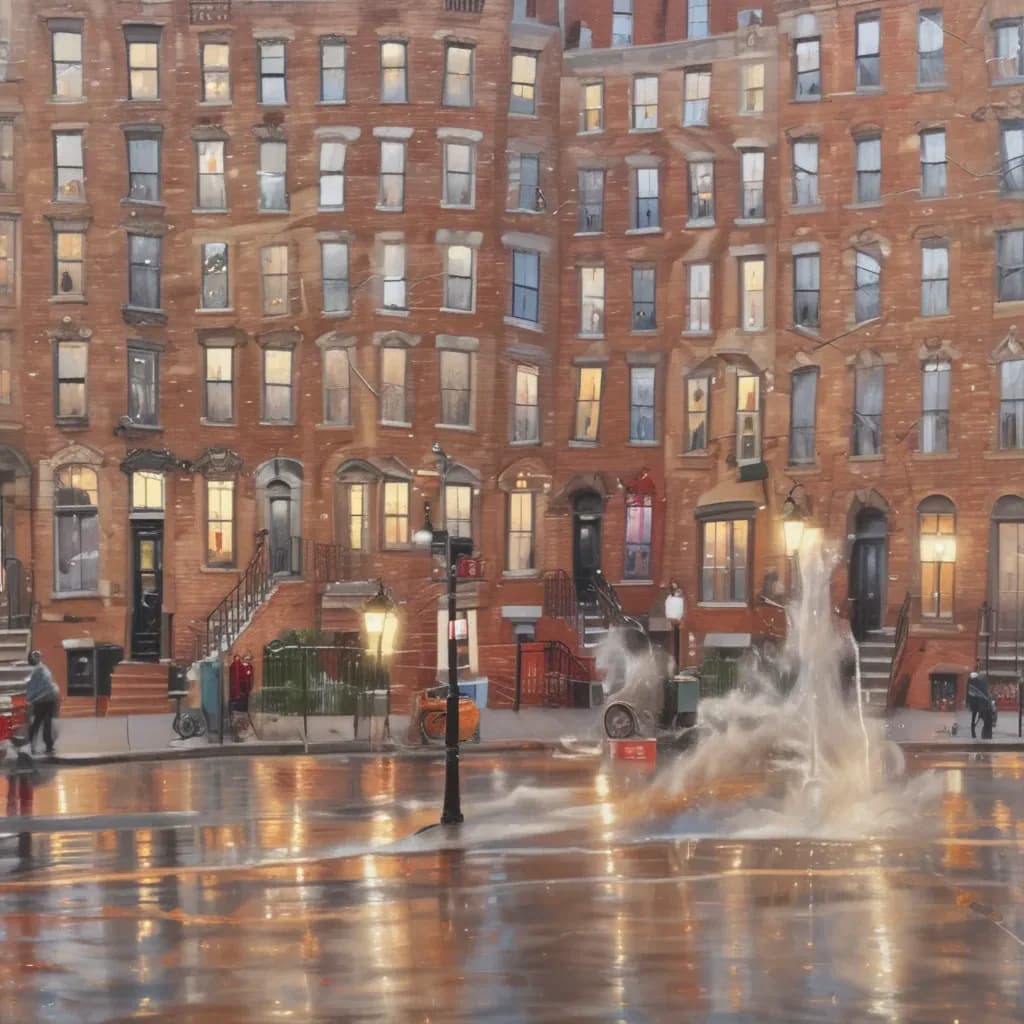
The song was written in 1964 by Marvin Gaye, William "Mickey" Stevenson and Ivy Jo Hunter, with Stevenson producing.[2] Stevenson's spark was an ordinary summer scene in Detroit: children opening fire hydrants to cool off, with people leaping in and out of the spray in a way that looked a lot like dancing.[1] Gaye, hearing an early version, thought the tempo was sluggish and pushed Stevenson to speed it up.[1]
Gaye's first instinct for the song was also different from where it ended up. By Martha Reeves's recollection, Gaye sang the demo as something close to a love song, while she pictured block parties and Mardi Gras and asked to sing it her own way.[2] She also admitted that she first found the song too repetitive, and Hunter was brought in to help build out the musical composition.[2]
Reeves had a particular stake in all this. Before she was a star she had worked as Stevenson's assistant at Motown,[1] and the Vandellas themselves had grown out of a Detroit girl group called the Del-Phis, reshaped by Motown into a trio with a new name.[5][6] By 1964 they had already scored hits, but nothing on the scale of what happened next.
The recording was done in two takes on June 19, 1964, at Motown's Hitsville U.S.A. studio.[2] The sound was built from the label's house band, the Funk Brothers, with James Jamerson on bass. Gaye himself played drums, and Hunter struck a tire iron to give the downbeat its metallic crack.[2] That improvised percussion is a big part of why the record feels less like a polished studio product and more like something being hammered out in a garage while the neighborhood gathers.
The invitation
Set the history aside and listen to what the lyric actually does. It never tells a story about a particular person. There is no heartbreak, no rival, no named love interest. Instead the narrator makes a sweeping announcement and then keeps widening the circle. The song calls out to everyone, lists one city after another as if reading the stops on a national tour, and eventually brings the invitation home to Detroit by name.[2] The message is that wherever you are, the same thing is happening, and you are welcome to join it.
That structure is what makes the song feel generous. A typical pop single narrows its focus to one relationship. This one expands outward until the whole map is included. The street, rather than a club or a ballroom, is the venue, which means there is no door fee, no guest list and no one to ask permission from.
The vocal delivery sells it. Reeves does not sing like someone making a polite suggestion. She sings like someone who has already started dancing and is calling you over. The backing vocals, which included Betty Kelly and Rosalind Ashford along with Stevenson and Hunter,[2] answer her like a crowd that has already arrived. The arrangement keeps the energy building without ever resolving into a single big climax, which suits a song about something that is meant to keep going.
Summer, heat and release
A second theme sits underneath the invitation: the pressure valve of summer. The imagery of heat and the promise that the season itself has given everyone a reason to cut loose ties back to Stevenson's original image of kids soaking themselves in the hydrant spray.[1] In a city where the work was often hard and the weather could be punishing, dancing in public was a shared way to let that tension out.
There is a second kind of release at work as well. The song gives permission for ordinary people to take up space together. Nobody is performing for anyone else, and nobody is excluded. Dancing here is both private pleasure and public act, and the track makes no distinction between the two.
Why it became something larger
The record came out on July 31, 1964, on Motown's Gordy label,[2] in the middle of one of the most turbulent summers of the civil rights era. It climbed to number two on the Billboard Hot 100, held back only by Manfred Mann's "Do Wah Diddy Diddy."[2] In the UK it reached number 28 on first release, then returned in 1969 and climbed to number four.[2]
Almost immediately, listeners began hearing a second song inside the first. When a lyric calls on a whole nation to gather in the streets, it is hard for that not to echo with the protests and marches that were filling those same streets. The political reading is usually traced in part to activist H. Rap Brown of SNCC, who reportedly played the record while organizing demonstrations.[1]
Reeves herself was careful about this over the years. She described the mid-sixties as a very bad time across the country, with riots breaking out, and said the writers hoped to get people dancing and happy in the streets instead of fighting in them.[1] In public in the sixties she rejected the idea that it was a protest song, though she knew it could be read that way.[1] That tension is the interesting part. The song was designed as pure fun, and it became political precisely because its idea of public joy was so inclusive.
Later artists seemed to hear it too. The Rolling Stones' "Street Fighting Man" in 1968 reworked the song's signature call into something far more confrontational, a sign of how easily the same idea could be turned toward conflict instead of celebration.[2]
Where it sits on the album
The single was the lead release from the group's third album, Dance Party, issued in April 1965 and made up mainly of dance tunes.[3] The record was produced by Stevenson, with several tracks from Holland, Dozier and Holland, and it spun off two more singles, "Wild One" and "Nowhere to Run."[3] One review has called it one of the great party albums of the sixties and noted that the group had not previously measured up in the LP format.[4]
Seen that way, the song is the thesis statement for the whole project. An album titled Dance Party needs a track that explains what the party is, who is invited and where it is held, and this one does all three in under three minutes.
Alternative readings
There are several ways to hear the song beyond the plain dance-floor invitation.
One is the civil rights reading described above, in which the street becomes a stage for collective presence and public claim-making. Another is a more local reading, in which the song is a love letter to Detroit, the Motor City whose factory rhythms and neighborhood block parties shaped Motown's whole sound. A third is simply as a seasonal ritual, a song about what communities do when the heat arrives and there is nowhere better to be than outside.
None of these cancel out the others. The song is open enough to hold all of them, which is probably why it has proved so durable.
A song that kept moving
The recording was inducted into the Grammy Hall of Fame in 1999 and preserved in the National Recording Registry in 2006.[2] Other artists have kept returning to it, with mixed results. The Kinks' 1965 attempt was panned, the Mamas and the Papas took it to number 73 in the US in 1966, and Van Halen reached number 38 in 1982.[2] The most famous remake came in 1985, when David Bowie and Mick Jagger took their version to number one in the UK and number seven in the US.[2]
Those covers tend to underline what the original does so well. Most of them add swagger or irony. The Vandellas version has neither. It simply asks, with total conviction, that everyone come outside and move, and the plainness of that request is what has carried it across six decades.
Conclusion
"Dancing in the Street" began as a picture of children playing in the water from an opened hydrant and became a record that people have used to describe joy, solidarity and defiance. Its power lies in how little it asks of anyone. There are no tickets, no rules and no performance required, only a willingness to show up.
Reeves, Stevenson, Gaye and Hunter set out to make a good dance record, and they succeeded so thoroughly that the world kept finding new rooms inside it. Whenever a crowd wants to remind itself that public space belongs to the people in it, the song is still ready to play.
References
Keep reading
More Motown
- Tracks of My Tears The Miracles
- Ball of Confusion (That's What the World Is Today) The Temptations
- Cloud Nine The Temptations
- Love Child Diana Ross & the Supremes
- Reflections Diana Ross & the Supremes
- Baby Love The Supremes