DeAnn's Denim
Some songs earn their right to be short. At just two minutes and forty-one seconds[1], “DeAnn’s Denim” doesn’t waste a syllable. It opens on a simple acoustic guitar pattern, and then Zach Bryan begins working through something that is not quite a memory and not quite a confession -- somewhere between the two, in the space where inherited grief lives.
The title is where the song’s intelligence announces itself. “DeAnn” is his mother’s middle name, the name he placed on his 2019 debut album as a form of tribute and survival. “Denim” refers to cloth, to jeans, to the physical artifact of a person’s life. But denim sounds like genes. The wordplay is the point[2], and the entire song is built around it: you wear what your mother gave you, whether you choose to or not.
A Life Shaped by Loss
Annette DeAnn Bryan died on August 3, 2016, when her son was twenty years old. Her death, connected to complications from long-term alcohol abuse, left a gap in Zach Bryan’s life that has never fully closed and that he has never pretended to close[3]. From the beginning, his career has been an act of returning to her: the debut named for her, the grief scattered across every subsequent record, the wound that keeps informing how he writes.
“With Heaven On Top,” Bryan’s sixth studio album, was released January 9, 2026, debuting at No. 1 on the Billboard 200 with 134,000 album-equivalent units in its first week[1]. It was recorded across three houses in Oklahoma during the winter of 2025 with his touring band[4] -- an approach Bryan described as feeling like making music with his closest friends again, something more intimate than the enormous productions his commercial success might otherwise demand.
The album arrived at a period of significant personal transition. Bryan had stopped drinking in late 2025[4], a fact that transforms the album’s relationship to its grief and gives “DeAnn’s Denim” an acute autobiographical charge. And nine days before the album’s release, on December 31, 2025, he married Samantha Leonard in a private ceremony in San Sebastian, Spain[5]. Leonard’s custom wedding dress incorporated details honoring his late mother[6] -- a gesture that runs through the fabric of the album’s own emotional architecture.
“DeAnn’s Denim” sits fourth in the record’s tracklist[1]. Its placement matters: it arrives early enough to establish the album’s emotional center of gravity before the record expands outward into political and philosophical territory.
What’s Hidden in the Title
The denim-as-genes conceit is the song’s organizing metaphor, handled with understatement. Bryan doesn’t announce it. He lets the title do the conceptual work and then allows the song to inhabit it naturally. This is a technique he uses throughout his songwriting: reach for the image that holds the idea, and then trust the listener to follow.
Clothes as inheritance is not a new metaphor in literature or in song. What Bryan does with it is make it specific. These are not clothes in the abstract. They are his mother’s clothes, and to put them on is to feel, physically, what it meant to be close to her -- and to understand, with adult clarity, what she was carrying when she wore them.
Multiple analyses of the song have identified the denim-genes wordplay as central to its meaning[2][7]. Placing a dead parent’s clothes in a metaphorical position where they simultaneously represent genetic inheritance is a striking compression of the double nature of addiction: you can see it as something outside yourself, a material thing you could choose to pick up or set down, and also as something already inside you, woven in.
Wearing What You Inherited
The core argument of “DeAnn’s Denim” is about alcoholism as something absorbed rather than strictly inherited. The song does not explore clinical genetics. It explores proximity. Growing up alongside a parent’s addiction teaches things that biology never explicitly hands down: what numbing feels like, why people reach for it, how the glass offers something that nothing else quite replaces.
One of the song’s most emotionally honest moments comes when the narrator admits to missing the mental freedom that drinking once brought -- specifically, the way alcohol could quiet a mind that won’t stop running[2]. This is not nostalgia for the bottle. It is a precise and honest account of its appeal. Bryan captures this without softening it and without condemning it. He is describing something true about why cycles repeat across generations.
The song doesn’t ask why she drank. It doesn’t judge. It asks what you do with the fact that you understand exactly why she did.
Bryan has spoken about his mother’s death reshaping him at a foundational level, forcing a kind of emotional self-sufficiency that has been both a strength and a wall. He has said with characteristic directness that the person he would most want to tell his inner thoughts to is gone -- and that no one else has earned that access in the same way[3]. “DeAnn’s Denim” is, in part, one of those things he is saying to her through the only channel still available.
The Closet and the Absent Voice
The song’s central question -- did you become what your mother wanted you to be? -- carries within it the unbearable condition of grief: you don’t get to know the answer. She’s not there to say. You can only guess, based on incomplete evidence, what her assessment would have been.
Bryan has described how his mother recognized his musical talent early and encouraged it[3]. In that sense, he did become what she saw in him. But the song doesn’t let the easy version of that answer land softly. It sits with the uncertainty, with the parts of a self that are less defensible -- the inherited shadows alongside the inherited gifts.
The jeans as a physical object carry both. They are her. They are what she left. They are also everything she was carrying when she wore them.
The Blue Jeans on the Floor
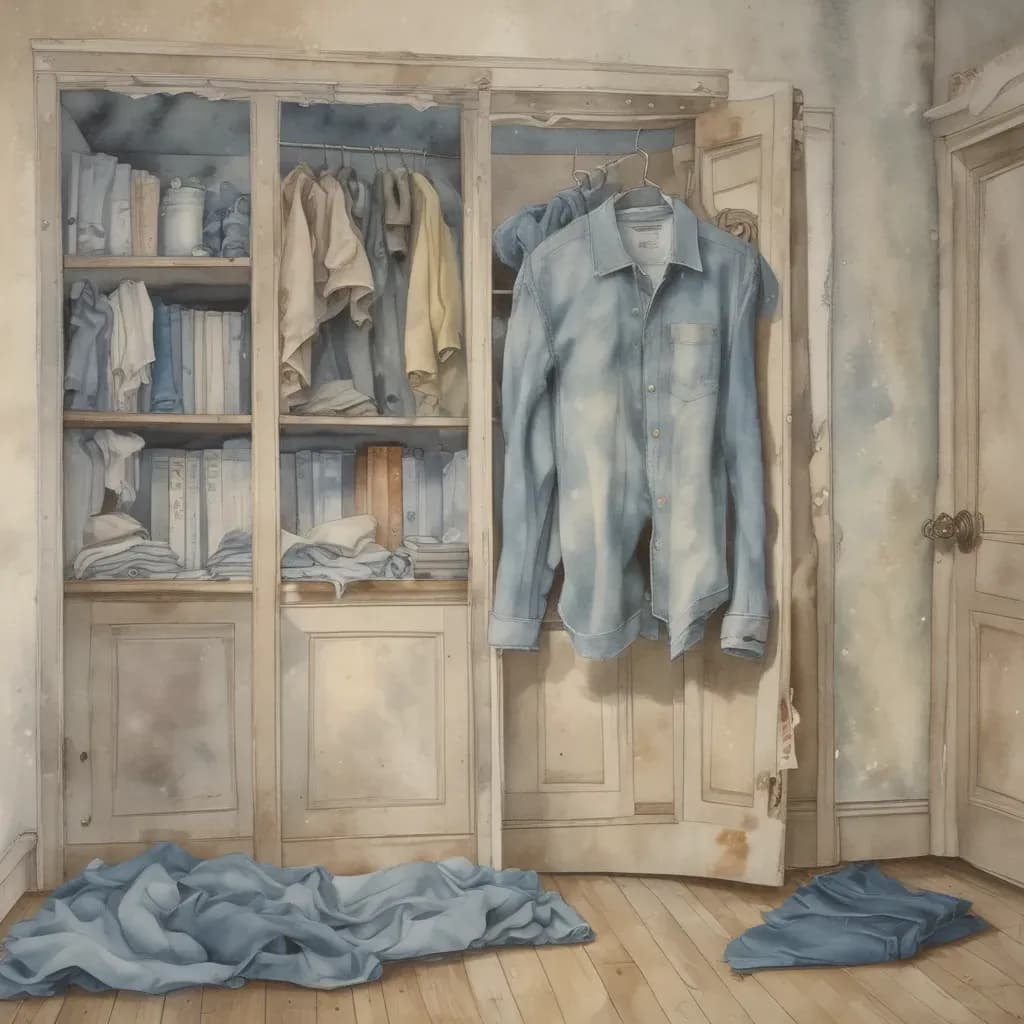
The song’s final gesture -- discovering old jeans in a closet and putting them on the floor -- is the closest thing it has to resolution, and it is a deliberately ambiguous one. This is the physical act that follows grief: going through what someone left behind, deciding what to do with it.
In one reading, the act of throwing the jeans down is a release. It is the conscious choice to stop carrying what your parent could not put down. Bryan’s sobriety, achieved in the months before this album, makes that reading feel autobiographically grounded.
But the jeans are still there, on the floor. They haven’t disappeared. This is the version of closure that Bryan tends toward in his writing: not resolution, but reckoning. The thing is still present. You’ve just stopped putting it on.
Where It Fits
“DeAnn’s Denim” arrives early in an album that is, in part, about the costs of carrying a version of America that no longer serves you. The more overtly political tracks interrogate the American promise from the outside. This song interrogates it from the inside, from the family. What do you inherit? What do you discard? What can’t you separate from yourself even when you want to?
Saving Country Music called it “Zach Bryan songwriting at its finest”[8], while Stereogum cited it as one of the album’s examples of “cathartic beauty”[9]. For critics navigating an album that runs 78 minutes across 25 tracks, that kind of clear emotional statement stands out. Paste Magazine noted that somewhere inside the album’s sprawling runtime is “a great record about maternal loss, addiction across generations, faith, and the American Dream”[10]. “DeAnn’s Denim” is one of the places where that record is most fully itself.
The song’s stripped-down musicality -- light acoustic picking, piano, distant horn elements -- recalls Bryan’s earlier, more minimalist work and contrasts productively with the album’s more expansive moments. Atwood Magazine described the album overall as “a bruising, deeply human companion to modern American life”[11], and this track is among its most bruising and most human.
Another Way to Hear It
Not everyone brings biographical context to a song. For a listener who doesn’t know about Annette DeAnn Bryan, “DeAnn’s Denim” still works as a meditation on inheritance more broadly -- on the ways you are shaped by the people who raised you, for good and for ill, in ways you can’t fully see until you’re standing in front of an open closet wondering what to do with what they left behind.
The question “did you become what your mother wanted?” has universal reach. It’s the question adult children ask across every kind of family and every kind of loss. Bryan’s particularity -- the addiction, the specific grief, the specific name -- makes it more universal rather than less. The more precise the wound, the more people recognize it.
Others have read the song’s closing gesture as genuinely open-ended: throwing jeans on the floor doesn’t necessarily mean you’re done with them. It could be temporary. It could be the beginning of letting go rather than the completion of it. Bryan, characteristically, leaves that open.
Conclusion
“DeAnn’s Denim” is two minutes and forty-one seconds of Zach Bryan working through the particular shape of his grief and finding, in the process, a way to speak about something most people only feel in silence. It is a song about becoming, about what gets handed down, about the difference between understanding a pattern and repeating it.
The fact that Bryan recorded it in the same period he was choosing to get sober gives the song a quiet urgency. He is not just describing the closet. He is standing in front of it. The old jeans are on the floor. Whatever comes next is still unclear, but the act of putting them down -- of naming them, of seeing them whole -- is the beginning of something different.
His mother’s name is in the title. Her memory runs through every stitch. And the song ends not with closure exactly, but with the kind of honesty that is its own form of keeping someone alive.
References
- With Heaven on Top (Wikipedia) — Album tracklist, runtime, chart performance, and release details including DeAnn's Denim as track 4 at 2:41
- DeAnn's Denim by Zach Bryan: Lyrics and Meaning — Primary lyrical and thematic analysis, including the denim/genes wordplay and key emotional moments
- Zach Bryan Shares How His Mother's Death Changed His Outlook — Bryan's own statements about his mother's death, her recognition of his talent, and emotional repression
- Zach Bryan's New Album: What We Learned — Biographical context including Bryan stopping drinking and the recording environment in Oklahoma
- Zach Bryan Married Samantha Leonard — Confirmed wedding date of December 31, 2025 in San Sebastian, Spain
- Zach Bryan Shares Heartfelt Note to His Late Mother About His Wedding Day — Details of the wedding dress incorporating honors to Annette DeAnn Bryan
- Zach Bryan 'DeAnn's Denim': Meaning and Review — Song meaning analysis and review, corroborating the central inheritance metaphor
- Album Review: Zach Bryan's 'With Heaven On Top' — Called DeAnn's Denim 'Zach Bryan songwriting at its finest'; rated album 7.6/10
- Premature Evaluation: Zach Bryan 'With Heaven On Top' — Cited DeAnn's Denim as an example of the album's 'cathartic beauty'
- Zach Bryan 'With Heaven On Top' Review — Noted the record contains 'a great record about maternal loss, addiction across generations, faith, and the American Dream'
- Zach Bryan 'With Heaven On Top' Album Review — Described the album as 'a bruising, deeply human companion to modern American life'
- Zach Bryan 'With Heaven On Top' Review — Rolling Stone album review covering the record's scope and emotional range