A Ballad for the Stubbornly Alone
Some songs catch you off guard. They arrive dressed as one thing and turn out to be something else entirely. "Desperado" opens with the imagery of a lone figure on the frontier, a renegade riding hard against the world. But within moments, the song reveals itself as something far more intimate: a plea from one friend to another, urging them to stop running from the very thing they need most.
Written by Don Henley and Glenn Frey, "Desperado" became one of the Eagles' most enduring compositions, despite never being released as a single.[1] It is a song about emotional self-exile, wrapped in the mythology of the American West. More than fifty years after its release, it continues to find new audiences because its core question never stops being relevant: why do people choose loneliness when love is standing right in front of them?
Origins: A Song That Took Years to Find Its Shape
The roots of "Desperado" stretch back to 1968, years before the Eagles even existed. Don Henley began working on a melody inspired by the parlor songs of Stephen Foster and the vocal style of Ray Charles.[1] The original version was addressed to a friend named Leo, with an opening line that called out his name directly.[2] It sat unfinished for years, a promising fragment without a home.
Everything changed in late 1972. The Eagles had just returned from London, where they recorded their self-titled debut album under producer Glyn Johns. Henley and Frey, who had been contributing songs separately, decided to try writing together.[3] As Frey later recalled in a 2003 interview with Cameron Crowe, Henley sat down at the piano and played him the unfinished piece. Frey immediately recognized its potential.[4]
Henley described Frey's contribution in characteristically generous terms: his partner "leapt right on it, filled in the blanks and brought structure" to what had been a shapeless idea.[4] The character of Leo was replaced by the more evocative figure of the desperado, and the song's direction locked into place. Within days, the pair also completed "Tequila Sunrise." It was the beginning of one of the most productive songwriting partnerships in rock history.[1]
Henley later acknowledged the musical DNA running through the song, noting that when he plays and sings it, he thinks of "Ray Charles and Stephen Foster. It's really a Southern gothic thing, but we can easily make it more Western."[2] The piano introduction, in fact, borrows its structure from Ray Charles's arrangement of "Georgia On My Mind."[1]
Recording Under Pressure
"Desperado" was recorded at Island Studios in London, with members of the London Philharmonic Orchestra providing the lush string arrangement.[4] The orchestral parts were written and conducted by Jim Ed Norman, a friend of Henley's from his pre-Eagles band Shiloh.[1]
The sessions were not easy for Henley. In a 2015 interview with Mojo, he described being "a nervous wreck" in the studio, standing in a cavernous room with a full orchestra arrayed behind him. The classical musicians, accustomed to more demanding material, were visibly bored. Some had brought chessboards and played between takes.[4] Producer Glyn Johns, characteristically economical, limited the vocal recording to roughly four or five takes.[4]
Henley has never been fully satisfied with his vocal performance on the track, feeling the pressure of the moment prevented him from delivering his best.[4] It is one of those revealing ironies of popular music: the performance that the singer considers imperfect is the one millions of listeners consider definitive.
The Western Metaphor: Outlaws and Emotional Fugitives
"Desperado" exists within the larger conceptual framework of the album that shares its name. The record was built around the mythology of the Old West, loosely inspired by the story of the Dalton Gang, a group of outlaw brothers from the late 19th century.[5] The idea emerged from conversations among Frey, Henley, Jackson Browne, J.D. Souther, and Ned Doheny, who saw parallels between frontier outlaws and the rock musicians of their own era.[5]
But where much of the album plays with cowboy imagery in service of stories about rebellion and rambling, the title track turns the metaphor inward. The desperado of this song is not robbing banks or riding across open plains. He is someone who has built emotional walls so high that he can no longer see over them. The Western trappings serve as a disguise for what is essentially a conversation about the fear of intimacy.
The song is structured as an address from a concerned observer, possibly a close friend or a former lover, to someone who has spent too long playing a role. The figure being addressed has styled himself as a tough, independent loner, but the narrator sees through the act. What looks like freedom is actually a prison. What looks like strength is really fear.
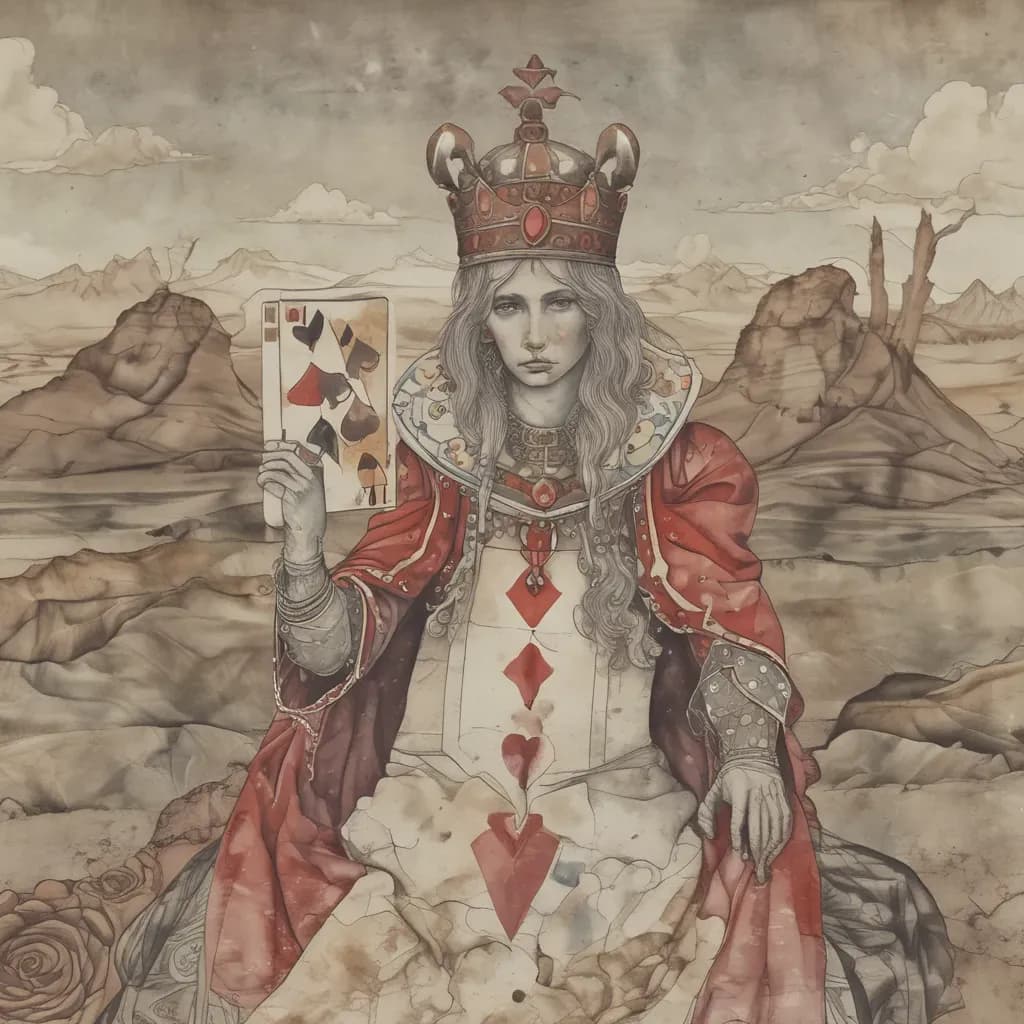
The Gambler Who Won't Play the Hand That Matters
One of the song's central images involves a card game. The desperado is presented as someone who understands risk and reward in the abstract, someone familiar with the language of high stakes and calculated bets. But when it comes to the most important wager of all, opening himself up to genuine human connection, he folds every time.[6]
The narrator gently points out that the desperado keeps reaching for things that glitter but carry no real warmth. He surrounds himself with distractions and superficial pleasures while avoiding the deeper satisfaction that comes from allowing someone in. There is a quiet frustration in the narrator's voice, the exasperation of someone who has watched a friend make the same mistake over and over, choosing the thrill of the chase over the comfort of arrival.
The song also carries a strong sense of time passing. The narrator warns that the desperado's window is not infinite. The imagery shifts toward winter, toward coldness, toward a future in which the choice to remain alone will no longer feel like a choice at all but simply the way things turned out. There is an urgency beneath the song's gentle surface, a reminder that emotional stubbornness has consequences that compound with time.
A Hit That Never Was (And Didn't Need to Be)
In a remarkable twist, "Desperado" was never released as a single.[1] The album itself was the Eagles' lowest-charting release, debuting at number 145 on the Billboard 200 and peaking at number 41.[5] Both singles pulled from the record, "Tequila Sunrise" and "Outlaw Man," failed to crack the top 50.[5] By conventional metrics, the album was a disappointment.
Yet "Desperado" the song transcended the commercial fortunes of its album. Its rise in public consciousness was aided significantly by Linda Ronstadt, who recorded a cover version in 1973.[1] At the time, Ronstadt had a larger audience than the Eagles, and her rendition introduced the song to listeners who might not have encountered it otherwise. Henley himself acknowledged that the song did not truly become a hit for the Eagles until Ronstadt's version brought it wider attention.[2]
This is fitting, in a way. "Desperado" has always been a song that works through quiet persuasion rather than force. It did not need the machinery of a single release or heavy radio promotion. It found its audience the way the best songs often do: through word of mouth, through covers, through the slow accumulation of meaning in listeners' lives.
The Song as Self-Portrait
There is a long tradition of reading "Desperado" as autobiographical, and Henley has done little to discourage it. The Eagles of 1972-73 were young men living fast in Los Angeles, surrounded by the temptations of the Laurel Canyon scene. The song can be heard as Henley writing to himself, or to his bandmates, or to an entire generation of young men who confused recklessness with independence.[3]
Don Henley later praised Frey's contributions in warm terms, noting that his partner "wrote some pivotal lines that I wouldn't have thought of in a million years."[7] The collaboration brought out something in both writers that neither could have achieved alone. Henley supplied the emotional core and the melody; Frey provided the narrative architecture and the lyrical precision that kept the song from drifting into vagueness.
The Western metaphor also carries a specifically American resonance. The mythology of the lone gunslinger, the self-sufficient man who needs nobody, runs deep in American culture. "Desperado" takes that mythology seriously and then turns it on its head. It says: this romantic ideal you have been chasing is killing you. The frontier closed a long time ago. Come inside.
Alternative Readings
While the most common interpretation frames "Desperado" as a song about romantic avoidance, other readings have gained traction over the decades. Some listeners hear it as a commentary on addiction, with the desperado's refusal to "come down from his fences" representing the addict's inability to abandon destructive habits even when the damage is obvious. The references to fleeting pleasures and the inability to recognize what is truly valuable support this reading.
Others have interpreted the song in the context of the music industry itself. In this reading, the desperado is the rock star who sacrifices personal relationships for career ambitions, collecting accolades and experiences that look impressive from the outside but leave him hollow. Given the Eagles' own trajectory, with the internal conflicts and personal costs that came with their enormous success, this interpretation carries real weight.[6]
Music writer John Einarson argued in his book Desperados: The Roots of Country Rock that despite its weak initial sales, the album "would set the tone for all the later soft country rock sounds, and impact what would become the foundation of 'new country,' in both image and music."[8] The song, like the album, proved to be ahead of its time.
Why It Endures
"Desperado" endures because it speaks to a universal human tendency: the impulse to protect ourselves from pain by refusing to be vulnerable. Nearly everyone has known someone like the figure in this song. Many of us have been that figure. The genius of Henley and Frey's writing is that the song never lectures. It pleads. It reasons. It appeals to the desperado's better nature with the gentleness of someone who genuinely cares.
The musical arrangement reinforces this tone. The piano is warm and unhurried. The strings swell without overwhelming. Henley's vocal, the one he was never happy with, carries exactly the right mix of weariness and compassion. The performance at the 2015 Kennedy Center Honors demonstrated that the song has lost none of its emotional power with age.[4]
There is something almost paradoxical about a song this gentle becoming one of the defining tracks of a band known for internal warfare and volcanic egos. But perhaps that is precisely the point. The Eagles understood the desperado's predicament from the inside. They were writing about themselves as much as anyone, and the song's emotional honesty is what gives it its lasting power.
In the end, "Desperado" is not really about cowboys or outlaws or card games. It is about the moment when someone you love is standing at the edge of a self-imposed exile, and you reach out one last time to say: the door is still open, but it will not stay open forever. That is a message that never goes out of style.
References
- Desperado (Eagles song) - Wikipedia — Comprehensive article on the song's origins, writing, recording, and cultural impact
- Songfacts - Desperado by Eagles — Collection of facts about the song's writing and recording history
- Behind the Song: The Eagles' Desperado - American Songwriter — Feature article on the songwriting process behind Desperado
- 50 Years Ago: Eagles Channel Classic Influences for 'Desperado' - Ultimate Classic Rock — 50th anniversary retrospective with recording details and band quotes
- Desperado (Eagles album) - Wikipedia — Album context including concept, critical reception, and commercial performance
- The Story Behind The Eagles' Country-Western Heartbreaker - Wide Open Country — Background on the song's Western themes and cultural significance
- He wrote some of the best parts - Don Henley on Glenn Frey - MusicRadar — Don Henley interview praising Glenn Frey's songwriting contributions
- Desperado - Eagles - AllMusic — Professional album review and critical assessment