There is something quietly defiant about the word "evergreen." It names a plant that refuses to comply with the calendar, keeping its color through frost, surviving the season when everything else is stripped bare. In music, the word works differently: an evergreen is a classic, a song that never ages out, as alive in a decade as it was the day it was pressed. When Ladytron chose this title for the final single from their 2026 album Paradises, they were staking a claim on both meanings at once.
A New Beginning for a Veteran Trio
Paradises was released on March 20, 2026, Ladytron's eighth studio album and their first as a trio.[1] The change came after founding synthesizer player Reuben Wu departed in 2023 to pursue his art and photography career in the United States.[2] The remaining members, vocalist Helen Marnie, vocalist and synthesizer player Mira Aroyo, and multi-instrumentalist Daniel Hunt, approached the album's creation with a deliberate spirit of liberation.
Hunt described the sessions through their emotional temperature: "Every time I went into the studio, I'd come out after an hour with a new track... The key motivation was fun."[3] Marnie felt similarly: "Feeling at ease brings the best out of us, and there was a buzz in the studio about the material that felt new."[4] Aroyo reached back to the very beginning: "I wanted to write from that perspective and channel that fun feeling of first working together back in the late '90s when we had nothing to lose."[3]
Recording stretched across multiple cities including Liverpool, Sao Paulo, Montrose, and Dalston, with final sessions at Dean Street Studios in Soho, the historic room where Tony Visconti worked with David Bowie on Scary Monsters.[3] The result was sixteen tracks, over seventy minutes, and the band's most explicitly dance-oriented offering since Light & Magic in 2002.[5]
"Evergreen" appears as track eleven on the album. Composed by Hunt, it runs five minutes and twenty-one seconds, and was released as the final single on the same day as the record itself.[1]
The Persistence of Paradise
The album's title is plural for a reason. Not one utopia but many, each with its own texture and its own fragility. Critics described Paradises as building "a new world within its synthesised bounds, evoking everything from tropical islands to sleek spaceships to long-lost cobbled city streets."[4] Track by track, the album constructs a series of alternate realities, sanctuary spaces held together by synthesizers before dissolving.
In this context, "Evergreen" stands distinctly apart. Where much of the album is heavier and more urgent, this track occupies a lighter, more whimsical register. Joyzine described it as taking "a blockier shape" with "bright solid rhythms that clack along cheerfully," layered with "higher, thinner synths" and "dream-sequence harps," drawing a comparison to an early-1980s Top of the Pops performance and calling it "a door into Wonderland."[4] The Live Wire similarly noted its "brittle and bright rhythms that bounce along in a soundscape of sequenced sound of the harp."[6]
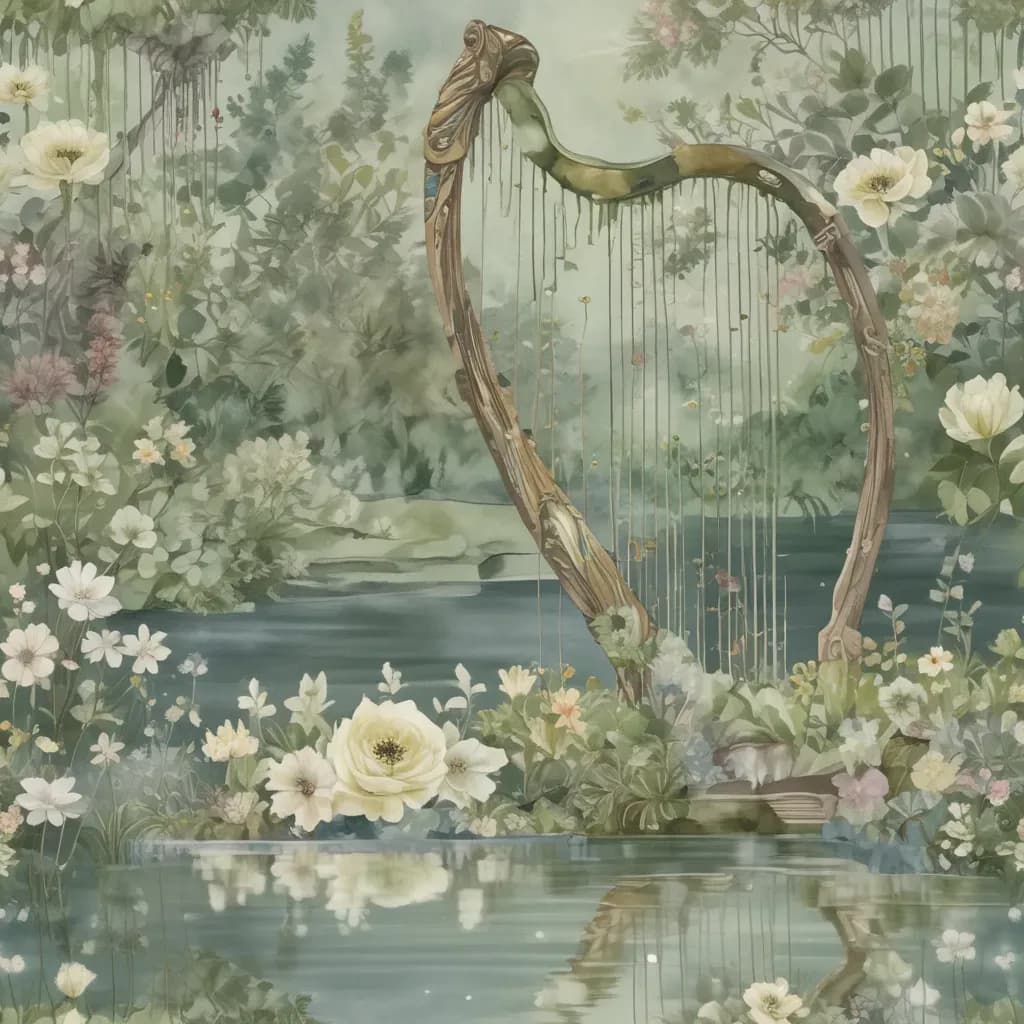
The harp is significant here. In Western musical tradition, the instrument evokes celestial space, fairy tales, and timelessness. Ladytron's use of it is not ironic: it lifts the track into something genuinely otherworldly. The sequenced harp lines, looped and shimmering, create a sense of perpetual motion, something that hums along without losing momentum.
Thematically, "Evergreen" operates as the album's most sustained meditation on permanence. The album is largely about escape, but most of its paradises carry the shadow of impermanence. This track imagines the exception. Whatever state it describes holds together. It does not shed itself.
The title resonates on at least two planes. The botanical meaning suggests a natural resistance to cycles of decay: something that grows without retreating, that does not bare itself down to the branches in winter. In the context of an album obsessed with imaginary sanctuary, "evergreen" represents the most radical kind of paradise, one that actually lasts.
The musical meaning of "evergreen" as a song outside of time is harder to miss in a band as self-aware as Ladytron. Their career has been a sustained argument that electronic pop can be both rooted in a specific historical moment and completely outside of trends. "Evergreen" feels like an encoded artistic statement: this is music made to outlast its era.
Outlasting the Moment
Ladytron formed in Liverpool in 1999, taking their name from a Roxy Music track.[2] They emerged at the moment when post-punk's love affair with synthesizers was being rediscovered, but they were never quite of the electroclash scene that briefly surrounded them: too austere, too European, too committed to their own internal logic to chase whatever was happening at a given moment.
That independence has been a survival mechanism. Marnie articulated it precisely: "Our sound is never reactionary to outside elements, it's always natural and down to experiences."[4] Over more than twenty-five years, the band has outlasted multiple trends without capitulating to any of them.
Hunt talked about a longstanding creative ambition at the heart of Paradises, specifically the desire to finally make a proper dance record: "There's an itch we never scratched. Despite our origins in the DJ world, we never actually made a 'disco' record."[3] "Evergreen" channels this into a track that builds to what one reviewer called "an ecstatic fake-out ending which could well make it the perfect concert closer."[4] Its physical, communal energy makes the most of that ambition.
The song arrived during a period of broader cultural reassessment for early-2000s electronic acts. Paradises made the case for continued relevance not through nostalgia but through genuine renewal, a harder thing to demonstrate and a more meaningful one.
What Evergreen Could Mean
No single reading exhausts the song.
One reading, consistent with the album's frequent imagery of loss and urban decay, treats "evergreen" as aspirational rather than achieved: the longing for permanence rather than its actual possession. The paradise that persists in the imagination precisely because the real ones keep falling apart.
Another interpretation centers on human connection. An evergreen bond, one that does not change with the seasons, is an ideal most relationships fail to achieve. The song's bright, relentless motion could embody such a connection or represent an act of wishful thinking, music performing the permanence it imagines.
A third reading is almost self-referential: "Evergreen" as a love letter from Ladytron to their own creative process. Aroyo described wanting to recover the feeling of the band's earliest days, when they "had nothing to lose."[3] "Evergreen" reconstructs that quality of freedom inside a sound that is unmistakably contemporary, and in doing so becomes a kind of portrait of the band's artistic ideal.
Holding Its Color
"Evergreen" lands near the end of Paradises, and it earns its position. After nearly an hour of constructed worlds, some glittering and some burning, Ladytron offers a space that does not change. The harps keep spinning, the rhythms keep clacking, and the thing holds together.
Critics noted that the album's sixteen tracks, totaling over seventy minutes, diluted its overall impact, describing it as something that "cries out for a judicious pair of editing scissors."[7] They were not wrong about the math. But "Evergreen" is one of the places where the album's ambition coheres into something more than pleasant: a track with genuine staying power, built from the conviction that beauty can resist time rather than submit to it.
It is, in both senses, an evergreen. A song about endurance, made to endure. In a catalog of carefully constructed fantasies, it may be the most hopeful thing Ladytron has made.
References
- Paradises (album) - Wikipedia — Factual information including track listing, release date, duration, and credits
- Ladytron - Wikipedia — Band history, formation in Liverpool 1999, and name origin
- Ladytron: Paradises (FEMMUSIC) — Source for Daniel Hunt and Mira Aroyo creative process quotes, recording context, and disco ambitions
- Album Review: Ladytron - Paradises (Joyzine) — Key source for song-specific analysis of 'Evergreen', band member quotes, and album thematic descriptions
- Ladytron Return to the Floor with Paradises (RANGE) — Notes album as most dance-oriented since Light & Magic (2002)
- ALBUM REVIEW: Ladytron - Paradises (The Live Wire) — Source for description of 'Evergreen' sound and rhythmic character
- Ladytron - Paradises (musicOMH) — Critical reception including observations about album length and track commentary