Fish Bowl
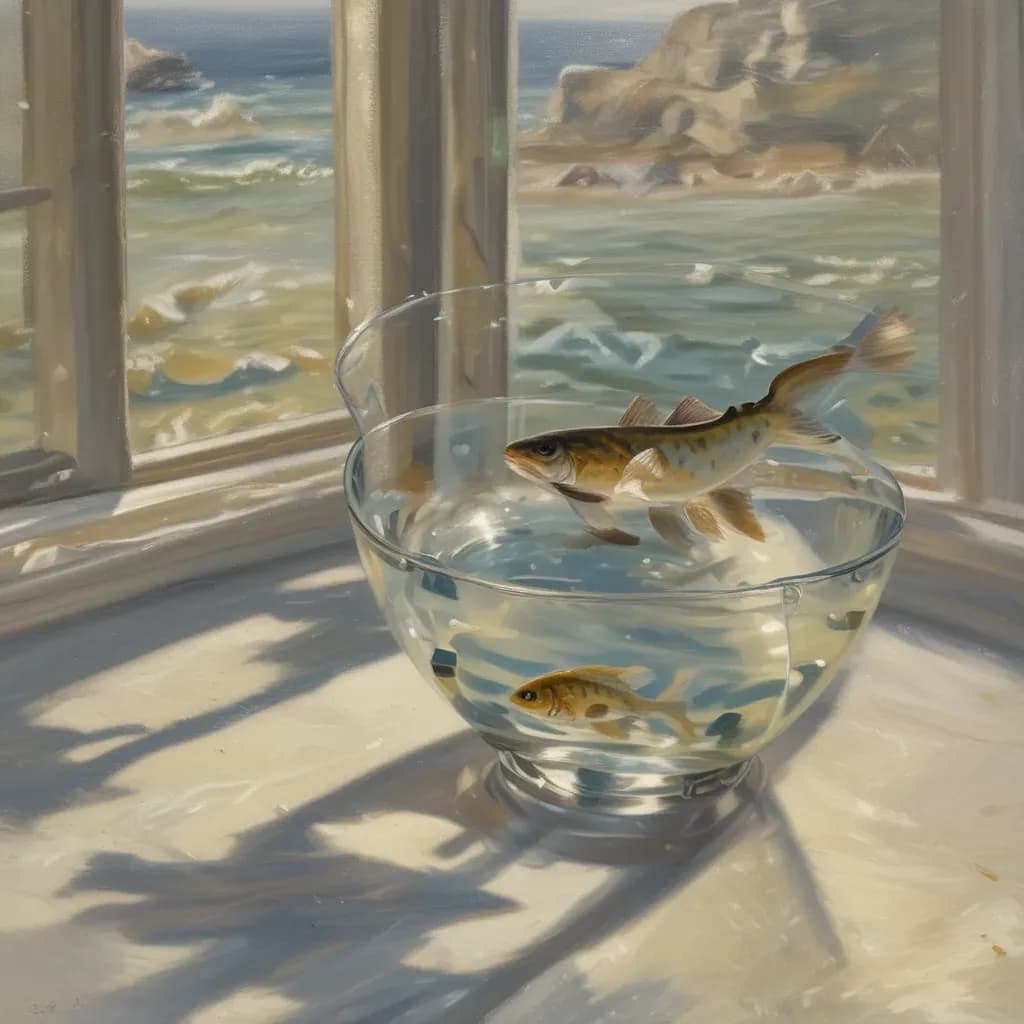
The image at the center of "Fish Bowl" is deceptively humble: a small creature in a glass container, circling the same few inches of water it has always known. Kero Kero Bonito takes this most familiar of domestic metaphors and finds inside it something genuinely unsettling. The fish has food, safety, and transparent walls that reveal a larger world just out of reach. Whether it is a prisoner or the sovereign ruler of its miniature domain depends entirely on how you choose to look.
That ambiguity is not accidental. Released as the fourth track on Bonito Generation in October 2016[1], and later issued as a standalone single in September 2017[1], "Fish Bowl" arrived during a year of significant cultural upheaval. Brexit had fractured Britain. A contentious US presidential election amplified widespread anxiety about futures that had been promised but not delivered. Kero Kero Bonito, the London trio of vocalist Sarah Midori Perry and producers Gus Lobban and Jamie Bulled, had been building toward this moment since 2011. Bonito Generation was their first full-length album, and "Fish Bowl" was one of its most carefully calibrated songs.
A Generation in Glass
Gus Lobban described Bonito Generation as a deliberate generational statement, telling Stereogum that the album was "a record for our people" and that the moment had arrived to make something that spoke directly to those navigating early adulthood in the mid-2010s[2]. That framing matters for understanding "Fish Bowl." The song is not simply about longing in the abstract; it is about the specific experience of being young, capable, and hemmed in by circumstances that feel simultaneously safe and stifling.
Sarah Perry has spoken about the album's tonal architecture with unusual candor. The brightness is real, she has noted, but it is not naive: there is always something darker moving beneath the surface[2]. Bonito Generation acknowledges the genuine difficulty of its moment without abandoning joy as a creative mode. "Fish Bowl," more than almost any other track on the record, holds both of those registers at once.
The Geometry of Confinement
The fishbowl metaphor works on multiple levels simultaneously. On the simplest reading, the fish is a stand-in for a young person who has grown up in a protected environment, comfortable in their routine, vaguely aware that the world beyond the glass is larger and stranger than the world within. Within its small sphere, the fish is entirely sovereign. It is the biggest thing in its world. It is also, from any outside vantage point, tiny.
Critics noted the way the song layers what one described as "cutesily-veiled lyrics about the crushing dread of becoming an adult"[3] beneath a surface that sounds like a children's song about aquatic life. This is classic Kero Kero Bonito. The candy coating is real, but it is also a deliberate strategy. The sweetness makes the underlying unease more effective, not less. You register the feeling before you register the analysis.
There is also a genuine fondness for the bowl itself running through the song. This is not a simple escape narrative. The fish is not miserable. It hides, it plays, it moves through its small world with something resembling contentment. The song understands why you might choose the familiar container over the terrifying openness of the sea. The tension is not between comfort and suffering; it is between comfort and possibility. That is a considerably more interesting problem.
Bilingualism and Doubled Worlds
Sarah Midori Perry's bilingual delivery, alternating between English and Japanese within the same song, is not merely a stylistic flourish. Perry grew up in Otaru, Hokkaido until the age of thirteen before relocating to the UK[4], and she has always inhabited two linguistic and cultural worlds at once. Her code-switching in "Fish Bowl" performs the song's central argument about containment and openness. Each language is its own bowl. Each feels complete from the inside and limited from the outside.
This dimension carries particular resonance for anyone who has grown up between cultures, navigating registers of belonging and not-quite-belonging. The fish in its bowl is not simply any young person; it is specifically a figure who knows that other waters exist and has already learned to swim in more than one.
Shoegaze in the Candy Store
Musically, "Fish Bowl" occupies a distinctive position on Bonito Generation. Where most of the album deploys bright, percussive synth-pop with the density of a well-stacked arcade cabinet, "Fish Bowl" introduces a hazy, submerged quality that mirrors its lyrical content. The production weaves shoegaze textures into the band's typical candy-pop framework[5], creating something that sounds like bubblegum heard through water. This is not incidental. Music about submersion should feel, at least a little, like being submerged.
The result is a track that works differently from its neighbors on the record. While surrounding songs push forward with energetic certainty, "Fish Bowl" floats. Its tempo is comfortable rather than propulsive. It does not want to escape its bowl so much as describe it with precision. The music mirrors the psychology: this is what it feels like to circle a known space, finding it slightly smaller every time and somehow no less familiar.
The Frankie Cosmos Connection
When Kero Kero Bonito assembled their Bonito Retakes EP to accompany the Japanese release of the album, they invited Frankie Cosmos, the project of New York indie songwriter Greta Kline, to contribute. Kline and her bandmates chose "Fish Bowl" specifically, and she later explained that they had wanted to cover the song even before receiving the invitation[5]. She described KKB as one of the rare bands that all four members of Frankie Cosmos loved and admired equally[5], pointing to a shared sensibility between two acts that both used deceptively simple forms to carry unexpectedly complex emotional freight.
That cross-subculture appeal is telling. "Fish Bowl" had clearly registered as something special even within a consistently strong album. Its resonance spanning from the J-pop-adjacent online communities that first embraced KKB to the American indie world Frankie Cosmos inhabits speaks to the universality of its central image. The fishbowl belongs to no single genre, background, or generation.
Alternative Readings
The song sustains several interpretive layers without collapsing under their weight. One reading centers on the digital world: the internet as a fishbowl that shows you the entirety of human experience through a screen while keeping you physically stationary. You can see everything. You can touch almost nothing. The glass is transparent but impermeable.
Another reading follows Sarah Perry's own biography more closely. A child who grew up in Hokkaido, relocated to London in her early teens, and built a creative life operating across English and Japanese cultures is someone who has repeatedly broken out of one container and found herself in another. The fish is not simply trapped; the fish is perpetually adjusting to new bowls, each a little larger, each still a bowl.
There is also a generational economics reading that connects to the album's broader context. The Bonito Generation cohort, the millennials Lobban described making the album for[2], inherited a world of shrinking practical possibility dressed in the language of infinite potential. The fishbowl is the housing market, the precarious job market, the tightening circumference of what is genuinely achievable. The fish is told the ocean exists. It can see the ocean. The glass remains.
Why the Bowl Endures
What makes "Fish Bowl" linger is its refusal to resolve. The song does not end with the fish jumping free. It does not end with the fish deciding the bowl was always enough. It holds a condition with precision and something close to affection: a small creature in a bounded world, aware of its limits, adapting, circling, persisting.
Bonito Generation as a whole was praised for the way its relentless brightness contained a subtler emotional depth[1]. "Fish Bowl" is perhaps the most direct expression of that dynamic on the entire record. It sounds like a toy. It thinks like an essay. In under two minutes, it captures something true about being young and contained and somehow still at home in the glass.
References
- Bonito Generation - Wikipedia — Album history, track listing, release dates, single releases, and critical reception
- Kero Kero Bonito's Radical Positivity Pop - Stereogum — In-depth interview with KKB including Lobban on generational identity and Perry on the album's dual positivity/negativity
- How London Pop Trio Kero Kero Bonito Went From Trampolines to Wildfires - Metro Times — Album described as bilingual raps about growing up and fitting in; Fish Bowl as life in a fishbowl as a literal fish
- Kero Kero Bonito - Wikipedia — Band biography including Sarah Perry's background, formation in London, and musical history
- Kero Kero Bonito - Fish Bowl (Frankie Cosmos Remix) - Stereogum — Frankie Cosmos on choosing to cover Fish Bowl, describing its kawaii synths and indie resonance