From
Most songs about hardship are about the hardship. This one is about what you do with your hands while it happens. Hana Stretton recorded "From" with the windows thrown open as a dark storm rolled in, and the track keeps that atmosphere: soft, exposed, and listening hard to the weather.[1]
It is the last single released from her second album, tiarn, and it may be the clearest statement of what the record is reaching for. The song asks how a person can go through rough conditions without turning rough themselves.[2]
Where the song came from
Stretton is a British-Australian songwriter and composer who makes what writers call ambient folk, built from nylon-string guitar, voices, strings and electronics.[1][4] She describes the making of "From" in unusually physical terms. A storm was closing in, she opened every window, and she recorded with her dog Roo asleep beside her.[1]
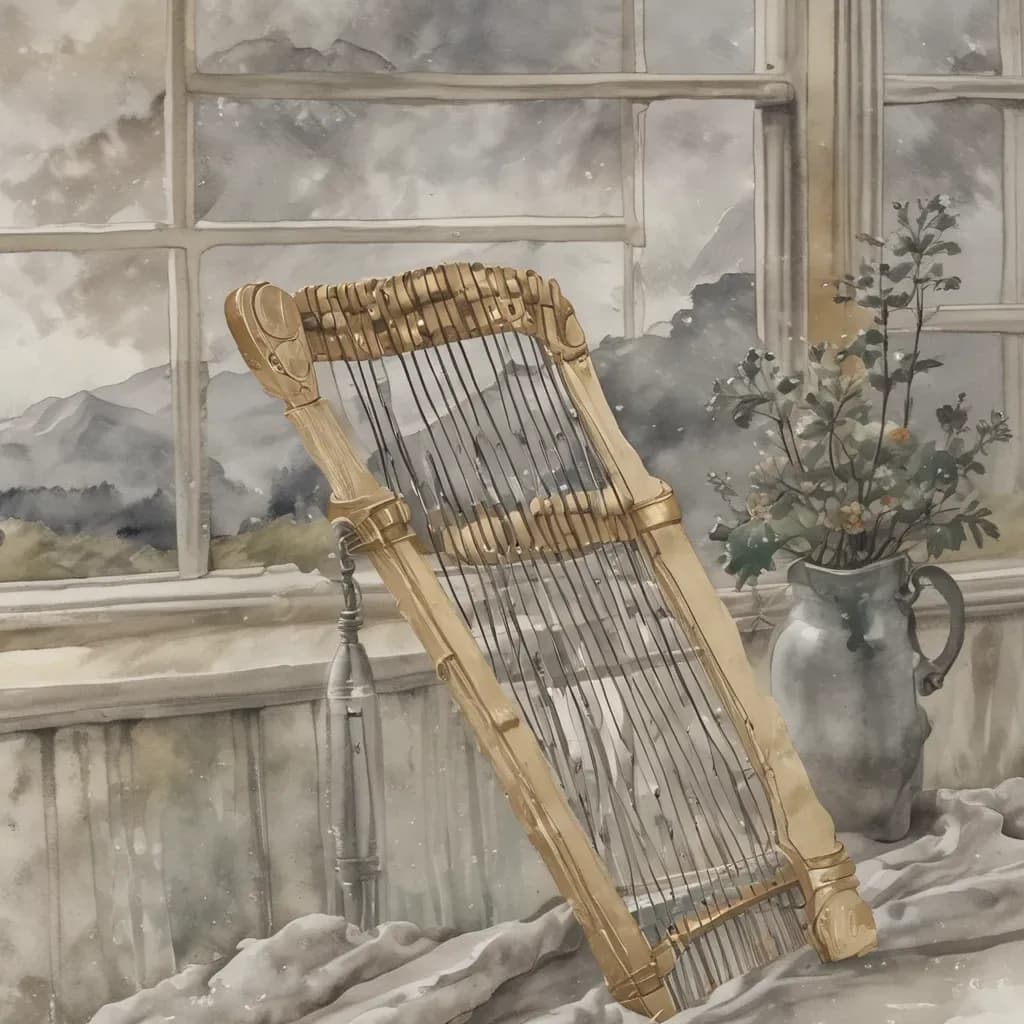
The instrumentation is homemade in spirit. She says the guitar part came from a hairbrush rather than a guitar, alongside some synthesizer and a tiny harp.[1] That detail says a lot about her method. The sounds are close at hand, a little improvised, and chosen for texture rather than polish.
The single arrived on August 4, 2026, three days before tiarn was released as a self-release with help from several small labels.[1] A video directed by her sister, Amelia Lander, wraps the song in fog, which suits the music.[1]
A storm without hardening
Stretton has offered one direct reading of the song, and it is worth taking seriously because it came to her afterward. Only later did she realize that the piece was about weathering our own storms without hardening, and about continuing to reach for warmth and kindness in a world she calls stubbornly sharp.[1]
That framing explains the song's emotional posture. It does not fight the storm or pretend it is not happening. It stays soft inside it. The arrangement, which The Line of Best Fit describes as classical and electronic, is used to express a desire for connection rather than a retreat from the world.[2]
The distinction between enduring and hardening is the heart of the matter. Many people learn to survive pain by armoring up, and the armor tends to stay on. The song proposes a harder discipline: let the weather in, and keep your capacity for tenderness anyway.
Solitude and the pull toward other people
To hear why that matters to her, it helps to know how Stretton works. For years she treated isolation as the condition of her art. She has said that creativity, for her, could only emerge in silence, and that being surrounded by people cut her off from the creative part of herself.[3]
Her earlier life fits that picture. She grew up moving between Australia, the UK and elsewhere, learned nylon-string guitar as a child, and later spent time in London before retreating to quieter places to write alone.[5] Her debut, Soon, was written and self-produced during the 2019 Australian wildfire summer, and she has said she could not have found what she wanted without time by herself.[5]
On the second album that pattern shifts. She says her music was trying to tell her, below the level of conscious thought, that she needed friends and community. Several songs on tiarn involve chanting or dancing with a group, and she calls the record an attempt to build a bridge between her life in nature and her life with people.[3]
Read against that, "From" sits at the point where the bridge starts. The desire for connection that The Line of Best Fit hears in the song is not abstract. It belongs to someone who has just begun to admit that solitude, however productive, is not enough.[2][3]
Weather as a way of thinking
Weather and landscape run through everything Stretton does. She has said that humans are animals and part of nature, and that something has been lost or forgotten in that relationship. If her music can remind herself and others of it, she is happy.[4]
A storm is a useful image for that outlook. It is not a villain. It is an event in the natural world that a person happens to be standing inside. To weather it is to treat yourself as a participant in something larger, not as its target. That is a gentler way to think about difficulty, and it is consistent with the album's wider concerns about caring for the earth and taking from it without despair.[3]
The recording method supports this reading. Open windows mean the storm is literally part of the sound world. The song was made with the weather, not in spite of it.[1]
The sound of reaching
Even without words in mind, the production tells the story. The textures are sparse and breathable, with a small harp, a bowed or sustained electronic bed and a guitar figure that is more rhythm than melody. Nothing is forceful. The song unfolds the way a cloud front moves, by accumulation rather than attack.[1][2]
This is consistent with the rest of the album, which was made on analogue tape on the south coast of New South Wales and leans on choirs, looped fragments and layered voices.[3] Comparisons made to Grouper and William Basinski point at the same quality: music that creates a space to be in rather than a narrative to follow.[3]
Why it resonates
Stretton calls the album something close to an unanswered question, about how to live well on a damaged planet without being flattened by grief.[3] "From" is one of the places where that question is held most gently. Listeners dealing with anxiety, climate dread or ordinary private weather can hear in it a model of staying open that does not require pretending everything is fine.
She has also said that when people sing her songs with her, they escape her grasp and become part of other people, no longer feeling like hers.[3] That is a fitting wish for a song about connection. It is meant to be borrowed.
Other ways to hear it
Because the song is so spare, it leaves room for readings that Stretton has not offered. Some listeners may hear it as a song about grief, with storm standing in for loss. Others may hear a quiet political statement about how to remain humane in a harsh public climate. The title itself, a single small word pointing at origin or distance, invites questions about where tenderness comes from and where it is headed.
None of these cancel her own account. They are different angles on the same instinct: that the most radical response to a sharp world may be to stay soft.
Conclusion
"From" is a modest song with a large idea. Recorded beside a sleeping dog in an open-windowed room, built partly from a hairbrush and a tiny harp, it argues that kindness is not what remains after the storm. It is what you carry through it.[1]
For an artist who spent years believing she needed silence and solitude, that argument sounds like a turning point. It marks the moment she stops waiting for the weather to clear and reaches out into it.[3]