Grease Paint!
Every album has to end somewhere, and the last track is usually where an artist decides what the listener should carry out the door. On OTIS, Conway the Machine's 2026 album, that slot belongs to a song called "Grease Paint!", and it is a strange choice on paper. The guest is Robby Takac, the bassist and co-founder of the Goo Goo Dolls, a band whose name belongs to alt-rock radio and not to the cold, basement-lit world of Griselda boom-bap.[1] The pairing is the song's first and loudest statement, before a single bar is considered.
The available press coverage tells us very little about the song's sound or lyrics, so this essay does not pretend to a line-by-line reading. What can be done honestly is to place the track in its context: the album it closes, the city its two voices share, and the idea packed into its title. From there, a few readings of the song become possible, and they are offered here as interpretation, not as settled fact.
Where the song sits
OTIS arrived on November 20, 2026, running eleven tracks. Its title is an acronym for "Often Times I Suffer," and the album was described before release as tightly curated, not padded.[1] It was announced alongside a guest list that mixed Wu-Tang Clan names (Ghostface Killah, Method Man, Raekwon) with Kool G Rap, Flee Lord, Inkredible N.E.S. and Shots Almigh, plus that unexpected rock band credit.[2]
The singles established the tone. "Diggwutumsayn!," produced by Daringer, was pitched as raw boom-bap for Griselda purists, while "Sarah!," produced by Conductor Williams, leaned catchier and came with a video that played with Terminator imagery.[1] One reviewer found the album as a whole to be a sharper and more focused Conway than recent outings, with colder, darker production and a performer who sounds like he has something to prove.[3]
"Grease Paint!" is the eleventh and final track.[3] The same review rated the album highly overall, but singled out the closer as its weakest moment, calling the Takac pairing an interesting idea that feels awkward in practice.[3] That is one critic's verdict, and it is worth holding loosely, because unlikely collaborations often take longer to settle than a first listen allows. It does confirm something useful, though: the song is understood by its early audience as a deliberate risk, placed at the very end of an album otherwise full of hard-edged rap.
Two Buffalo careers
The most concrete thing connecting these two artists is geography. Conway was born Demond Price in Buffalo, New York, in 1982, and became a co-founder of Griselda Records with his half-brother Westside Gunn.[6] His story is one of unusual hardship: years in and out of jail in his twenties, then a 2012 shooting that left him with partial facial paralysis, an injury that shaped his distinctive delivery.[6] He later left Shady Records and Griselda and started his own label, Drumwork.[6]
Takac comes from the same city and an entirely different musical lane. The Goo Goo Dolls formed in Buffalo in 1986, founded by Takac, John Rzeznik and drummer George Tutuska.[5] Takac has also built a life as a local institution, running the Music is Art organization and the GCR Audio recording studio, which he opened to the public in 2009.[4] Both men, in other words, are Buffalo lifers who turned a hard-working, regional scene into national careers by different roads.
That shared origin is probably the most useful way into the track. A rapper who has spent a career writing about survival and a bassist who has spent one building community infrastructure are not natural duet partners, but they are neighbors, and the album is titled around suffering.[1] A closing song that brings the city's two best-known musical exports into one room reads as a statement of belonging as much as a stylistic experiment.
What the title suggests
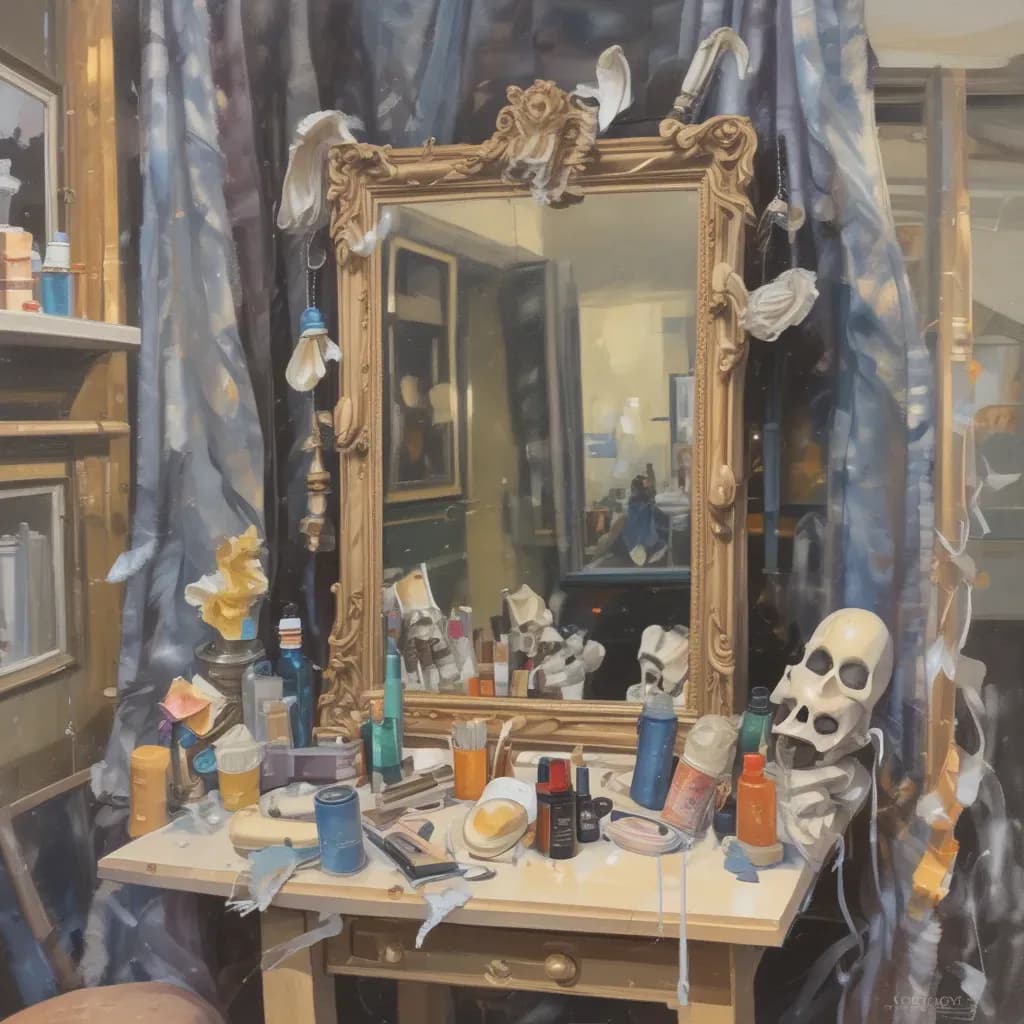
Grease paint is the thick theatrical makeup performers wear under stage lights. It is a mask, and it is also a uniform: a way of becoming the character the audience came to see. For an artist who goes by "the Machine," whose public image rests on menace and invincibility, the phrase invites an obvious question about the distance between the persona and the person.
That is one reading, and it fits the arc of the album. The review describes a record in which Conway moves between threats and flexes and moments of explaining himself, touching on loyalty, street credibility and strained relationships.[3] If the bulk of the album is the performance, a closing track named for stage makeup could be the moment the face underneath briefly shows. Ending an album on the idea of the mask coming off is a familiar move, and the title makes it a natural one here.
A second reading treats the phrase more literally and more broadly. Grease paint belongs to circus clowns, vaudeville comics, and rock performers alike, to any entertainer whose job is to look larger than life while carrying something heavier. Pairing a rapper and a rock bassist under that title suggests a shared occupation: both are people who paint a public face on and walk out under the lights regardless of what the night has cost them. The theme of suffering in the album's name gives that idea some weight.[1]
The risk of the crossover
Hip-hop and rock have a long, uneven history of meeting in the middle. Some of the results are canonical, and many are remembered mostly as curiosities. The danger in a collaboration like this is that each artist is asked to leave their strengths at the door, and the critical response suggests some listeners felt that tension here.[3]
Still, the choice carries meaning that does not depend on whether every listener loves the result. Conway has spent the last several years building his own label and releasing work at a steady clip, and the artist biography records a run of albums from 2023 onward.[6] An independent artist with that much control over his catalog can place a guest wherever he likes. Putting a rock musician on the final track, with the rest of the guest list drawn from rap's old guard, is the kind of decision only someone certain of his own identity makes.
The Buffalo angle also matters for the people who will meet the song cold. A listener who knows the Goo Goo Dolls from the radio may arrive at Conway through Takac, and a Griselda devotee may be pushed to notice what a rock band from the same city has meant to local music. Few albums create a bridge like that in their final minutes.[1]
Placement matters as much as pairing. Closing tracks tend to be read as the artist's final word, and a song that ends an eleven-track album built around suffering invites listeners to treat it as a summing-up. Whether it lands as a release, a shrug or a challenge is left to the individual ear, and that openness is part of why the track rewards a second listen after the album's harder-hitting material has set the mood.[1]
Alternative interpretations
There is a more skeptical way to hear the song. If the album works as a tight, cold, mostly rap-centered statement, the closer can be read as an epilogue that deliberately breaks the mood, a coda that lets air into a claustrophobic record. Under that reading, the awkwardness a reviewer noticed may be partly the point: the track is meant to feel like stepping out of a dark room into unfamiliar light.[3]
There is also the personal reading. Reviews framed the album against apparent friction between Conway and his Griselda past, particularly with Westside Gunn.[3] Against that backdrop, ending with a collaborator from outside the Griselda circle, one who shares only the hometown, can be heard as a quiet declaration of independence: the city belongs to Conway and not only to the crew that made him famous.
Neither reading can be confirmed from the available sources, and the song's exact production credits and lyrical content were not documented in the coverage consulted. Listeners with the track in front of them will be able to test these ideas against what they actually hear. The lyrics themselves are available on the lyrics page linked in the sidebar.
Why it matters
OTIS presents itself as an album about difficulty and endurance, and its last word is given to an unlikely ally from the same hometown. Whatever one thinks of the execution, the song makes an argument that Buffalo's musical identity is wider than any one scene, and that an artist as hardened as Conway can close his most focused project in years by opening a door instead of slamming one.[1][3]
The title, meanwhile, keeps working after the music stops. Grease paint is what performers put on and what they eventually wipe off, and an album about suffering that ends on that image leaves its listener thinking about the person under the character. That may be the song's quiet achievement: it sends the audience out of OTIS wondering who was wearing the mask all along.
References
Keep reading
More by Conway the Machine
More Hip Hop
- Diggwutumsayn! Conway the Machine
- Sarah! Conway the Machine
- Almigh! Conway the Machine
- Close My Eyes! Conway the Machine
- Cobra! Conway the Machine
- BOB! Conway the Machine