Heroes
There is a reason "Heroes" has become one of rock music's defining statements of the human spirit. Not because it promises triumph. Not because it offers comfort. It locates heroism in the most ordinary and transient of places: a single afternoon, a stolen kiss, two people choosing to be close despite forces arrayed against them.
The genius of the song is its precision. It does not declare permanent victory. It claims one day. That constraint, far from diminishing the sentiment, amplifies it. The song feels as vast and uncontainable as the world it describes.
West Berlin, 1977
David Bowie arrived in West Berlin in late 1976 in rough shape. Years of severe cocaine addiction during his Los Angeles years had brought him to a breaking point, and he moved to the divided city deliberately, seeking anonymity and distance from the machinery of American rock stardom.[1] He brought Iggy Pop with him. The two rented a modest flat in the Schoneberg district, rode bicycles through the city, and visited museums.[2]
"For many years Berlin had appealed to me as a sort of sanctuary-like situation," Bowie said later. "It was one of the few cities where I could move around in virtual anonymity."[1] The city he chose was unlike anywhere else on earth. West Berlin sat entirely within East Germany, an island of Western life surrounded by communist territory and bisected by a twelve-foot concrete barrier lined with guard towers and kill zones. The tension between the city's vivid subculture and the claustrophobic geopolitical context gave it a quality unlike anywhere else.
The recording sessions for "Heroes" took place at Hansa Tonstudio in the summer of 1977. The studio, a former Weimar-era ballroom, sat approximately 500 yards from the Wall. Its windows looked out onto guards patrolling the border. The atmosphere was not metaphorical. It was architectural.[3]
Sound as Architecture
The musicians who assembled at Hansa were a remarkable group. Bowie's rhythm section from the previous year's "Low" sessions returned: Carlos Alomar on guitar, George Murray on bass, Dennis Davis on drums. Two additions transformed the sessions into something entirely new.
Brian Eno brought his EMS Synthi AKS synthesizer, a portable instrument built into a briefcase with a joystick controller. During the recording he manually worked the instrument's oscillators and noise filters in real time, creating a shuddering, building effect that accumulates through the song. Eno has said he had the word "heroes" in mind from the beginning of the session, describing the music as feeling "grand and heroic" before Bowie had written a single lyric.[4]
Robert Fripp, of King Crimson, flew to Berlin carrying only his electric guitar and no amplifier. He used the studio's monitor speakers as feedback sources, measuring the precise distance from each speaker at which individual notes would sustain. He marked those positions on the floor with tape, then moved deliberately between them during the recording, converting what would ordinarily be uncontrolled noise into soaring melodic lines that float above the rhythm section.[5]
The vocal recording technique devised by producer Tony Visconti may be the most celebrated technical achievement in the song's history. Visconti placed three microphones at different distances from Bowie in Hansa's cavernous hall: one close, one at mid-room, and one at roughly fifty feet. Each microphone was connected to a noise gate set at a progressively higher threshold. When Bowie sang softly, only the nearest microphone was active. As his voice grew in intensity, the gates opened one by one.[4]
The result is that Bowie's voice changes not just in volume but in physical space as the song builds, moving from intimate to enormous without any artificial reverb. What you hear is entirely natural room acoustics, captured in a single vocal pass onto the last available track on the multitrack tape.[3]
Love as Resistance
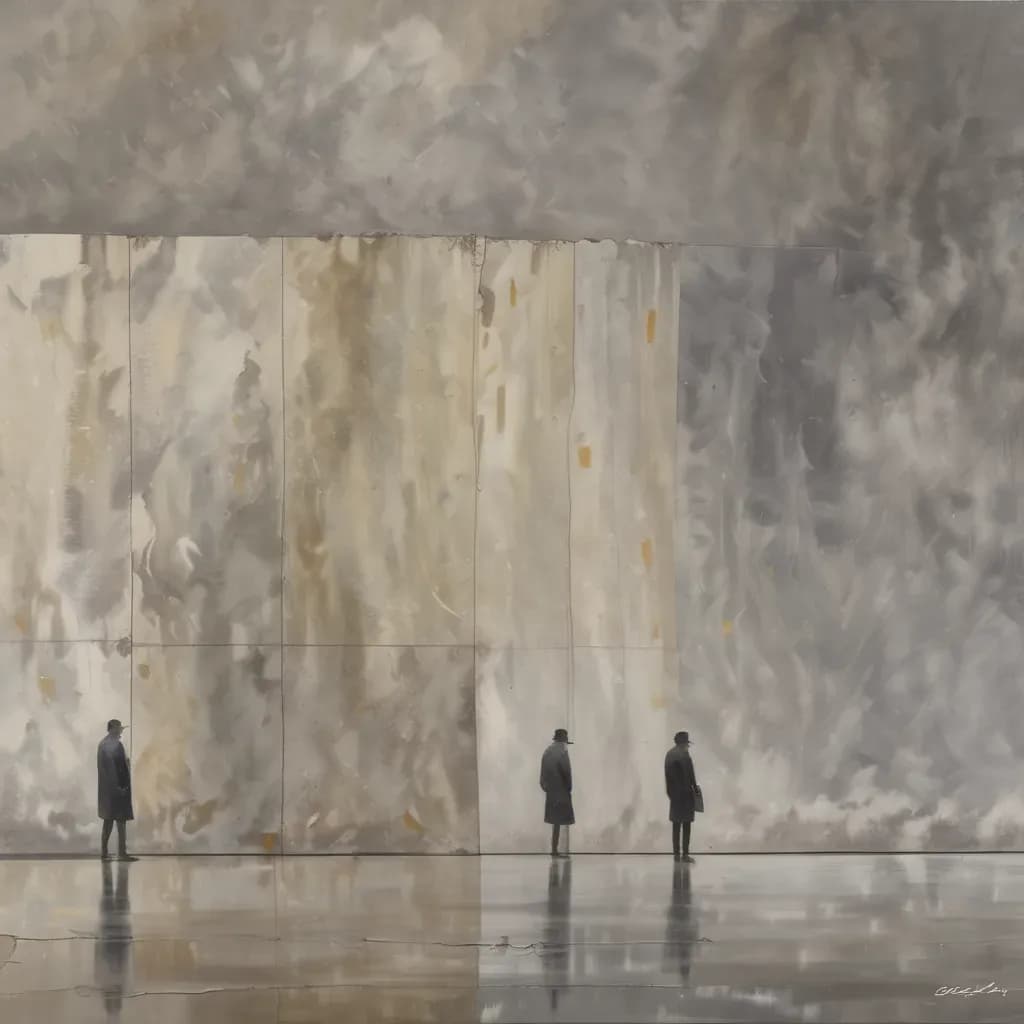
The central lyrical idea of "Heroes" is not what you might expect from a song with that title. The narrator does not describe victory or lasting change. He describes an afternoon: two lovers meeting in the shadow of the Wall, standing beneath guard towers, choosing to be there together. The song positions this as heroic in the fullest sense, not because it accomplishes anything visible, but because it is done anyway.
Love offered in full knowledge of the situation's impossibility constitutes its own kind of courage. The lovers in the song know where they are. They stand there regardless. The imagery throughout is specific: the guns, the guards, the Wall itself. These are not abstractions. They are the conditions under which the act of loving takes place.
There is a specific biographical inspiration for these images. Bowie kept the story private for roughly 26 years, but in 2003 he confirmed that the couple he had observed was his own co-producer, Tony Visconti, and German singer Antonia Maass, who had met during the sessions. Visconti was married at the time. Bowie said he found the sight genuinely moving and that it provided the emotional core of the song.[6] "Tony was married at the time, and I could never say who it was," he later explained. "I think possibly the marriage was in the last few months, and it was very touching because I could see that Tony was very much in love with this girl, and it was that relationship which sort of motivated the song."[7]
This context does not reduce the song. It clarifies it. The heroism Bowie describes is not grand, public, or political. It is private, slightly illicit, and emotionally fragile. The scale is deliberately human.
The Weight of Quotation Marks
Bowie placed the word "Heroes" in quotation marks on the album's cover and throughout its promotional materials, and said explicitly that this was intentional. The scare quotes introduce a dimension of irony that keeps the song honest.[8] He was aware that the word "hero" carries weight it rarely deserves, that declarations of heroism are often grandiose and empty. The quotation marks acknowledge that the lovers in the song are not heroes in any recognized sense. They are two people with feelings too large for their circumstances, standing somewhere they probably should not be.
This is what separates the song from sentimentality. It does not claim more than it can support. The central refrain acknowledges the limitation plainly: just for one day. That single word does enormous work. It admits the constraint. It embraces it. In doing so, it makes the aspiration feel real instead of inflated.
A Concert at the Wall
On June 6, 1987, Bowie performed an outdoor concert at the Platz der Republik in West Berlin, just meters from the Wall, during his Glass Spider Tour. The sound system was powerful enough that thousands of East Berliners gathered on the other side to listen.[9]
Before playing "Heroes," he addressed the eastern crowd in German, sending his wishes to those on the other side of the barrier. When the song began, the crowd there broke into chants demanding the Wall come down. East German police drove them back with force. It was among the most politically charged live performances in rock history.
Bowie later described the experience: "When we did 'Heroes' it really felt anthemic, almost like a prayer."[9] When the Berlin Wall fell in November 1989, many observers connected the cultural pressure of moments like this concert to the political collapse that followed. After Bowie's death in January 2016, the German Foreign Ministry posted a public tribute: "Good-bye, David Bowie. You are now among #Heroes. Thank you for helping to bring down the #wall."[10]
The song has continued to accumulate meaning across the decades. It was played during the opening ceremony of the 2012 London Olympics as the British team entered the stadium. It closed the final episode of Netflix's Stranger Things, prompting a massive surge in streaming. Each new context finds something the song was already holding in reserve.[8]
Why It Endures
"Heroes" endures because it is honest about what hope actually looks like. Not a guarantee. Not a transformation. A single day, a single kiss, a defiant act of being alive in the presence of someone you love.
The song was recorded in a studio overlooking soldiers and walls, by musicians who treated feedback, synthesizers, and enormous empty rooms as instruments. The technical brilliance of its construction matches the emotional precision of its central claim: that the act of loving, however briefly, is worth the attempt.
Bowie described the song as being about "facing reality and standing up to it" and about "deriving some joy from the very simple pleasure of being alive."[1] The reality it faces is not small. It is walls, guns, time, and the eventual failure of all things. What the song offers is not a way around those facts. It offers one day, in the present tense, as if that were enough.
It turns out to be enough.
References
- David Bowie's 'Heroes': How Berlin Shaped Eclectic 1977 Masterpiece — Rolling Stone deep-dive on the biographical and recording context of the album and song
- Why David Bowie and Iggy Pop Chose Berlin Over Los Angeles — Context on Bowie's move to Berlin, drug recovery, and life with Iggy Pop in Schoneberg
- Classic Tracks: David Bowie 'Heroes' — Detailed technical analysis of the recording, including the Hansa studio location and vocal technique
- Key Tracks: Tony Visconti on 'Heroes' — Visconti's firsthand account of the recording process, microphone setup, and Eno's contributions
- How Robert Fripp Recorded the Guitar Line on David Bowie's 'Heroes' — Explains Fripp's taped-floor feedback technique for creating the guitar lines
- How Familiar Lovers at Berlin Wall Sparked David Bowie's 'Heroes' — Documents the real-life inspiration behind the song, including the Visconti/Maass story
- Was David Bowie's 'Heroes' Really Based on a True Story? — Examines Bowie's 2003 revelation about the Visconti/Maass inspiration
- "Heroes" (David Bowie song) - Wikipedia — Comprehensive overview including the scare quotes, chart performance, and cultural usage
- Flashback: David Bowie Sings 'Heroes' at the Berlin Wall — Account of the landmark 1987 Berlin concert and its political resonance
- Germany to David Bowie: Thank You for Helping to Bring Down the Berlin Wall — Documents the German Foreign Ministry's tribute and the song's connection to the Wall's fall