Hot Water (Cahuilla)
In American idiom, being in hot water means you have made a mess of things and are now living in the consequences. But for the Cahuilla people of Southern California's Coachella Valley, hot water carried a different and older meaning: sacred healing, spiritual renewal, a gift from the earth with the power to restore the body and the spirit. Earl Sweatshirt, on the fifth track of his UTILITY side from the collaborative double album POMPEII // UTILITY (April 2026), places both meanings in deliberate tension.[1] The title is a small act of excavation, returning a colonized phrase to its indigenous root.
The Weight of the Title
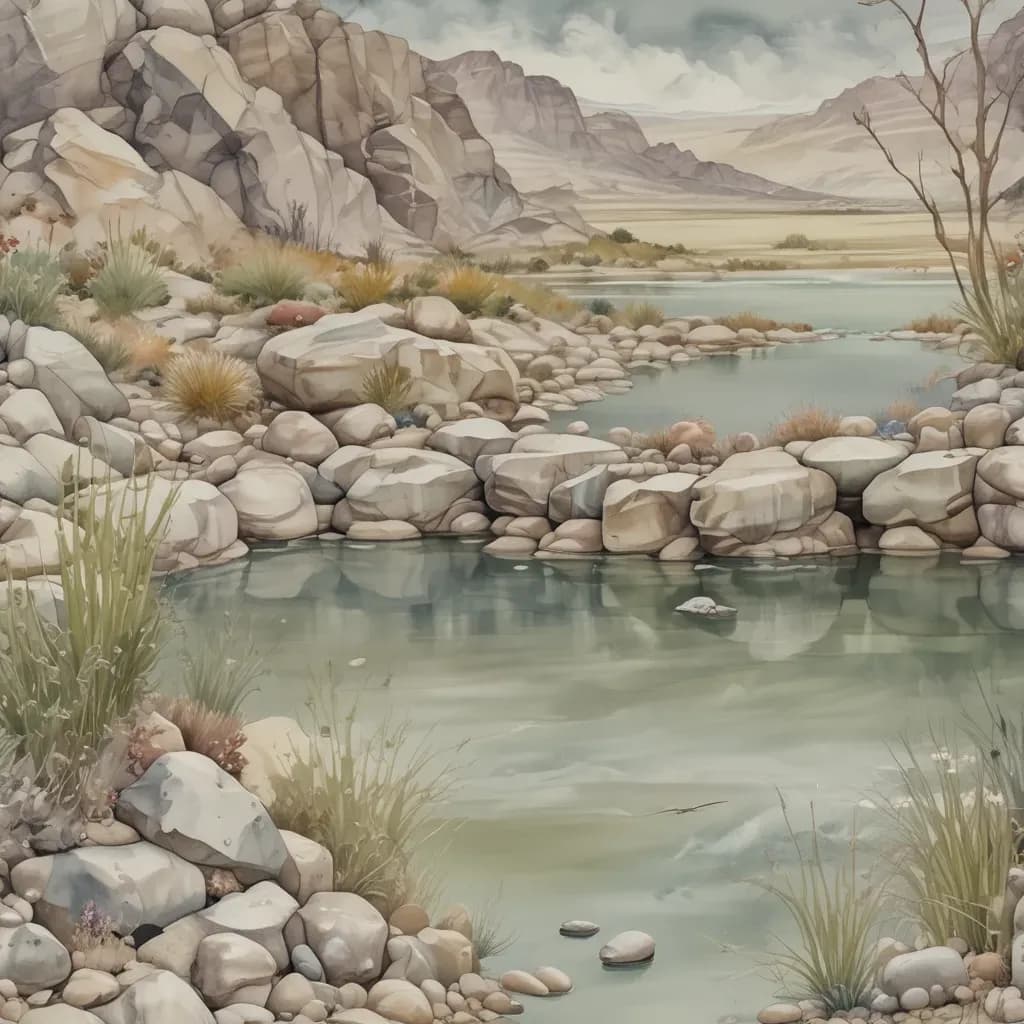
The Cahuilla people called the thermal springs in what is now Palm Springs "Sec-he," a word approximating the sound of boiling water. When Spanish explorers arrived in the early nineteenth century, they renamed the place "Agua Caliente," which translates simply as hot water. The Agua Caliente Band of Cahuilla Indians remain a federally recognized tribe based in Palm Springs to this day.[2]
According to Cahuilla oral tradition, a legendary figure struck his staff of power into the earth and created the spring as a perpetual gift to the sick and suffering, a source of healing that was never to dry up. The waters were understood as a point of contact between the living world and deeper spiritual forces, used for physical healing, purification, and ceremonial practice.[2]
By embedding this reference in a song preoccupied with sobriety, personal accountability, and the refusal of stagnation, Earl aligns his own particular hot water (the colloquial kind, trouble brought on by destructive habits) with this older tradition of the spring as a site of restoration. The title is, quietly, a thesis statement.
A Season of Reckoning
POMPEII // UTILITY arrived on April 3, 2026, during one of the most personally eventful stretches of Earl's adult life.[1] In 2025, he married actress and comedian Aida Osman. The couple welcomed a daughter in July of that year, adding to Earl's son from a prior relationship.[3] Around the same time, he addressed his relationship with alcohol, stepping away from drinking that had grown problematic. These weren't peripheral biographical details. They formed the emotional skeleton of the UTILITY side.
Earl and MIKE (the New York rapper who shares this project) conceived POMPEII // UTILITY as two distinct but complementary records.[4] POMPEII, MIKE's domain, grapples with grief, loss, and the survivor's remorse of rapid success. UTILITY, Earl's side, moves in the other direction: forward, and with intention. Reviewers noted the duality in stark terms -- if POMPEII is organized around fear, UTILITY is organized around faith.[5] "Hot Water (Cahuilla)" sits at the heart of that dynamic, its title alone registering both the trouble Earl is moving through and the tradition of healing he is reaching toward.
The album grew from a collaboration years in the making. MIKE cited Earl as a foundational influence on his teenage creative self. Earl later acknowledged that MIKE's compressed, murky aesthetic had bent the sound of his own Some Rap Songs (2018) in ways that proved difficult to untangle.[4] By 2026, the mutual debt was easier to honor in shared work than to parse separately.
Healing by Degrees
The track's core argument is about action. Earl issues a blunt assessment about the futility of passivity, the sense that waiting for circumstances to improve is itself a form of complicity in staying stuck. The delivery is direct to the point of roughness, less a piece of advice than a confrontation with the self. The idea is stated not once but repeatedly, as if the repetition is part of the point.[6]
But the song doesn't arrive at this via anger. Woven into the verse is a clear-eyed accounting of personal damage, an acknowledgment of specific failures that reads less like self-flagellation and more like inventory-taking. Earl describes drawing a kind of line, marking a before and after. This isn't the abstract spiritual language of someone who found recovery easily. It is the language of someone who ran the numbers and decided the costs were no longer acceptable.
The water metaphor threads through all of it. Getting through a period of being in hot water implies eventual emergence, a body that passes through heat and comes out different on the other side. The Cahuilla hot springs, in their traditional use, operated on exactly that principle: submerge, endure the heat, surface restored.[2] Earl never makes the analogy explicit, but the title ensures it is always present in the background.
There is also something quietly optimistic here that sits against the grain of what long-time listeners might expect. Earl's earlier work, particularly the period spanning I Don't Like Shit, I Don't Go Outside (2015) and Feet of Clay (2019), was defined in part by withdrawal and refusal. Songs arrived in fragments, associations collapsed inward, and the prevailing mood was one of someone retreating from the world rather than addressing it.[7] "Hot Water (Cahuilla)" belongs to a different temperament: confrontational in the most useful sense, directed outward as often as inward.
Sound and Place
Surf Gang's production on this track has the restless, slightly disorienting quality that one reviewer compared to a melody pulled from a surreal, exploration-based video game, the kind of music designed to evoke wandering through unfamiliar terrain with no certain destination.[6] The 808s sit below the surface rather than driving it, giving the track an almost weightless quality that sits in productive tension with the directness of the lyrical content.
This gap between vaporous sound and concrete language is a recurring feature of the UTILITY side.[7] Bandcamp Daily's Martin Douglas described how the Surf Gang beats run a gamut of contemporary styles while Earl demonstrates free-associative mastery that incorporates references spanning Greek mythology to musical history.[7] The approach rewards close listening. It asks a listener to close an interpretive gap that the production deliberately leaves open.
The geographic precision of the title adds a further layer of texture. Palm Springs, home of the Agua Caliente Cahuilla hot springs, sits on the western edge of the Coachella Valley, roughly 100 miles east of Los Angeles, a landscape defined by desert heat, mountain shadow, and the strange coexistence of indigenous heritage and mid-century American leisure culture.[2] Earl, who grew up in Los Angeles, would know that landscape. The choice to invoke it is deliberate.
Faith as a Practice
Part of what makes "Hot Water (Cahuilla)" land is that it doesn't pretend the work of recovery is elegant. It is ungainly and repetitive, requiring the same acknowledgment to be made multiple times before it starts to hold. Earl captures this with dry recognition rather than defeat: you said it before, you are saying it again, and the saying has to count for something this time.
NME described POMPEII // UTILITY as the work of "rap's most restless minds," noting how both artists push against conventional structure without losing the thread of what they are communicating.[8] On this track, that restlessness is channeled into self-reckoning, which may be the most internal kind of restlessness there is.
The Cahuilla parenthetical in the title also performs a cultural function beyond biography. It insists on a geographical and historical specificity that runs against hip-hop's default tendency toward either universal abstraction or very particular urban geography. The hot springs of the Agua Caliente Cahuilla are neither. They are a specific kind of Western American landscape, associated with indigenous healing traditions that predate and survive the American experience.[2] Dropping that reference into a song about sobriety and personal reckoning suggests that the work of healing has a deeper genealogy than any single individual's struggle.
There is also a quiet alignment with the broader arc of Earl's career. From the teenage provocateur of Odd Future, through the grief-fogged introversion of Some Rap Songs, to the father, husband, and sober artist of UTILITY, the through-line has always been someone taking honest inventory of where he actually is.[4] "Hot Water (Cahuilla)" is that inventory at its most compressed: trouble acknowledged, healing invoked, action demanded.
Conclusion
"Hot Water (Cahuilla)" is a small track with large coordinates. It won't be the first song most listeners reach for from POMPEII // UTILITY. But it encodes something central to what Earl is doing on this album: insisting that being in trouble is not a permanent condition but a terrain to move through. The Cahuilla knew the spring was always going to be there. The healing was built into the landscape. Earl, drawing the same line in a different century, seems to be working toward the same confidence about himself.
References
- Pompeii // Utility - Wikipedia — Album overview, track listing, release date, and label information
- Cahuilla - Wikipedia — Historical and cultural context on the Cahuilla people, their hot springs, and the Sec-he healing traditions
- Earl Sweatshirt and Aida Osman Welcome Daughter - AllHipHop — Biographical context on Earl's personal life during the UTILITY recording period
- Earl Sweatshirt, MIKE and Surf Gang Interview - The Face — Primary interview with Earl Sweatshirt and MIKE discussing the recording process, creative relationship, and UTILITY concept
- Earl Sweatshirt and MIKE link fates on Pompeii // Utility - NPR — Critical review examining the POMPEII/UTILITY duality and the album's emotional arc
- MIKE and Earl Sweatshirt Take Cloud Rap Detour on Double Album - Daily Campus — Track-level review noting the Surf Gang production on Hot Water Cahuilla resembles a surreal game-world melody
- POMPEII // UTILITY - Bandcamp Daily — Album of the Day review praising Surf Gang production and Earl's free-associative mastery
- POMPEII // UTILITY Review - NME — 8/10 review describing the album as a sprawling two-headed opus from rap's most restless minds