how many things
There is a particular kind of anguish in the arithmetic of unrequited attention. You add someone up in your mind dozens of times each day, turning them over in ordinary moments, in the space between tasks, in the quiet hum of a room that used to hold both of you. And then the question arrives, not as a confrontation but as a dread: does your name appear anywhere in their equivalent inventory?
"how many things" by Sabrina Carpenter does not ask that question gently. It builds toward it, over a spare acoustic arrangement, through the confessions of a narrator tallying her own obsessive mental inventory of someone who may not be running any count of her at all. The song's closing blow, a raw question about whether she registers even as a passing second thought, arrives with the weight of every vulnerable thing you have ever held back from sending.
Background: From Disney Stardom to Confessional Pop
Released on August 19, 2022, "emails i can't send" was Carpenter's fifth studio album and her first for Island Records, following years under Hollywood Records, the Disney-affiliated label where she had grown up professionally[1]. The label change was more than administrative. Carpenter described approaching the album's writing with a different set of internal rules: allowing herself to actually feel the pain she would normally deflect, fighting the instinct to cover difficult emotions with confidence and wit[2]. She composed many of the songs as stream-of-consciousness emails she sent to herself, operating under the freeing assumption that no one would ever hear them[3]. The honesty that assumption unlocked shows throughout the record.
The biographical raw material was substantial. By early 2021, Carpenter had become a reluctant figure in one of pop culture's most scrutinized romantic narratives. When Olivia Rodrigo released "Driver's License," its lyrics were widely interpreted as referencing Carpenter. The internet rendered judgment quickly and harshly. On the album's most directly confrontational track, Carpenter describes being publicly branded and receiving death threats over what was, in private reality, a short-lived relationship with actor Joshua Bassett[4]. That relationship, which she has described as her first real heartbreak[5], casts a long shadow over the album's emotional landscape.
"how many things" sits at track seven on the standard edition, in the album's quieter middle stretch. Critics noted that it stood apart sonically from the record's more uptempo material, an acoustically spare and emotionally naked moment that some found misplaced and others considered among the album's most arresting passages[6]. It catches the narrator past the first shock of loss, in the territory where grief stops being dramatic and becomes instead a low-grade persistent interference.
The Fear at the Song's Core
The song's animating anxiety is a problem of proportion. The narrator's inner life has been colonized by someone. He appears unbidden, attached to objects and places and sensory details, multiplying across her days in ways she cannot control. The central rhetorical move of the song is to frame this invasion as an arithmetic question: if she counts him this continuously, where does she rank on whatever mental list he keeps? The question carries more dread than anger. The narrator is not confronting him. She is running the probability.
This fear of emotional asymmetry is one of the most universal experiences in romantic grief, which is part of what makes the song travel far beyond the specifics of its biography. The person who grieves more, who misses harder, who reorganizes their inner life around an absence, cannot know whether that grief is matched on the other side. They can only wonder. "how many things" inhabits that wondering without resolving it, and that refusal to provide resolution is part of what gives it staying power.
The Fork, the Fan Symbol, and the Truth of the Ordinary Object
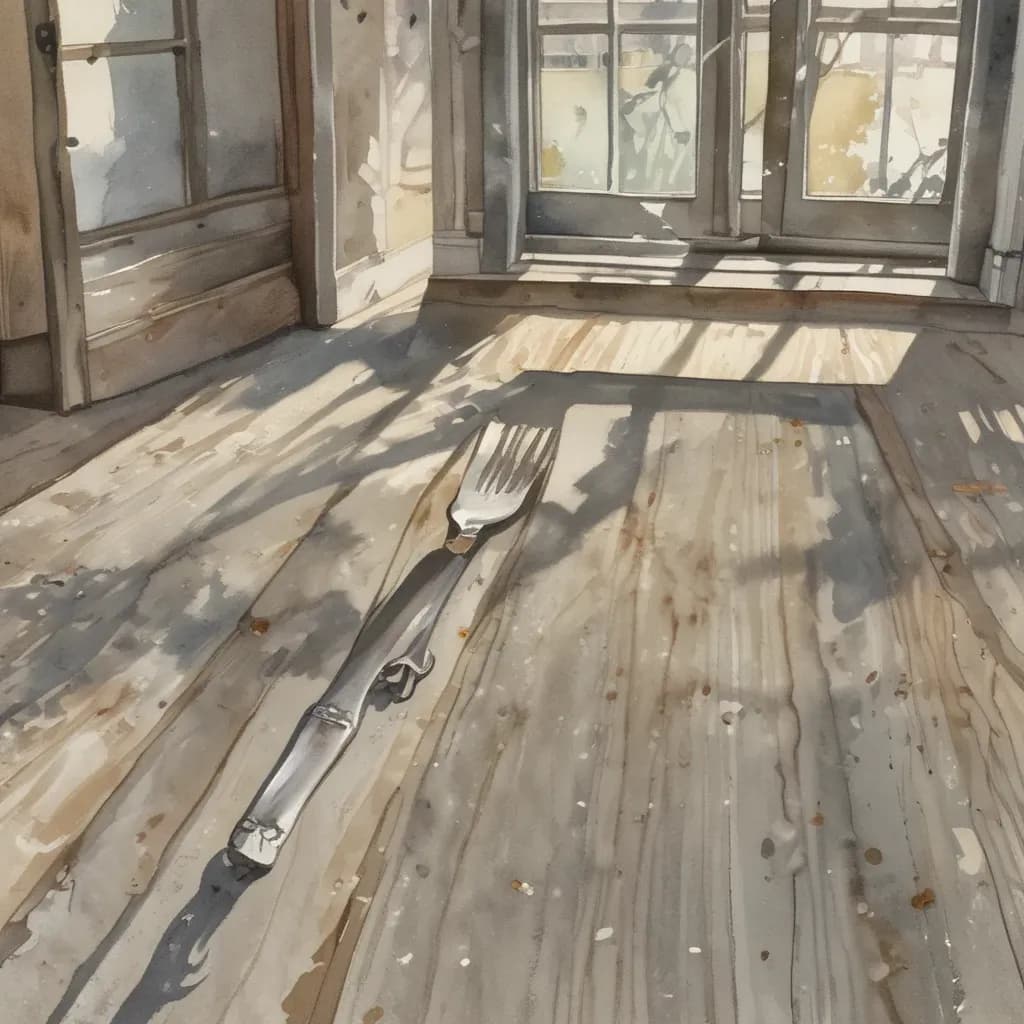
No single element of the song has generated as much discussion as its opening image involving a fork. Carpenter has explained in interviews that the lyric was not crafted as a poetic device but transcribed almost verbatim from something she actually said aloud to herself: she found herself getting emotionally worked up over a fork her ex had once used, recognized the absurdity of that reaction, and voiced it almost as a joke. She recalled thinking it might make a lyric, and her collaborators agreed to keep it[5].
The fork works because it is indefensible as a symbol. A rose is expected. A photograph is understandable. A fork is ridiculous. And grief that arrives through the ridiculous is often more emotionally true than grief that arrives through the cinematic. Carpenter described her intention with disarming directness: sometimes at the end of something painful, the smallest thing in the world can set you off, and it can be anyone or anything or any little minuscule detail[5]. The song trusts that universality.
The lyric became a genuine cultural artifact. Audiences began bringing actual forks to Carpenter's live shows, a collective identification with the absurdity of grief's ordinary triggers. Carpenter has noted with some unease that a venue full of forks looks alarming from the stage, resembling pitchforks from a distance[5]. The object became a shared shorthand for a community recognizing something true about how loss actually works.
Memory, Distance, and Self-Aware Longing
The song holds a rooftop memory at its structural center: late-night conversations, the kind of extended intimacy that functions as proof that something was real. The memory is not deployed as simple nostalgia. It is positioned against the current emotional distance as an unanswerable exhibit. This is what existed. How did we arrive somewhere so different?
The narrator's pain lives precisely in that gap. She is not mourning something she never had. She is mourning a version of a relationship that she has firsthand evidence existed. The warmth of the rooftop makes the coldness of the present more specific, and more devastating.
There is also a quietly devastating self-portrait running through the song. The narrator recognizes that she keeps making excuses for the other person's emotional unavailability, and she acknowledges that she keeps doing it anyway. The song does not judge this quality. It renders it as simply true. The intellectual understanding that someone is not prioritizing you, and the emotional inability to stop prioritizing them in return, coexist without resolution in the same body, and both states are given equal standing.
This is where Carpenter's songwriting maturity on the album shows most clearly. An earlier, more defensively constructed version of this song might have moved more quickly toward indignation or resolution. "how many things" sits in the fog and stays there deliberately. Its refusal to assign blame or reach a tidy conclusion is not a failure of nerve. It is its most honest formal choice.
Critical Reception and Cultural Moment
"emails i can't send" received substantial recognition at the end of 2022, appearing on Rolling Stone's 100 Best Albums of the year (at No. 44) and Billboard's 50 Best Albums (at No. 19)[1]. Critics noted the album's wide tonal range. One reviewer observed that "how many things" functioned as an admittedly lovely acoustic passage that felt stylistically distinct from the record's more uptempo material[6]. Kayla Beardslee at In Review Online called the album as a whole one of the best pop surprises of the year[7].
For Carpenter, the album marked a decisive shift in how she was perceived critically. Where her earlier work had been understood largely through the lens of her Disney Channel origins, the confessional depth of "emails i can't send" made that framing feel insufficient. Audiences arrived with biographical context, primed by the broader discourse around the overlapping songs released by Carpenter, Rodrigo, and Bassett. But "how many things" does not require that context. It rewards listeners who bring it while standing firmly without it. The arithmetic of unrequited attention is not specific to any particular love triangle.
Reading the Song Beyond Its Biography
While the biographical context linking the song to Carpenter's relationship with Bassett is widely understood and partially confirmed by the album's own narrative arc, "how many things" does not require that assignment to function. The emotional situation it describes, being consumed by someone who may not register you at all, applies to any intimate relationship where affection has become lopsided, and to friendships, family bonds, and creative mentorships that faded or soured.
Some listeners have read the narrator's self-aware excuse-making not merely as a personal failing but as a gentle diagnosis of a broader romantic mythology: the idea that patience and sustained devotion will eventually be noticed and returned. Under this reading, the song's closing question is not only grief but the edge of a reckoning, the moment just before a person decides whether the excuse-making is something they can continue to sustain.
The album also contains threads about paternal disappointment and emotionally withholding figures outside of romance. Carpenter has spoken about the inspiration behind the title track as involving someone she looked up to who let her down, an experience that changed how she loves and receives love[5]. The emotional territory of "how many things" is wide enough to hold those readings as well.
An Unsent Letter, Found
What "how many things" ultimately achieves is the feat of making a deeply personal accounting feel universal without flattening what is specific about it. The fork remains a fork. The rooftop remains a particular rooftop. The closing question remains the question that a specific person was afraid to send.
Carpenter described the album as a time capsule of a period in her life when she dealt with many things for the first time[3]. She wrote its songs as private correspondence, treating each draft as something she could say freely because no one would hear it[2]. "how many things" sounds like that. It sounds like something found in an unsent folder: honest past the point of strategy, raw with the specificity of lived experience, and arriving at the ache of something that mattered more to one person than it probably did to the other.
On the album's two-year anniversary, Carpenter wrote that it had changed her life in many ways[5]. Listening to this track, that is not hard to believe. This is what it sounds like when someone stops covering up and just feels it, fork and all.
References
- Emails I Can't Send - Wikipedia — Album overview, chart performance, critical reception, and release details
- Sabrina Carpenter on 'Emails I Can't Send' — Rolling Stone interview about vulnerability, fighting defensiveness, and the album's songwriting approach
- Sabrina Carpenter On Healing Through Songwriting — Nylon interview covering the album's emotional process and Carpenter's private writing method
- Sabrina Carpenter - Wikipedia — Biographical overview covering the Driver's License drama, Disney career, and transition to Island Records
- Sabrina Carpenter Explains Her Favourite Lyrics — Carpenter's in-depth explanation of the fork lyric, the album's inspiration, and its emotional origins
- Sabrina Carpenter - Emails I Can't Send (Album Review) — Critical review noting the song's acoustic character relative to the album's broader sonic range
- Emails I Can't Send - In Review Online — Critical review praising the album as one of the best pop surprises of 2022