Hunger of the Pine
There is a kind of longing that does not feel romantic at all. It feels like an empty stomach. It gnaws, it distracts, and it makes everything else in the world look like a meal you cannot reach. "Hunger of the Pine" is alt-J's study of that sensation, a song that treats missing someone as a bodily condition rather than a poetic mood.
It is also one of the stranger lead singles of its era: a lurching, pitch-shifted, deliberately awkward piece of art rock that borrowed a vocal hook from a pop star and then built a story of obsessive yearning around it. It rewards both a casual listen and a long look.
Where the song came from
alt-J came together at the University of Leeds in 2007, where Joe Newman, Gus Unger-Hamilton, Thom Green and Gwil Sainsbury met.[1] Their debut, An Awesome Wave, arrived in 2012 and won that year's Mercury Prize.[1] A band that wins a major prize with a first record inherits an awkward problem: everyone is waiting to see what the second one will sound like.
The follow-up carried an extra complication. Sainsbury left in early 2014, which the band described as a personal decision, so This Is All Yours was made and released in September 2014 by the remaining trio.[1] Reviews were divided. Metacritic's critic average sat around 70 out of 100, with some outlets praising a bolder, more cohesive vision and others finding it a record lost in its own cleverness.[2][3]
"Hunger of the Pine" was the record's lead single, and it announced that the band had no interest in repeating themselves.[4] It is angular where the debut was often hushed, and playful in a way that could be easy to miss on first contact.
Longing as a physical need
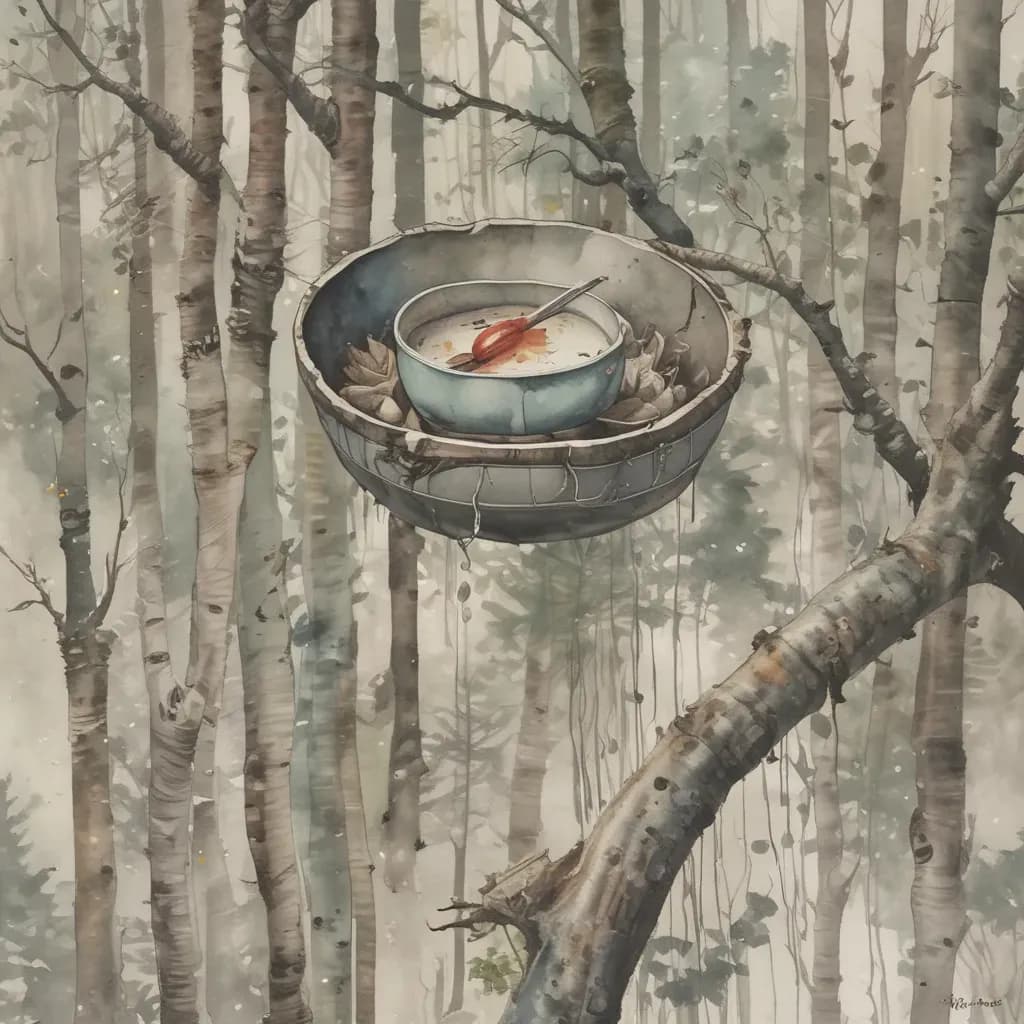
The most useful clue to the song's meaning comes from Gus Unger-Hamilton, who explained that the lyrics mainly suggest the idea that missing someone, pining, can be a physical pain much like hunger.[5] The title does the work in one stroke. Pining is both the ache of absence and, in the title's wordplay, the tree. A pine is evergreen, rooted, and indifferent to the seasons, which makes it a good image for a feeling that refuses to fade.
Once you hold that reading in mind, the song's whole posture makes sense. The narrator is not reflecting calmly on a lost love. He is depleted, fixated, and a little feverish. Desire is described in terms of appetite and deprivation, and the mood is closer to a craving than a heartbreak ballad.
This is a smart choice, because hunger has no dignity. Nobody sounds noble while starving. By framing yearning as something that hollows the body, the song strips away the self-flattering glow that love songs often give to their sufferers. What remains is need, plain and a little undignified.
The sound of an appetite
The arrangement supports the idea that something is off balance. Newman's voice, always a distinctive instrument, is bent and stretched, sometimes sounding almost like it is being pulled in two directions at once. The rhythm lurches rather than flows, and the textures shift from sparse and tense to suddenly full. It never settles into a groove that lets the listener relax.
That restlessness is the point. A comfortable beat would suggest a comfortable narrator. Instead the track keeps the listener slightly hungry too, withholding resolution and returning to its central, nagging gestures like a mind that cannot stop circling the same thought.
The borrowed voice
The most talked-about element of the song is the sample. Midway through, a female voice cuts into the track with a short, defiant declaration of independence, lifted from Miley Cyrus's 2013 song "4x4."[4] The origin story is surprisingly casual. Thom Green had made a remix of "4x4," and while the band worked on this song in the studio they realised that a fragment of that remix fit their track perfectly.[6][7]
Asked whether the borrowing was meant as provocation, Green's answer was disarmingly simple: it just sounded good.[7] Newman added that Cyrus was relaxed about the use and had been very supportive of the band.[7] Reports also say she helped when licensing talks became difficult.[6]
The band's modesty about the choice does not stop listeners from reading meaning into it, and that is fair, because the effect is striking. Inside a song about a male narrator consumed by want, a woman's voice breaks in to assert herself. It works as a counterpoint: the object of desire, or at least a voice from outside the narrator's fixation, refusing to be a passive prize.
A band that likes to disguise feeling
It helps to remember how alt-J usually work. Their lyrics tend to arrive sideways, through oblique images, literary allusions and sudden swerves in perspective, rather than through plain confession. Unger-Hamilton studied English literature while his bandmates studied fine art, and that mix of word-minded and image-minded sensibilities shows up in how the songs are built.[1]
"Hunger of the Pine" is a good example. The emotion at its center is direct and almost embarrassingly simple: I miss you, and it hurts. But the song never says so in a straightforward way. It routes the feeling through a pun, a body metaphor, a sample from a pop record and a video about a man being shot at in the woods. The disguise is the style, and the feeling underneath is strengthened by the effort it takes to find it.
That approach also explains why the song can feel cold at first and then grow warmer. The surface is arch and clever. Only after a few listens does the repetitive, circling quality of the music begin to feel like what it is: a mind stuck on a single person.
The sample as a mirror
It is worth lingering on the Cyrus sample once more, because it complicates the song in a useful way. A track about a lovesick man could easily have drifted into self-pity. The sudden appearance of a confident, independent voice interrupts that. It reminds the listener that the person being missed has a perspective of her own, and that the narrator's hunger says more about him than about her.
Seen this way, the sample works as an unspoken rebuke to possessive longing. The narrator may feel starved, but nobody owes him a meal. The moment is brief, and the band have been clear that they chose it because it sounded right.[7] Even so, the best pop collisions are often accidents that turn out to mean something, and this is one of them.
The cross-genre borrowing also fits the album's wider restlessness. This Is All Yours moves between delicate acoustic passages, dense electronic textures and moments that sit nearer to pop than the band's reputation suggests.[2] Putting a fragment of a mainstream pop single into the middle of an art-rock lead single announced that the band would not stay in a single lane.
Alternative readings
The video offers a second way in. Directed by Nabil Elderkin from a concept by Newman, it shows a man running through a forest while arrows fly at him from all sides.[8] It is a literal-minded image of pursuit, and it invites a different interpretation: longing as an attack. The pining does not just sit in the narrator's stomach. It chases him, and no amount of running will let him escape it.
Some listeners hear the song more broadly, as a piece about obsession in general, whether for a person, a place or a state of mind that has gone. The tree imagery supports this. A forest can be a refuge, a trap or simply a setting where you are lost, and the song never commits to one.
There is also a more playful reading. alt-J have always enjoyed puns, odd narrative angles and the pleasure of ambiguity. The title's double meaning, the sample dropped in without ceremony and the video's absurdly relentless arrows all suggest a band who take emotion seriously while declining to take themselves too seriously. The song can be sincere and a joke at once.
Why it endures
Many songs about missing someone try to sound beautiful. This one tries to sound accurate. Longing, for most people, is not elegant. It is distracting and physical and faintly ridiculous, and "Hunger of the Pine" captures all of that without apologising.
It also marks a moment of transition for the band. Reduced to a trio, they chose for their return a single that was bolder and odder than anything they had to prove. That decision, to sharpen their strangeness instead of smoothing it, is part of why the track still stands out within their catalogue.
In the end the song asks a simple question and answers it with a shrug and a crooked smile. What does it feel like to miss someone? Like being hungry, it says, and like being chased. Anyone who has lain awake craving a voice, a face or a particular kitchen light will know exactly what it means.
References
Keep reading
More Art Rock
- The Rain Song Led Zeppelin
- Another Brick in the Wall, Pt. 2 Pink Floyd
- The Greatest Show On Earth U2
- Motion Picture Soundtrack Radiohead
- Starman David Bowie
- Rock 'n' Roll Suicide David Bowie