I Had a Dream She Took My Hand
There is a particular cruelty to the dreaming mind. It conjures warmth, intimacy, the sensation of another person's hand clasped around yours, and then, at the moment of waking, it vanishes. You are left grasping at nothing, trying to reconstruct a face, a name, a feeling that was completely real seconds before. "I Had a Dream She Took My Hand" lives entirely inside that moment of dissolution. As the third track on James Blake's seventh album "Trying Times," it transforms what sounds like a simple romantic reverie into something far more unsettling: a meditation on the fear of losing love itself.
A Song Born from Return
Blake released the song in February 2026 as the second advance single from "Trying Times," a record that already carried substantial expectations.[1] The album arrived on March 13, 2026, on his own Good Boy Records label, following his departure from Republic Records after more than a decade in the major label system. It was a significant moment of recalibration, one that coincided with another major life shift: his move back to London after roughly eleven years living in Los Angeles.
That return to his home city carried emotional weight. London shaped Blake's early sensibility: its grey post-industrial atmosphere, its debt to dub and reggae, its art school experimental margins, all of it feeding into his music's particular combination of warmth and austerity. Coming home as a Grammy-winning artist who had collaborated with Beyonce, Kendrick Lamar, and Frank Ocean, and who had consciously stepped away from the machinery of major label music, he brought a complex emotional history with him.
"Trying Times" grew from this confluence of personal and professional change. Blake described it in conversation with NPR as a confrontation with what he saw as the relentlessness and fragmentation of contemporary life, his sense that people's capacity for empathy was eroding under the weight of constant noise and algorithmic provocation.[2] Love, on this album, is positioned as both refuge and argument: the thing worth holding onto precisely because everything else threatens to dissolve. The title track, also on this site, lays out those terms most explicitly. But this song establishes the stakes first.
The Sample and What It Carries
The track is built on a sample from "It Was Only a Dream" by Thee Sinseers, an East Los Angeles ensemble whose work draws on the lowrider sweet soul tradition of the California Chicano community.[3] Their original, released in 2019 on Colemine Records, carries a Lynchian quality: reverb-heavy, doo-wop inflected, evoking a particular mid-century American dreamscape. Critics initially mistook the sampled material for a genuine 1950s standard, which says something both about how seamlessly Blake incorporated it and about how powerfully the older idiom communicates longing across time.
The choice is deliberate and rich with meaning. Sweet soul music, particularly in the lowrider tradition, has always been music about yearning, about wanting something to last that is already slipping away, about sustaining beauty and tenderness against difficult circumstance. By building his song on that foundation, Blake locates his own dream imagery within a much longer human project: the effort to preserve what we love in the face of its inevitable fragility.
The musical arrangement amplifies all of this. Beginning with voice and piano in characteristic stripped-back mode, the track builds, as Stereogum noted, into a reverb-drenched choral swell over a live drummer, the sound expanding from intimacy to something approaching the sacred.[4] The doo-wop and gospel inflections carried in from the Thee Sinseers material give the whole track the quality of music performed for its own sake, against all odds: the way the song itself, in its central images, describes devotion.
Dreams, Ascent, and the Physics of Love
The song's central narrative traces a subconscious romantic encounter that carries the speaker skyward. Blake's imagery works through contrasts, a sense of simultaneous elevation and weightlessness, depth and security, that captures exactly the peculiar physics of dream logic, in which extreme sensations coexist without contradiction. Clash Magazine's review identified this dynamic precisely, describing the song as imagining connection as ascent: a lover's touch pulling the narrator away from the ordinary weight of the world.[5]
What makes this potentially euphoric imagery unsettling is the dream frame around it. The hand that offers this ascent belongs to someone the speaker is at risk of losing, and the dream itself is already dissolving even as it occurs. DIY Magazine described the song as "balancing between optimism and unease," which captures how these two emotional currents run together without either canceling the other.[6]
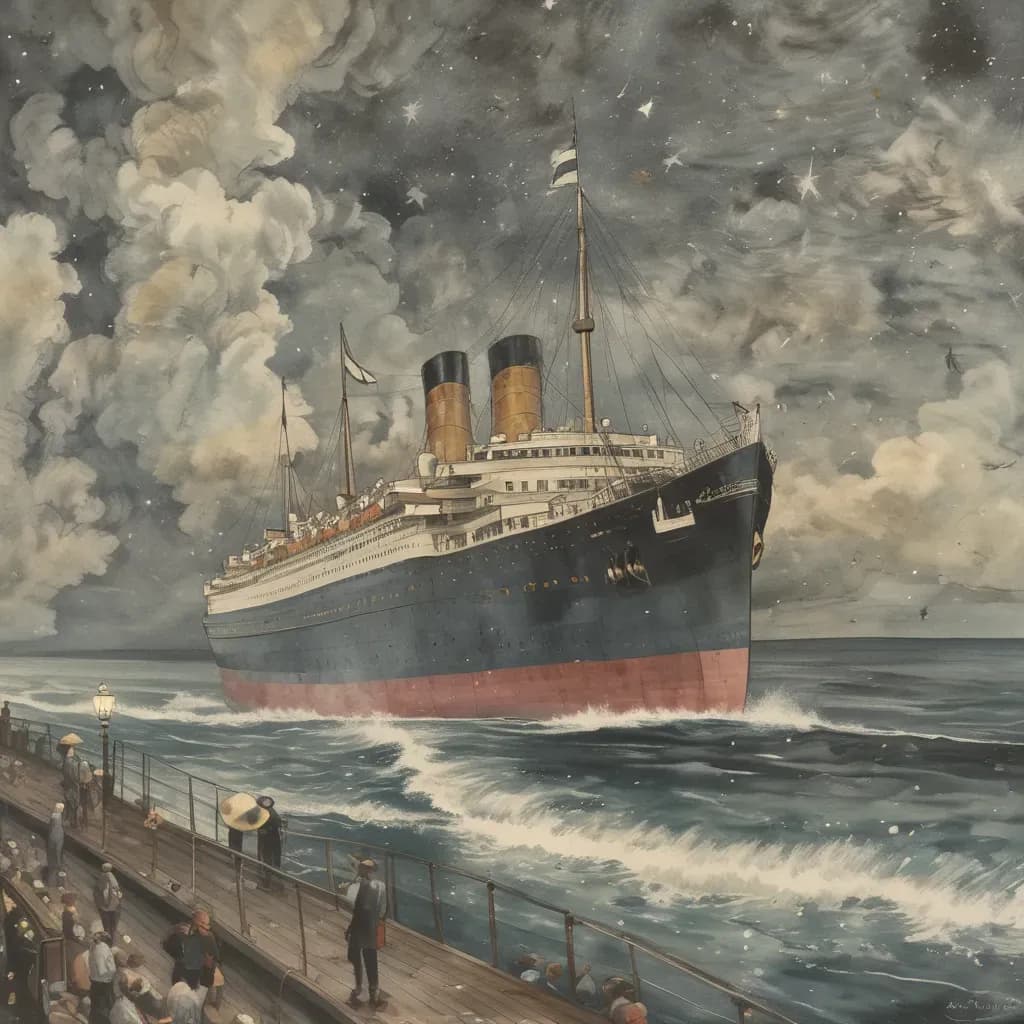
The Titanic reference that appears in the song is the most striking single image. Blake invokes the musicians who kept playing as the doomed ship went down as a figure for a particular kind of devotion: commitment that persists even when rational analysis would suggest its futility. It is one of the more audacious emotional moves in the song. Romantic love, as enacted in this image, is not about outcome or guarantee. It is about the gesture itself, the choosing to keep playing, to keep holding on, regardless of what the water is doing around you.[7]
The Terror of Forgetting
The song's emotional logic then folds in the terror of forgetting. The outro circles the horror of waking from the dream to discover the specific details slipping away: the face becoming indistinct, the name dissolving before it can be spoken. This is not just the mechanics of how dreams work. It maps onto something deeper, the anxiety that love can make itself feel unforgettable only to be lost anyway, that the person who felt like salvation might become someone whose face you can no longer fully reconstruct.
Blake has spoken throughout his career about using music as what he calls "word painting," shaping sounds to match and deepen lyrical meaning.[2] The musical architecture here enacts the forgetting it describes: the reverb that blurs the choir's edges, the piano notes that sustain and then fade, the production that refuses clean resolution. You hear the dissolution as it happens.
Jameela Jamil and the Shape of the Song
Jameela Jamil's role as executive producer on "Trying Times" is documented in Rolling Stone's coverage, and it matters for understanding how this song arrived in its final form.[8] Blake credited her musical judgment as transformative for the album, describing her intuition for what makes songs reach their fullest potential as unmatched. "It's impossible to overstate how much you've transformed these songs," he wrote in the album credits. For a track as delicate and precisely calibrated as this one, that kind of careful attention to what works and what is superfluous matters enormously. The song's restraint, its willingness to leave space, feels like the product of exactly that kind of deliberate shaping.
Independence and the Soul Revival
The song arrives at a moment when the soul and doo-wop revival has been gathering energy in independent American music, particularly through labels like Colemine Records and artists in the Chicano soul tradition.[3] Blake's engagement with Thee Sinseers' work is not stylistic tourism. It reflects genuine affinities: the same interest in emotional directness, in the voice as primary instrument, in music that stakes everything on whether the feeling is true.
As with the broader "Trying Times" project, the song's independence from major label structures allowed Blake to make this kind of left-field, emotionally committed choice without calculating its commercial angle. NME described it as a "romantic waltz" upon its single release, noting how it departs from the more electronic textures of his recent work while remaining unmistakably his.[1] Far Out Magazine's review of the album noted how Blake's stylistic range on "Trying Times" showcases "more sides to his artistry" than previous records.[9]
Multiple Readings
Some listeners have heard the song autobiographically. The Titanic imagery and the dream of a lover taking his hand can be read as Blake's meditation on his own relationship with Jamil, particularly in the context of the life upheaval that preceded the album, the move, the career pivot, the years of intensive collaborative work together.
Others have placed its meaning in Blake's broader stated concerns about the erosion of empathy: love in the song becomes a figure for all kinds of connection, not merely romantic partnership, and the dream-logic dissolution maps onto a wider cultural anxiety about what we fail to hold onto.[10]
The song also sustains a reading in which the "she" of the title is more ambiguous, not necessarily a romantic partner but something like a feeling of hope itself, a sense of possibility that appears in dreams and threatens to vanish by morning. All three readings are available at once, and the song does not choose between them.
Keep Playing
What "I Had a Dream She Took My Hand" ultimately does is locate a very old human fear, the fear that love is not sturdy enough to hold, in very contemporary circumstances. The song does not resolve the anxiety it raises. It holds it, the way a hand holds another hand, knowing the grip is not permanent, keeping it anyway.
That combination of vulnerability and insistence is what makes this song worth returning to. The Titanic image insists that the answer to impermanence is not detachment but deeper commitment: the willingness to keep playing even as everything tilts. Blake has described his goal on this album as confronting the relentlessness of modern life not with resignation but with love as both shield and argument. Here, in three minutes of piano, falsetto, and a doo-wop dream, is the clearest statement of that case.[7]
References
- James Blake shares romantic waltz 'I Had a Dream She Took My Hand' (NME) — Single announcement with description of the track as a 'romantic waltz' and musical analysis
- James Blake discusses 'Trying Times' on NPR Weekend Edition — Blake on word painting technique, empathy erosion, and return to London
- Thee Sinseers 'It Was Only a Dream' songwriter info (peermusic) — Details on the Thee Sinseers original track sampled in 'I Had a Dream She Took My Hand'
- James Blake 'I Had a Dream She Took My Hand' (Stereogum) — Song premiere and review detailing the musical arrangement including choir and live drums
- James Blake 'Trying Times' album review (Clash Magazine) — Full album review discussing the song's imagery of love as ascent and fragile connection
- James Blake 'Trying Times' album review (DIY Magazine) — Album review describing the song's balance between optimism and unease
- James Blake interview: Trying Times (Pigeons and Planes) — In-depth interview on independence, creative process, and thematic concerns of the album
- James Blake on 'Trying Times' and Jameela Jamil's role (Rolling Stone) — Interview documenting Jamil's executive producer role and creative contribution to the album
- James Blake 'Trying Times' album review (Far Out Magazine) — Review praising the album's stylistic range and multiple sides of Blake's artistry
- James Blake enters the quiet storm with 'I Had a Dream She Took My Hand' (New Wave Magazine) — Single review discussing the song's themes of love, disorientation, and commitment in impossible circumstances