Inanimate Sensation
The title alone does the work of contradiction. "Inanimate Sensation" names something that should be impossible: an experience of feeling attached to objects that cannot feel, or perhaps a numbness so total it passes back into something like presence. In this single phrase, Death Grips compress what they have always been saying about modern life: that aliveness and deadness no longer occupy opposite ends of a spectrum but blur into each other in the glow of a screen, the thud of a bass drop, the hollow ritual of being connected while remaining fundamentally alone.
A Transmission From the Void
The song arrived under circumstances that were unusual even by Death Grips' theatrical standards. In July 2014, the trio announced via a handwritten note posted to Facebook that Death Grips was over.[1] There was no press release, no farewell tour, no official statement from a publicist. Just a napkin, a few words, and silence. The announcement came as the band was scheduled to support Nine Inch Nails and Soundgarden on a major tour, a slot they simply never filled.[1]
Five months later, in December 2014, without warning, they released "Inanimate Sensation" along with its music video.[2] For listeners who had watched the breakup play out in real time, the song's arrival felt less like a comeback and more like a transmission from a group that had never really agreed to stop existing.
The context matters because Death Grips had built their entire reputation around instability as artistic method. They had previously leaked their own album in order to escape a record deal,[1] stood up crowds by leaving only a pre-recorded playlist playing at a venue,[1] and cultivated a mythology of chaos that made every release feel as though it could be the last. "Inanimate Sensation" was the first evidence that whatever they were doing, it was not finished.
The Powers That B: A Double Album in Contradiction
The song belongs to Jenny Death, the second disc of The Powers That B, Death Grips' double album released on March 31, 2015.[3] The album had been recorded at Sunset Sound Recorders in Los Angeles, produced by Andy Morin.[3] The first disc, Niggas on the Moon, had been released as a free download the previous June, featuring all instrumentation performed on a Roland V-Drum kit by Zach Hill, with each track built around chopped vocal samples borrowed from Bjork.[3] Jenny Death, by contrast, swings hard toward rock and punk, enlisting guitarist Nick Reinhart of Tera Melos and organist Julian Imsdahl.[3] It is the most physically loud thing in the Death Grips catalog: drums front and center, guitars howling, synths warping around Hill's relentless kit work.
The gap between the two discs, in both time and texture, tells you something about the band's intention. The Powers That B is not a cohesive double album in the sense that requires both halves to rhyme. It is a document of contradiction, of two impulses that do not resolve. "Inanimate Sensation" sits at the second track of Jenny Death and functions as an announcement: what follows will be dense, aggressive, and not interested in making things easy.
In the months before the album's release, the band put out Fashion Week, an instrumental album whose track titles, read sequentially, spelled out the phrase "JENNY DEATH WHEN" -- a knowing joke about their own impatient fanbase.[3] The gesture was typical Death Grips: part teasing provocation, part genuine self-awareness about the strange co-dependence between artist and audience.
Preferring Objects: Alienation and Dissociation
At its core, "Inanimate Sensation" is a song about preferring objects to people. The narrator repeatedly invokes a sense of deeper connection, a more authentic feeling, with things that cannot feel back: machines, static surfaces, the hum of electronics.[4] This is not presented as merely pathological. It functions as diagnosis.
Critics have identified digital alienation as the song's primary concern.[5] We live, the song seems to insist, in an era when intimate connection is supposedly everywhere: every experience documented, every relationship mediated by a screen, and yet the experience of genuine presence has never been more elusive. The inanimate world has in some ways become more reliably responsive than the human one. Objects do not disappoint in the ways people do.
This connects to the broader anxiety running through Jenny Death: what critics described as a sustained attack on the disappearance of authenticity in a media-saturated and image-obsessed society.[6] Themes of fraudulence, constraint, and the hollowing-out of experience recur across the album. "Inanimate Sensation" addresses these concerns through their most intimate and paradoxical version: not the macro-scale corruption of cultural institutions, but the private experience of feeling more alive in the company of a dead thing than a living one.
There is also a dissociative quality to the song's affect. The narrator does not seem distressed by this preference. MC Ride's vocal performance here deploys extraordinary range: howled passages, chopped-and-screwed growls, whispered asides. The voice occupies the sensation without flinching. Analysts have read this as representing depersonalization, a psychological state in which the self feels unreal or detached, reframed not as disorder but as default mode.[5] The song is not mourning a lost capacity for connection. It is reporting from a state in which the distinction between animate and inanimate has simply stopped mattering.
The sonic construction reinforces all of this. The track features seasick bass synths and an erratic rhythmic structure that keeps listeners consistently off-balance, mimicking the disorientation the lyrics evoke. What one critic described as an industrial version of a house music drop[7] arrives at the song's center like a structural collapse, an internal implosion that resets the terms of what you were just listening to. The song is built to feel like what it describes.
Buried inside the production is a remarkable act of sampling. "Inanimate Sensation" draws on both The Beatles' "Mean Mr. Mustard" and AC/DC's "For Those About to Rock (We Salute You)".[8] The Beatles reference is worth sitting with: "Mean Mr. Mustard," from Abbey Road, is itself a portrait of a strange man who lives according to his own alien interior logic, hoarding and hiding from the world. Death Grips pull from this song not to comment on it directly but to fold its atmosphere into their own, adding another layer to the portrait of private worlds sealed off from social legibility.
The Fallen Screen: The Music Video
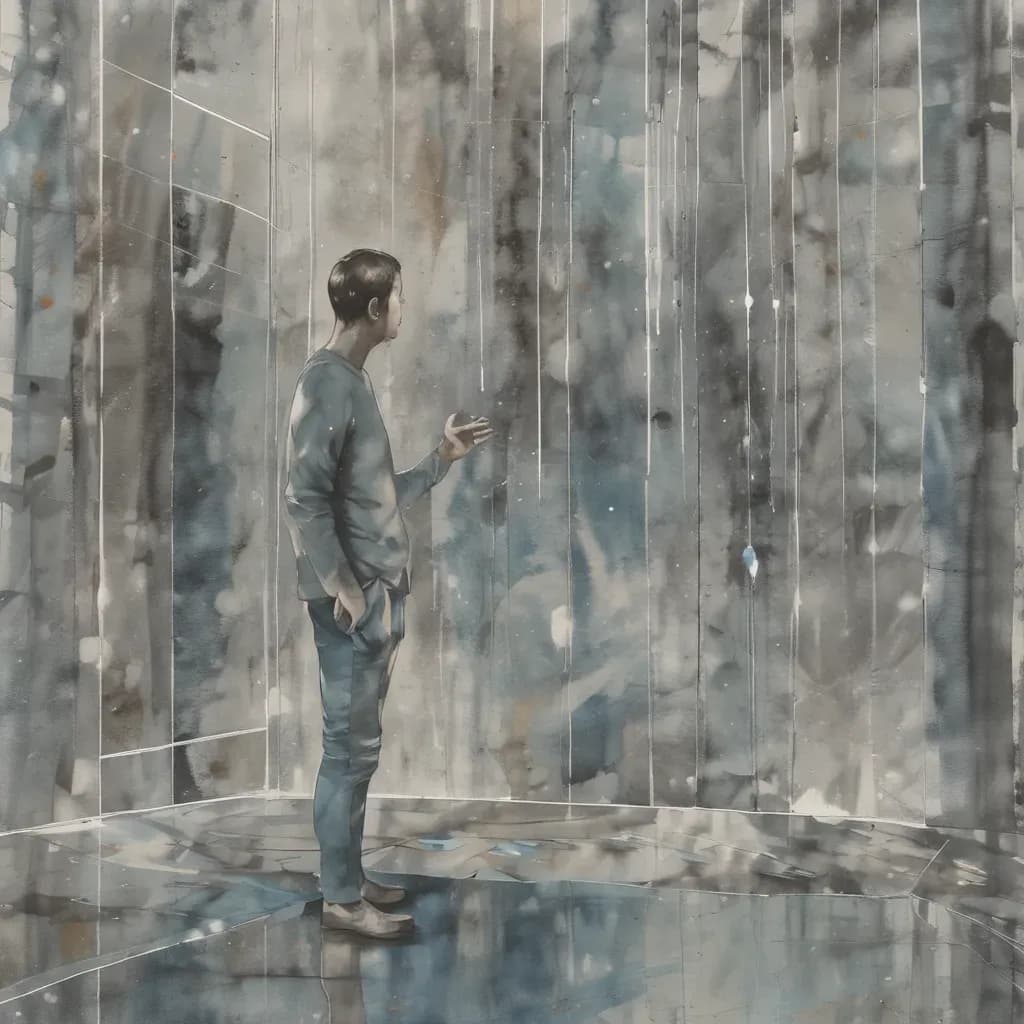
The music video, directed by the band themselves, is one of the most evocative visual statements in their catalog.[9] It takes place inside an empty indoor basketball arena at night. The arena's jumbotron has crashed to the floor at an angle, surrounded by debris. All of the action, distorted and glitching footage of MC Ride performing, plays out on this fallen screen, looping and stuttering in sync with the music.
The image is precise in what it communicates. The arena, an architecture of spectacle, has been emptied of its audience. The giant display, designed to show a crowd something too large to see with ordinary vision, has collapsed inward. The technology meant to amplify presence is now pointing at no one, projecting into the void of a space where communal experience used to happen. The video does not narrate the song so much as provide a visual equivalent: the spectacle of aliveness, going through its motions, for an audience of zero.
The choice to premiere this footage in December 2014, five months after announcing the band's end, adds another layer entirely. This was the first thing listeners saw after being told there would be nothing more. The jumbotron on the arena floor, still running, still broadcasting, still impossibly present: that is also a description of Death Grips' relationship to their own dissolution.
Cultural Significance
"Inanimate Sensation" holds a specific place in the Death Grips catalog as the song that signaled the band's refusal to actually be finished. Pitchfork awarded it Best New Track and noted that it comes closest to the "aggro-pop heights" of earlier Death Grips work, making it clear why it was selected as the first single.[2] It was widely recognized as a return to form: the drums really driving, the production operating at the level of the band's most focused work.
The song arrived at a moment when Death Grips had become something larger than a band. They had become a genre unto themselves, a reference point for a generation of artists and producers who found in their work a model for how to be extreme without being merely loud, how to be confrontational without being merely provocative. The release of "Inanimate Sensation" reminded listeners what that model actually sounded like in practice.
More broadly, the song captures something about its cultural moment that has only become more legible with time. The observation that technology and objects increasingly mediate our experience of our own emotions was not new in 2014, but Death Grips gave it a sound that was genuinely frightening and genuinely pleasurable at once. The "sensation" in the title is real, even if what triggers it is not supposed to be capable of doing that.
Alternative Interpretations
Some listeners have read "Inanimate Sensation" primarily through the lens of MC Ride's known psychological disposition. His stated distrust of human beings and of media, documented across the band's early career,[1] maps closely onto the narrator's apparent preference for inanimate things. In this reading, the song is less social critique and more personal confession: a portrait of what it actually feels like to be someone who finds objects more reliable than people.
Others have read the song's title and thematic content as meta-commentary on the Death Grips "breakup" itself. If the band can announce their own death and then reappear as though nothing happened, what does that say about the distinction between alive and not alive? The song, on this reading, is the sound of an entity performing its own continuation from a state of official non-existence. It is a sensation produced by something that should, by its own account, be inanimate.
Neither reading cancels the other. Death Grips' best work tends to hold personal, social, and structural registers simultaneously, which is part of why their audience finds so much to argue about.
Conclusion
"Inanimate Sensation" is a portal. It opens onto one of the stranger and more honest questions that contemporary life keeps generating: what does it mean to feel most alive in relation to things that cannot feel? Death Grips do not answer the question. They build a sound around it, drop a jumbotron on an empty arena floor, and let the display keep running. The image keeps projecting. The bass keeps moving. Whatever you call that -- living or not living -- it has not stopped yet.
References
- Death Grips - Wikipedia — Band biography, breakup announcement, label history, and career timeline
- Inanimate Sensation - Wikipedia — Overview of the single, release history, critical reception including Pitchfork Best New Track
- The Powers That B - Wikipedia — Album context, recording details, track listing, and chart performance
- Inanimate Sensation Lyrics Meaning - Song Meanings and Facts — Detailed lyrical analysis covering themes of inanimate objects and human disconnection
- Meaning of 'Inanimate Sensation' - SongTell — Thematic analysis including digital alienation and depersonalization
- Album Review: Death Grips - Jenny Death - Consequence of Sound — Critical review identifying the album's themes of authenticity and media saturation
- Death Grips 'Inanimate Sensation' Review - buffaBLOG — Single review describing the track's production and calling it an industrial house music drop
- Inanimate Sensation samples The Beatles 'Mean Mr. Mustard' - WhoSampled — Documentation of samples used in the track including The Beatles and AC/DC
- Watch the Video for Death Grips' 'Inanimate Sensation' - The FADER — Music video premiere coverage describing the fallen jumbotron concept