Jetta
The Car at Night
There is something about a car after dark that collapses the usual distances between people. The windows fog, the city blurs past in smears of amber and neon, and whoever is beside you in the backseat becomes briefly, unusually present. Arlo Parks understands this. Her song “Jetta,” the second track on her third album Ambiguous Desire (2026), lives entirely inside that pocket of time.
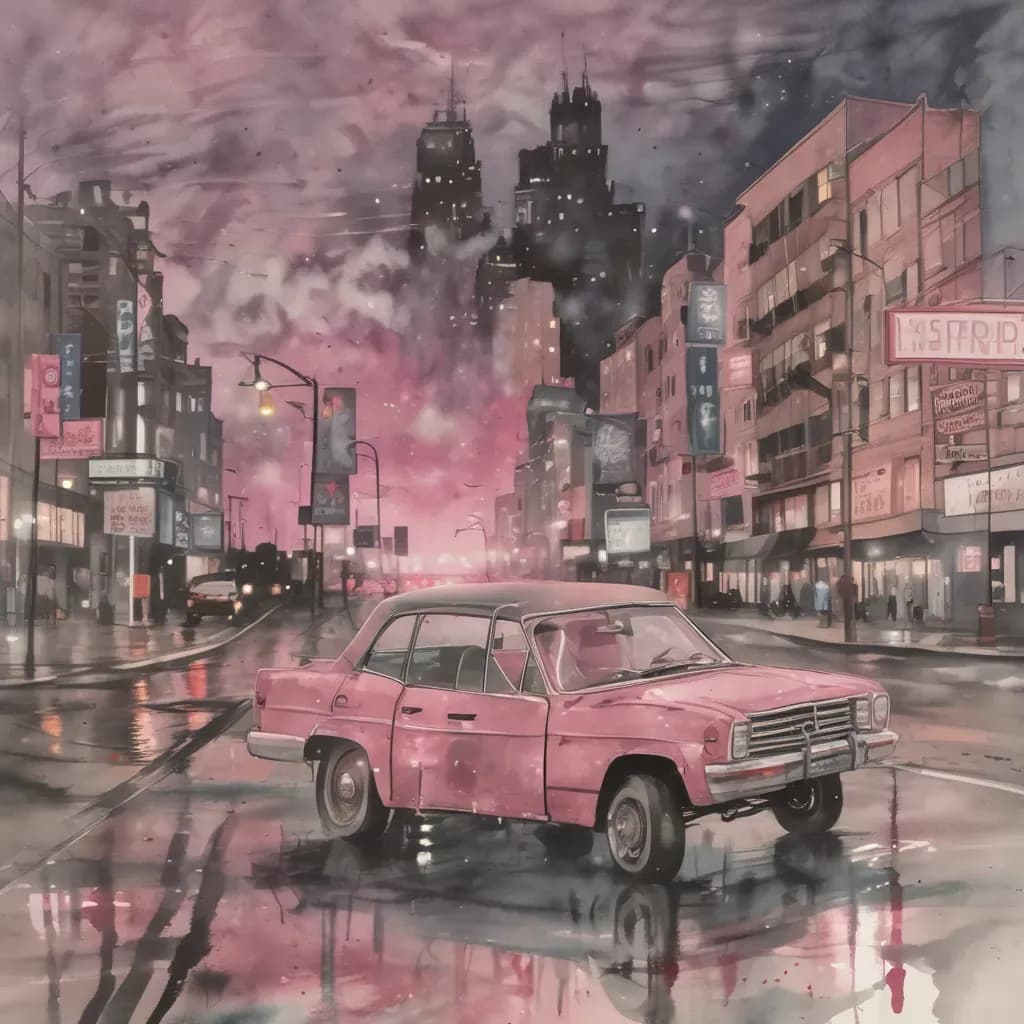
It is a compact song, running just under three minutes, but Parks fits a whole nocturnal world into it: a woman named Cindy stepping out of a car in leather and pink chrome, the low thrum of anticipation before a night begins, the particular helplessness of being unable to look away from someone. What sounds like a small subject turns out to hold a great deal.
From Bedroom Poet to the Dance Floor
To understand "Jetta," you have to understand how far Parks has traveled to get here. Born Anaïs Oluwatoyin Estelle Marinho in West London in 2000, she won the Mercury Prize at twenty with her debut Collapsed in Sunbeams, a record of whispered confessions and guitar-shaped pain. Her second album, My Soft Machine (2023), deepened that confessional mode. Then something shifted.
After finishing a tour in New York at the start of 2024, Parks found herself staying in the city, drawn into its underground nightlife. She fell in love with someone who lived there. She spent nights at Nowadays and Bossa Nova Civic Club in Brooklyn, at Venue MOT in London, absorbing the textures of these spaces after dark.[1] She found herself in what she has described as “the weird underbelly of New York juke nights,” dancing more than she ever had before, making more friends, discovering a version of herself that was unguarded and present.[2]
The album that grew from these experiences, released April 3, 2026 via Transgressive Records, traded Parks’ signature acoustic intimacy for breakbeat rhythms, modular synthesizers, and production textures drawn from UK garage, trip-hop, and ambient techno.[3] Critics drew comparisons to The Streets, Burial, LCD Soundsystem, and Theo Parrish: artists who found the epic inside the granular texture of urban nightlife.[3] “Jetta” sits near the album’s opening and functions as a kind of manifesto: this is the new territory, and it is intimate in a completely different way.
The Documentary Impulse
The song began with an actual moment. Parks was riding with a group of friends in New York, everyone crowded in a car, sorting out who controlled the music, the night still ahead of them. She filmed it. She felt compelled to capture the scene because these were people who rarely got to spend time together, and there was something in that ordinary collision of bodies and voices that she did not want to lose.[4] Recording real voices from real nights out, she has said, made the track feel “really lived in” and helped listeners feel connected, “like they’re bearing a part of themselves.”[4]
This impulse, to document rather than merely to emote, distinguishes Parks from many of her contemporaries. Where other songwriters abstract feeling into imagery, Parks insists on the concrete. She names people. She describes what they are wearing. She places characters in specific rooms at specific hours. On this album, she spoke of wanting to populate her songs with “peripheral characters drawn with care and intention,” people who would feel real because they were real.[5]
Cindy, arriving in leather and catching the light in a very particular way, is not a symbol or a composite. She is someone Parks noticed, in a specific place at a specific hour, and the song is a record of that noticing. This is the difference between a lyricist and a witness.
The Car as Threshold
Parks has spoken about being shaped by McKenzie Wark’s 2023 book Raving, which theorizes the club night as a kind of time that exists outside ordinary time. Wark writes about the “rave continuum” and the particular tension that accumulates between leaving your house and arriving somewhere transformed.[1] “Jetta” captures exactly this threshold state.
The car in the song is not a destination. It is the space between the ordinary world and whatever comes next: the dance floor, the night, the person you might become for a few hours. Parks has always been drawn to borders and transitional states, the moment just before something happens. Here, the Jetta itself becomes a kind of liminal room, a moving container where desire can be felt before it has to be acted upon or named.
The song’s brevity reinforces this. At under three minutes, it does not overstay its welcome in the threshold. It catches the moment and releases it before it can become something else.
Desire in Slow Motion
Parks has described desire as the album’s central animating force: “a life force, a wanting, a yearning, a momentum.”[2] But what makes “Jetta” distinctive is how carefully it renders the physical experience of being caught in that force. The narrator moves through the song in a kind of altered perception, everything slightly slowed, colors more vivid, sensation thickened by the hour and the company. The imagery of blushing in slow motion captures this precisely: attraction registered as a change in the body’s own tempo.
The song describes what it feels like to be unable to detach from a moment, to keep returning to the same image even as the night moves forward. This is the phenomenology of attraction rendered with clinical accuracy. Parks does not sentimentalize it. She simply records the way attention moves when it has been caught by something it cannot release.
There is also an ease in “Jetta” that marks a genuine shift in Parks’ emotional register. Her earlier work often carried a weight of sadness, of loneliness observed from a polite distance. This song is more alive than that. The desire is not painful. It is energetic, curious, present-tense. Even the tension it describes, the narrator’s helpless attachment to the moment, feels more like pleasure than suffering.
A Queer Way of Seeing
Parks is openly queer, and “Jetta” is, among other things, a queer love song. But its queerness is not announced. It is structural. The song’s gaze, the way it moves over surfaces, the precision of its attraction, reflects an experience of looking that has not traditionally been the default in popular music.[6]
Parks has spoken about how nocturnal spaces gave her the freedom to be whoever she wanted on a given night, to move from the fringes to the center of the dance floor and back, to try on different versions of herself without consequence.[6] “Jetta” carries that quality of freedom. It is a song written by someone who has found permission to look at the world on their own terms. The narrator’s attraction is confident, direct, and specific. It does not apologize for what it notices. The leather, the chrome, the particular angle of someone stepping out of a car: these details are noticed because the narrator has decided to notice them, and that act of choosing is itself a form of self-possession.
Where the Song Fits
“Jetta” arrived at a moment when a significant number of UK artists were turning away from guitar-centric indie toward club-influenced production. Parks’ third album drew comparisons to The Streets, Burial, LCD Soundsystem, and Theo Parrish, all artists who made the quotidian nocturnal, who found the epic inside the ordinary night.[3] Parks’ contribution to this tradition is literary. She is writing about club spaces the way The Streets wrote about a particular kind of English social life in the early 2000s: with granular, affectionate attention to specific textures.
“Jetta” is not abstract club music. It is a close-up portrait of one evening, one car, one woman stepping into the light. The production, house-inflected and gently kinetic, does not overwhelm Parks’ voice so much as give it new space to move in. The song demonstrates that Parks’ lyrical instincts remain intact even as her sonic language has expanded.[5]
Critics responded warmly to the album as a whole, with Metacritic recording a weighted average of 76 out of 100 from twelve critic scores, and several outlets describing it as Parks’ most fully realized body of work to date.[7] “Jetta” was noted by multiple reviewers for demonstrating how completely Parks had absorbed the sonic language of her new environments without sacrificing the lyrical precision that distinguished her earlier albums.
Another Way to Hear It
There is a reading of “Jetta” that does not require the queer framework to work. At its most elemental, the song is about the experience of being in a car at night with people you love and not wanting it to end. The desire in the song could be directed at a person, or it could be aimed at the moment itself: the particular quality of that night, that group, that hour. Most listeners will recognize the feeling regardless of who they imagine in the song.
Parks filmed the Uber ride because she wanted to hold onto something. “Jetta” is what happens when you turn that impulse into music. The desire to document is itself a form of love, and that argument sits at the center of the song whether or not you share Parks’ specific vantage point.
What Remains
Parks has said that this album was “about healing, about falling in love, about self-acceptance” and about wanting to understand herself better and her place in the world.[8] “Jetta” carries all three of those aims, but quietly, without announcement. It trusts the listener to feel its emotional weight in the specificity of the images: the leather jacket, the pink chrome, the friends in the backseat, the music finally finding its way through the speakers.
What makes the song endure is not innovation but precision. Parks has never been a maximalist. Even as her production has expanded to include dancefloor textures and breakbeat rhythms, her fundamental impulse remains the same: to notice, to name, to preserve. “Jetta” is a record of a moment that would otherwise have dissolved into the general blur of evenings: friends in a car, the music sorting itself out, a woman stepping into the night with the light catching her just so.
Parks keeps the film. The song is the proof that she was paying attention.
References
- On 'Ambiguous Desire', Arlo Parks turns fleeting nocturnal moments into lasting songs — NME interview covering the New York club nights, McKenzie Wark's Raving as influence, and the rave continuum concept
- Arlo Parks wants to soundtrack your walk home from the club — Xtra Magazine interview about desire as a life force, the juke nights of New York, and the album's emotional core
- Arlo Parks - Ambiguous Desire review — Paste Magazine's review covering the sonic shift to breakbeats, UK garage, and comparisons to The Streets, Burial, LCD Soundsystem
- Arlo Parks is taking her storytelling to the dancefloor — Dork interview with details about the specific inspiration for Jetta: the car ride with friends, filming the moment, the aux cord
- Album Review: Ambiguous Desire by Arlo Parks — Shatter the Standards review noting Parks' approach of populating songs with peripheral characters drawn with care and intention
- Arlo Parks: Nocturnal Awakening — Rolling Stone UK interview about nocturnal freedom, queer identity, and the experience of being whoever you want in club spaces
- Ambiguous Desire by Arlo Parks - Metacritic — Metacritic aggregated critic scores: 76/100 from twelve reviews
- Arlo Parks Wants You To Dance — RANGE Magazine interview about healing, falling in love, self-acceptance, and the album's emotional intentions