Kero Kero Bonito
Some songs announce themselves quietly, and some arrive like a frog jumping into a pond that did not know it needed one. "Kero Kero Bonito," the self-titled sixth track on Kero Kero Bonito's debut mixtape Intro Bonito, does the latter. In roughly two and a half minutes, the London trio introduces itself in a torrent of Japanese and English, frog sounds and buoyant rhythms, playground chants and a name that simultaneously belongs to at least three languages. It is not a song that asks permission.
Background
The band that made this song came into being through an unlikely convergence. Producers Gus Lobban and Jamie Bulled, childhood friends from the south London suburb of Bromley, wanted to make music with a bilingual singer who could move fluidly between English and Japanese. They posted an advertisement on MixB, an online community serving Japanese expatriates in the UK, and Sarah Midori Perry answered.[1]
Perry had grown up in Otaru, Japan, the daughter of a Japanese mother and a British father, until she was thirteen, when her family relocated to England.[1] She had no formal vocal training when she responded to the ad, having spent her earlier creative life playing alto saxophone, painting, and writing fiction. But the three clicked immediately, and a new kind of pop group was born.
The name they settled on is itself a puzzle designed to be unsolvable. "Kero kero" is the Japanese onomatopoeia for a frog's croak, the equivalent of English's "ribbit."[2] "Bonito" is simultaneously a type of fish central to Japanese cooking, a Spanish and Portuguese word meaning "beautiful" or "pretty," and the basis of the Portuguese phrase "quero quero" (meaning "I want, I want," and also the name of a Brazilian lapwing bird).[2] Lobban has said the name was chosen precisely because you cannot determine its origin from a single language, a quality that mirrors the band's identity and their refusal to belong to any one cultural tradition.[2]
Intro Bonito began as a self-released collection posted to Bandcamp and SoundCloud on September 30, 2013, then received an official physical release through Double Denim Records on August 25, 2014, and later expanded to 28 tracks in a Polyvinyl Records vinyl reissue in April 2023.[3] Much of it was built on a Casio SA-46 mini-keyboard, a toy instrument that gives the recordings an 8-bit warmth and deliberate lo-fi charm.[3] The self-titled song occupies track 6, at just under two and a half minutes, and functions as a kind of centerpiece declaration within the record's broader playful manifesto.
A Name as a Worldview
The most striking thing about the song "Kero Kero Bonito" is that its subject is its own name. This is not as self-absorbed as it sounds. The band's name encodes an entire philosophy about identity, language, and cultural belonging, and the song unpacks that philosophy through performance rather than argument.
Perry moves between Japanese and English throughout the track, weaving phrases from both languages together in ways that do not always submit to neat translation. This is not code-switching in the conventional sense, where a speaker moves from one coherent language-world to another. It is something more like code-blending, where the two languages become a single available idiom. It reflects Perry's own biography: she did not simply grow up in Japan and then grow up in England. She grew up in both simultaneously, and her sense of self has never cleanly belonged to either country.[4]
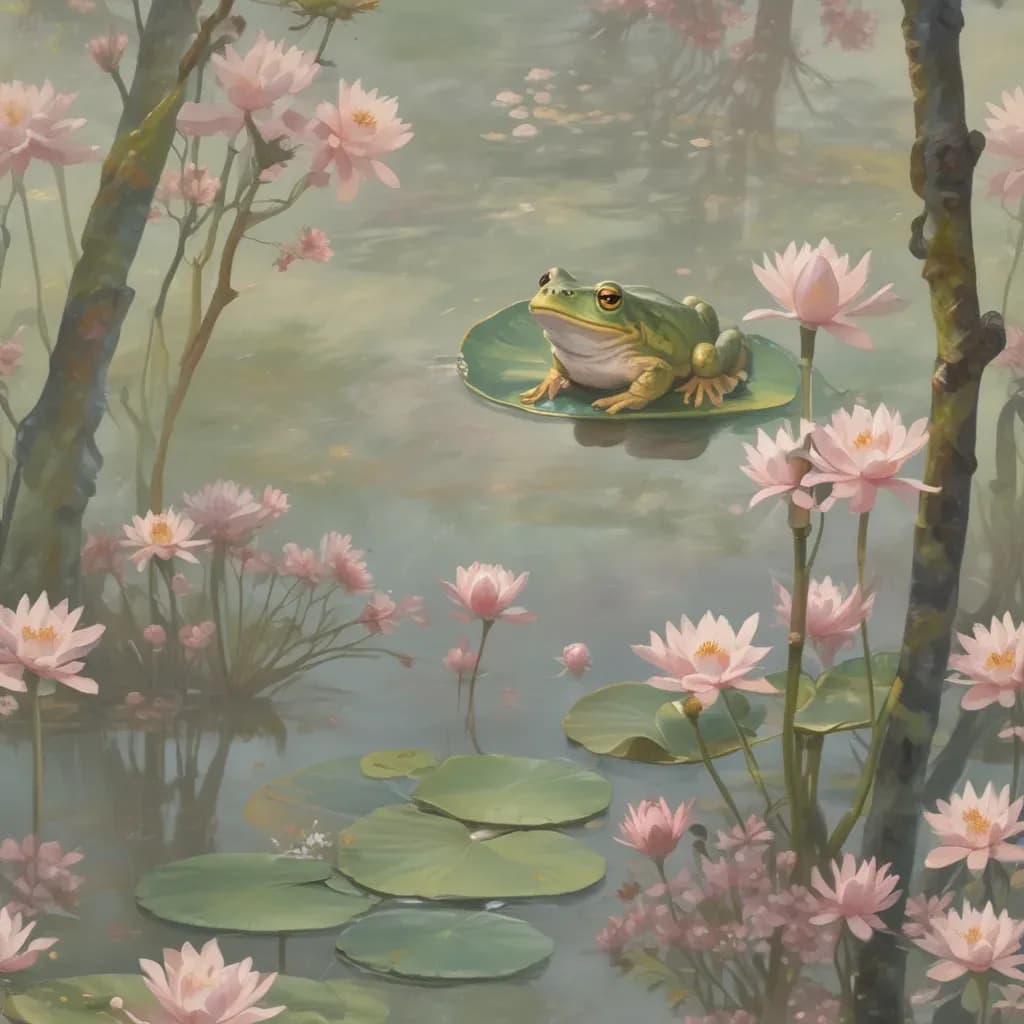
The frog at the center of the song's imagery carries its own layers of meaning. In Japanese, the word "kaeru" (frog) is a homophone for "to return," making frogs a common symbol of safe return and good fortune. A traveler leaving on a journey might carry a small frog charm to ensure they find their way home. The "kero kero" at the heart of the band's name thus vibrates between childlike silliness and something quietly resonant: the sound of a creature that belongs to two worlds, water and land, and is at ease in both.
The song enacts this double belonging. It does not explain the band's mixed origins; it demonstrates them. Every time Perry shifts between languages, or every time the track blends an 8-bit melodic figure with a hip hop cadence, the song is performing the argument that a person or a group can be genuinely multiple without being incoherent.
Radical Positivity as a Political Stance
In a 2016 interview with Stereogum, Gus Lobban articulated something he called "radical positivity."[5] His point was that cheerfulness has been systematically undervalued by music criticism. Albums built on irony, detachment, or darkness get labeled "serious" and rewarded with critical prestige. Albums built on joy get dismissed as lightweight or commercial. Lobban pointed out that this hierarchy is its own form of snobbery, and that the B-52s and Radiohead represent equivalent cultural achievements despite occupying opposite positions in the critical imagination.[5]
The self-titled song is a demonstration of this thesis in miniature. It is relentlessly upbeat, constructed around simple repeated phrases and a call-and-response structure built for communal participation. Critics have noted that it prioritizes live-show energy over studio listening appeal, with the kind of structure that turns a crowd into participants rather than audience.[6] This design is not a failure of artistic ambition; it is the ambition itself.
Bulled has noted that the band's live shows generate mosh pits despite the resolutely cheerful music, which suggests that high-energy positivity and high-energy punk occupy more shared psychological territory than critics typically acknowledge.[5] "Kero Kero Bonito" the song is built for exactly that kind of release. Making a crowd of strangers shout a bilingual frog-fish compound noun together is, in its way, a radical act if you believe that joy is politically serious.
The Language of Belonging
Perry has been clear that she resists being categorized as a J-pop artist. In a conversation with FLOOD Magazine, she said that people can be more than one thing, and that labeling the band as simply J-pop misses the point and makes her feel "a bit strange."[4] Her bilingualism is not a gimmick or a novelty; it is the most accurate way she knows to represent herself.
The song reflects this in its formal choices. It does not present Japanese as exotic decoration over an English-language core, nor does it subordinate English to a Japanese framework. Both languages carry equal weight simultaneously. This is unusual in Western pop, where non-English lyrics are typically either the main event or a flavoring added for atmosphere. In "Kero Kero Bonito," there is no hierarchy between languages.
This formal parity had real significance in 2013-2014, before the global streaming economy began to erode Western pop's cultural dominance. Most Western listeners encountering the song were encountering a piece of music that declined to position English as the default, without making any fuss about it. The song simply behaved as if this were normal.
A Founding Document of Hyperpop
Intro Bonito arrived years before "hyperpop" became a recognizable genre label, but the sound it represents, compressed digital production, saccharine melodic hooks, lo-fi toy instruments, ironic sincerity, maps almost exactly onto what that term would later describe.[7] Gorilla vs. Bear placed the mixtape at number 46 on their ranking of the best albums of the entire 2010s decade, an extraordinary placement for a self-released Bandcamp project.[8]
The band's connection to A.G. Cook and the PC Music collective deepened this positioning. Cook co-wrote the 2014 single "Build It Up" with them, and the adjacency to PC Music linked KKB to a broader artistic project that was simultaneously celebrating and deconstructing pop's most synthetic pleasures.[1] But where much PC Music work operates with considerable ironic distance, Kero Kero Bonito, and particularly the self-titled track, is warmer and more earnest in its commitments.
The 2023 Polyvinyl reissue of Intro Bonito charted at #42 on Billboard's Top Album Sales, a remarkable result for a ten-year-old mixtape making its first vinyl appearance.[3] The track "I'd Rather Sleep" from the same album went viral on TikTok in 2020 and became embedded in the Backrooms creepypasta phenomenon on YouTube, further evidence that the record continues to find entirely new contexts and audiences a decade after its creation.
Earnest or Ironic?
One question the song invites is whether its apparent self-celebration is genuine or ironic. A Sputnikmusic review of the record noted that the band maintains "an ironic sensibility even on seemingly self-celebratory songs like the title track,"[7] suggesting that the cheerfulness may be performed with a knowing wink rather than felt.
This is probably a false binary. The most interesting reading of the song holds both possibilities at once: it is genuinely celebratory and simultaneously aware of itself as a gesture. This double awareness is what separates it from naive pop on one side and cynical pastiche on the other. The band knows it is being silly, and chooses to be silly with full commitment, which is categorically different from either pure innocence or pure mockery.
There is also a reading of the frog imagery through the lens of kawaii aesthetics, the Japanese cultural philosophy that finds genuine emotional resonance in cuteness and playfulness. Kawaii is frequently misread by Western audiences as trivial decoration, but in its original cultural context it carries real psychological and social weight. Embracing the cute and the childlike is a way of preserving softness against the pressure toward adult severity.[1] The "kero kero" at the center of the song may be doing exactly that work.
Conclusion
To name a song after your band is to make a statement about what that band fundamentally is. "Kero Kero Bonito" the song argues that the band is exactly what its name suggests: a joyful impossibility, assembled from parts that do not resolve neatly into a single language or a single meaning, committed to fun as a form of seriousness, and completely at ease with being something you cannot quite categorize.
In two and a half minutes, it introduces a group that would become one of the more genuinely original acts in independent music of the 2010s. It does so not through statement or argument but through performance: mixing languages, chanting its own name, inviting everyone in the room to join in. The song's greatest achievement may be making that invitation feel less like a performance and more like the most natural thing in the world.
References
- Kero Kero Bonito - Wikipedia — Band history, formation, members, and career overview
- Kero Kero Bonito Tell Us Why Positivity Is Punk AF - Vice — Interview covering the meaning of the band name
- Intro Bonito - Wikipedia — Album history, tracklist, release details, and reception
- Kero Kero Bonito Are Doing Whatever They Want - FLOOD Magazine — Sarah Perry on bilingualism, identity, and J-pop categorization
- Kero Kero Bonito's Radical Positivity Pop - Stereogum — Interview with Gus Lobban on radical positivity philosophy
- Album Review: Intro Bonito - KURE 88.5 — Review noting the self-titled track's live-show energy
- Intro Bonito Review - Sputnikmusic — Critical retrospective review of the album
- Gorilla vs. Bear Albums of the Decade 2010-2019 — Listed Intro Bonito as 46th best album of the 2010s