Let's Go to the Forest
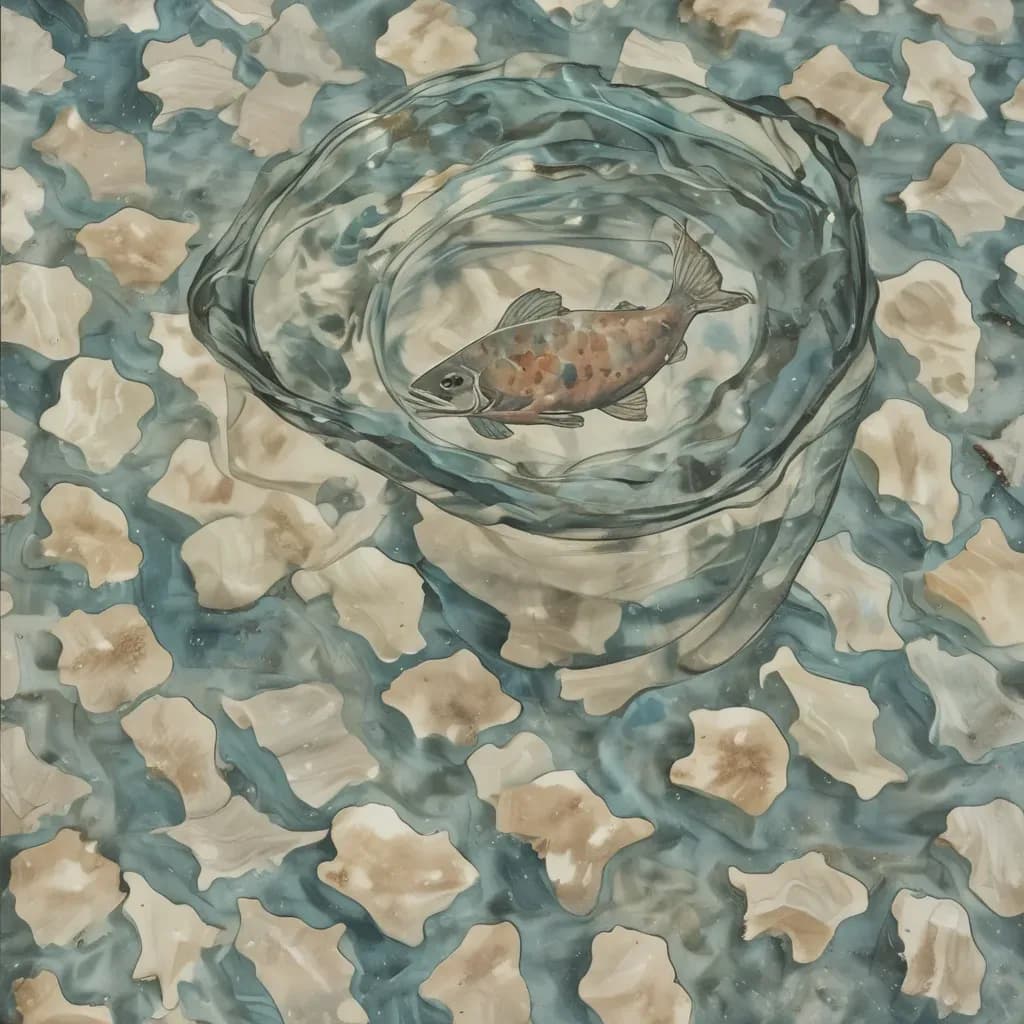
There is a specific kind of sadness that arrives not with drama but with a cheerful shrug. "Let's Go to the Forest," the thirteenth track on Kero Kero Bonito's debut mixtape Intro Bonito, opens like a children's nature walk invitation: an enthusiastic proposal to visit the animals of the forest. Then, without warning or fanfare, comes the catch. The forest was demolished years ago when they built the airport. And so, the song pivots one final time: the ocean can still be visited, because it has been conveniently relocated to a bowl at the mall. In the span of roughly two minutes, Kero Kero Bonito traces a complete arc of modern civilization, compressed to the runtime of a nursery rhyme.
That this song lands as both genuinely funny and quietly devastating is not an accident. It is, in miniature, everything that makes Kero Kero Bonito one of the most interesting pop acts to emerge from the early 2010s London underground.
Three People, One Casio Keyboard
Kero Kero Bonito formed in London in 2011 after producers Gus Lobban and Jamie Bulled, childhood friends from Bromley in south London, posted an advertisement on MixB, an online bulletin board for Japanese expatriates living in the UK[1]. They were looking for a bilingual vocalist with an affinity for J-pop, hip-hop, and electronic music. Sarah Midori Perry answered the ad. Born in Nagoya, Japan, to a Japanese mother and a British father, she had spent the first thirteen years of her life in the port town of Otaru before relocating to the UK Midlands at age thirteen[2]. She was studying fine arts at Kingston University and had no professional singing background. She joined, she has said, simply to try it.
The trio began making music that drew on their collective reference points: J-pop, especially the hyper-stylized world of Kyary Pamyu Pamyu; dancehall rhythms; video game soundtracks from the Nintendo 64 era; and the emerging aesthetic of the PC Music collective, which was brewing in London at the same time[3]. The tool that defined their early sound was, fittingly, a toy: the Casio SA-46, a miniature keyboard retailing for less than twenty pounds, whose plastic MIDI voices gave Intro Bonito its characteristic warmth and its 8-bit innocence[4]. Using a toy instrument was not a limitation they worked around. It was a statement.
The mixtape was self-released to SoundCloud and Bandcamp on September 30, 2013, then distributed by Double Denim Records in August 2014[5]. It was a DIY project in the fullest sense, recorded without a major label, without industry machinery, and without any concession to what British indie pop was supposed to sound like at the time. Where the early 2010s indie scene was largely committed to a warm, nostalgic 1980s aesthetic, KKB were making something spiky and cheerful and strange, something that sounded like it had been assembled from a child's bedroom and a Tokyo convenience store simultaneously.
The Arc of Disenchantment
"Let's Go to the Forest" is structurally simple, which is part of its power. The song begins with pure, unironic invitation, the sort of enthusiasm that belongs to a child who still believes in the forest as a place of magic and life, populated by animals worth visiting. The narrator speaks with the sincerity of someone who has not yet been told that the world does not organize itself around wonder.
Then comes the pivot, and it arrives with the same cheerful vocal energy as everything that preceded it. The forest is gone. It was cleared for an airport, and the demolition is treated as a historical footnote, something that happened years ago, something already absorbed into the background noise of modern life. There is no anguish, no protest, no elegy. Just the calm acknowledgment of loss delivered as a minor logistical inconvenience.
The resolution is where the song's real philosophical weight arrives. The narrator redirects attention to the ocean, which can still be seen at the shopping mall, where it has been placed in a bowl. The mall aquarium is offered sincerely, or at least with the performance of sincerity, as an adequate replacement. The audience is invited to accept this substitution and be satisfied. One reading of the song treats this as straightforward childhood naivety: the narrator genuinely does not yet understand why a mall fish tank is not the same as an ocean. Another reading, perhaps the more resonant one, is that the narrator understands perfectly and has simply run out of alternatives.
Reviewers have observed that the song functions as a portrait of someone coming to terms with reality in all its blunt materiality[6], and that reading is accurate as far as it goes. But the song's power comes precisely from the gap between the childlike surface and the adult recognition it encodes. It is a song about accepting diminishment. About learning to call the substitute good enough. About the particular way that modern life teaches us to mourn losses we never quite name as losses.
Sarah Perry's lyrical method across Intro Bonito has been described as pop-haiku: concise, image-forward, achieving its effects through compression rather than elaboration[7]. "Let's Go to the Forest" demonstrates this approach at its most concentrated. The ecological and existential critique embedded in the song is never stated directly. It is carried by the juxtaposition of the images and by the unflinching brightness of the delivery. The Casio's toy textures do not soften the content; they amplify its strangeness.
Cute as a Delivery Mechanism
The kawaii aesthetic, the Japanese cultural mode organized around cuteness, softness, and emotional immediacy, has often been read in Western contexts as trivial or purely decorative. Kero Kero Bonito's early work challenged that assumption by using kawaii conventions as a vehicle for content that was anything but trivial. "Let's Go to the Forest" is a case study in this approach.
Sarah Perry's bilingual upbringing gave the band access to a mode of expression that most British pop acts did not have. Singing unselfconsciously in both English and Japanese, drawing on the bright surfaces of J-pop without exoticizing them, KKB created something that a Japan Society reviewer described as successfully avoiding the trap of treating the Japanese element as novelty[8]. The cuteness in their music was functional, not cosmetic. It created the conditions under which an audience could receive a song about environmental destruction and commodified nature as something other than a lecture.
This positioning connected them to a broader current in early 2010s underground pop. The PC Music collective, centered on London producer A.G. Cook, was simultaneously developing an aesthetic of maximalist, hyper-processed pop that used artificiality as a critique of sincerity and corporate culture[1]. Gus Lobban's production work under the alias Kane West was directly PC Music-affiliated. KKB occupied an adjacent but distinct position: where PC Music could lean toward deliberate coldness, KKB retained emotional accessibility. Their toy instruments and bright melodies kept the warmth even when the content was melancholy.
In retrospect, Intro Bonito is now recognized as one of the foundational documents of hyperpop, the genre that would become a dominant force in underground and eventually mainstream music by the late 2010s. Gorilla vs. Bear listed it as the forty-sixth best album of the 2010s in their decade-end retrospective[9], and the 2023 Polyvinyl reissue, which pressed the record to vinyl for the first time, charted at number 42 on Billboard's Top Album Sales, a remarkable placement for a decade-old debut mixtape[5]. The critical consensus repositioned KKB not as a quirky novelty act but as genuine pioneers.
What the Forest Stands For
The song invites multiple interpretations, and its openness is part of its staying power. The most immediate reading is environmental: the forest is real nature, the airport is industrial development, the mall aquarium is the commodified simulacrum that replaces what development destroys. On this reading, the song is a concise and scathing piece of ecological critique delivered in a register so cheerful that it bypasses defensiveness entirely.
But the song also works as a more general meditation on growing up and what is lost in the process. The forest can be read as childhood itself: a space of imagination and inhabitation that adult modernity cannot accommodate, that gets cleared away to make room for more efficient structures. The airport connects people to the world; the forest connected a child to her imagination. The trade is presented as progress. The song quietly refuses to ratify that framing.
Gus Lobban articulated KKB's broader philosophy in a 2021 interview: pop music is "actually capable of more than it sometimes is used for." He expressed frustration with the way mainstream pop criticism had become fixated on the corporate machinery of pop rather than its artistic possibilities[10]. "Let's Go to the Forest" is, in one sense, an argument for that expanded possibility. It is a pop song, produced on a toy keyboard, that contains a complete philosophical position about the relationship between capitalism, nature, and human longing. It does not announce this. It just sings it.
There is also a reading of the song as a portrait of a particular kind of optimism, the kind that is not naive but that has decided to function anyway. The narrator does not collapse when the forest turns out to be gone. She redirects. The ocean at the mall is, after all, still something. There is a resilience in that pivot, a quality of getting on with things, that feels distinctly and recognizably human. The melancholy and the forward motion coexist.
Still Worth Going
The song runs two minutes and three seconds. In that time it builds a complete world, disassembles it, and proposes a diminished but still-functional substitute. This compression is not a limitation; it is a choice that reflects a mature understanding of what pop music can accomplish. The song is not trying to solve the problem of environmental destruction or the loss of childhood wonder. It is trying to name the feeling of living with those losses without quite naming them, because most people live with them that way.
That KKB pulled this off on a miniature Casio keyboard, on a self-released mixtape, before they had any profile to speak of, says something about the quality of their instincts. Intro Bonito as a whole has been characterized as an album in which the band addressed the nervousness of growing up into adulthood and a potentially harsh reality through deceptively innocent-sounding pop structures[6]. "Let's Go to the Forest" is that description made song. It is nervous and harsh and innocent and funny and sad, all at the same time, for two minutes, with a toy keyboard.
A decade later, in a cultural moment that has more ecological anxiety than it knows what to do with, the song sounds less like a quirk and more like a diagnosis. The forest is gone. The ocean is in a bowl at the mall. And here we are, being invited to go see it anyway, because what else are you going to do on a Saturday afternoon.
References
- Kero Kero Bonito - Wikipedia — Band history, formation, members, and discography
- Sarah Midori Perry - Wikipedia — Vocalist biography and background
- Kero Kero Bonito - Trading MP3s for Sick Beats (DIY Magazine) — Early interview on band formation, influences, and the MixB advertisement
- Intro Bonito - Kero Kero Bonito (Bandcamp) — Official release page with production credits and genre tags
- Intro Bonito - Wikipedia — Album history, release dates, tracklist, and critical reception
- Kero Kero Bonito - Intro Bonito Review (Sputnikmusic) — Critical review discussing lyrical themes and sonic character
- Review of Intro Bonito by Kero Kero Bonito (KURE Radio, Iowa State) — Campus radio review discussing lyrical themes and pop-haiku style
- Kero Kero Bonito: Lily Allen Meets J-Pop (Japan Society UK) — Review discussing KKB's bilingual approach and kawaii aesthetic
- Gorilla vs. Bear Albums of the Decade 2010-2019 — Listed Intro Bonito as 46th best album of the 2010s
- Kero Kero Bonito on magic pop, Bugsnax, and the limits of poptimism (The FADER, 2021) — Interview with band members on their philosophy of pop music