Life Boat
A Prayer from the Deep End
There is a precise moment in anyone's darkest winter when the question stops being philosophical. You are not asking what the universe owes you, or whether suffering has meaning. You are asking something far more immediate: is there anything out there that can hold me? "Life Boat" by RAYE lives in that question, and it refuses to look away from it.
The song is built around the image of a person adrift, calling out for something to cling to. It does not dress that image up in metaphor or soft-pedal the desperation behind it. It sits with the feeling of being underwater. And then, gradually, it does something remarkable: it answers the call with a choir of human voices. What begins as a solo cry becomes a congregation.
The Long Road to the Winter Act
Rachel Agatha Keen had good reason to know what it felt like to be underwater. Between 2014 and 2021, she was signed to Polydor Records, a deal that promised commercial stardom and delivered seven years of suppressed releases, ghostwritten sessions for other artists, and a slow erosion of creative agency.[1] When she finally broke publicly in June 2021, posting about waking up crying and being ready to give up on music entirely, it was not managed PR strategy. It was a person standing at an edge.[2]
She departed Polydor in September 2021, signed independently to Human Re Sources, and released "My 21st Century Blues" in 2023, an album so searingly personal it made her a household name and earned her six BRIT Awards in a single ceremony. But by the time she began building "This Music May Contain Hope," the question animating her work had shifted. Not: how did I survive? But: what actually saved me?[3]
Faith as the Answer
The answer RAYE returned to, repeatedly and without apology, was faith. Raised in a Christian household where her parents met making music at their church in Tooting,[1] she has spoken openly about drifting from that world during her label years, and about finding her way back during her lowest point. She told interviewers that there was a version of events in which she simply did not make it, and that rediscovering faith was what prevented that outcome.[4]
That return to faith is not a footnote to this album. It is the spine. "Life Boat" is among the most direct expressions of it anywhere in RAYE's catalog. The narrator's plea is addressed upward and inward simultaneously, in language that is unmistakably devotional. There is no hedging into vague "universe" spirituality. The grammar is specific, and the emotional weight behind it is specific, drawn from real experience rather than artistic posture.[4]
The Architecture of Despair Turning
"This Music May Contain Hope" organizes its seventeen tracks into four seasonal movements: Autumn, Winter, Spring, and Summer. The arc moves from grief and self-examination in the cold months toward renewal in the warm ones.[5] "Life Boat" sits at track eight, closing out the Winter section, and its placement is everything. It arrives when the album's protagonist has moved through loss, disillusionment, and near-total exhaustion. It is not a recovery song. It is a reaching-out song. The recovery, if it comes, is still ahead.
Critics identified this as the moment the album's larger arc begins to shift. The track functions as what one reviewer called a hinge point, where the signs of the hope promised in the album's title start to become visible for the first time.[6] It does not deliver on that hope. It simply allows it to be conceivable.
Asking as an Act of Courage
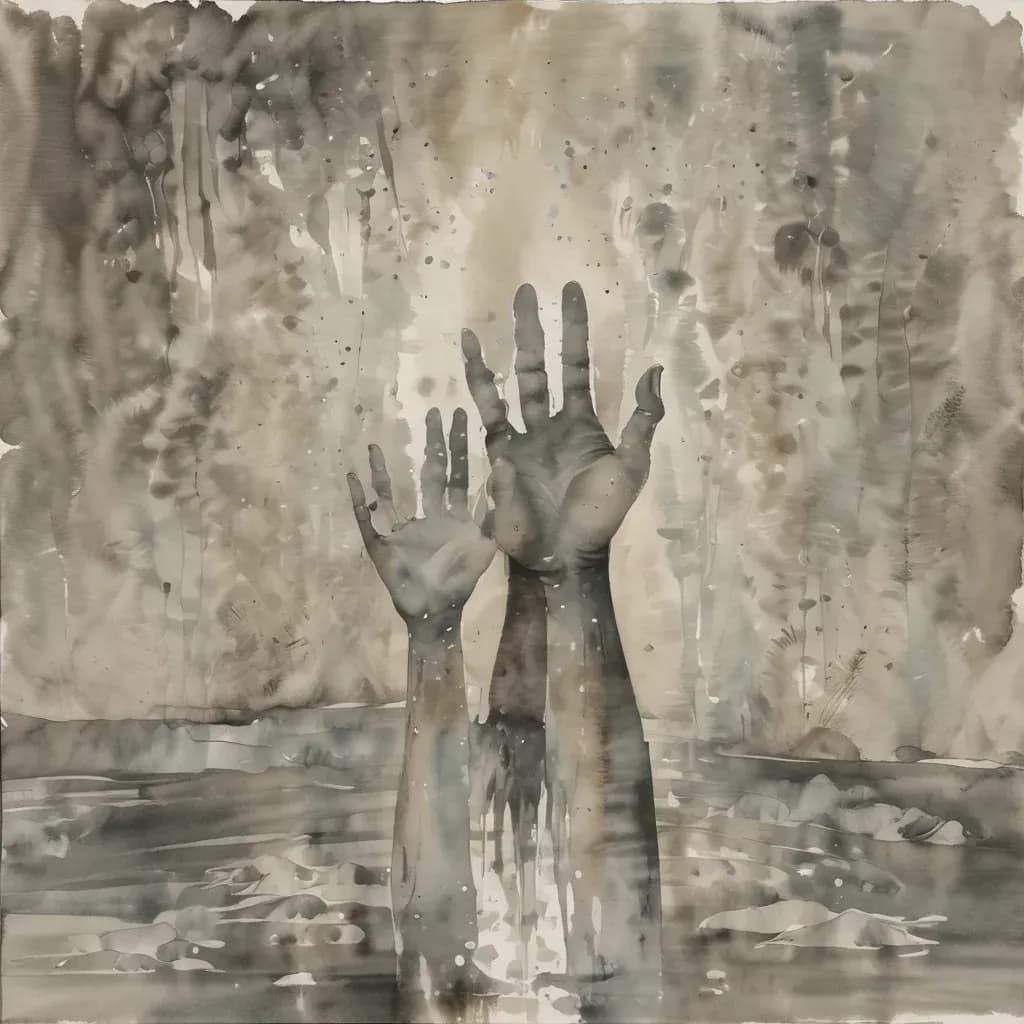
The song is built around a central image: someone adrift in deep water, calling out for a lifeboat, for anything to hold onto. The plea is addressed to the divine, framed in language that is both desperate and intimate. RAYE does not dramatize this as triumph. The narrator does not know if help is coming. The asking is the act of courage in this song, not the receiving.
The production, built in a deep house idiom with layered vocal architecture and a pulsing, patient rhythm, underscores this mood without overwhelming it.[7] The track does not rush toward resolution. It holds the discomfort, lets it expand, and then builds slowly toward something else entirely.
The Chorus That Answers
The most emotionally striking element of "Life Boat" is not the lead vocal. It is the accumulation of other voices. Layered into the track's architecture is a growing chorus of people of different ages, genders, and accents, all repeating some version of the same declaration: they are not giving up yet.[6] What begins as a smattering of individual statements gradually becomes something that functions like a communal chant.
This is a deliberate formal choice, and it works because it changes the emotional logic of the song. The narrator is alone and desperate. But the response to that desperation is not a single rescuing voice. It is a crowd. It is the vast, anonymous community of people who have been in their own dark winters and emerged to say: not yet. Not this time.
That design transforms what could have been a showcase ballad into something closer to a ceremony. The listener is not watching someone survive. They are being invited to join the chorus themselves. The second-person implication is quiet but persistent: if you are listening, you are already part of the group of people who have not given up.
Faith in the Open
The decision to frame a mainstream pop album around overt Christian faith, and to anchor one of its centerpiece tracks in a direct prayer for divine rescue, carried real cultural risk in the contemporary music landscape. RAYE is not hedging into the vague spiritual language that passes as acceptable in pop circles. "Life Boat" speaks in specifically devotional terms.[4]
Critics took note. Publications focused on faith and culture highlighted the album as a significant statement about how spiritual conviction can function as a survival mechanism, noting that RAYE was one of the few artists of her generation making this kind of claim openly.[4] The broader critical reception was largely admiring,[7][8] though some reviewers found the album's commitment to positivity overwhelming at scale.[9] That tension between those readings is itself a measure of how seriously the album takes its subject matter.
There is also a deeper resonance in the choice of house music as the vehicle for this kind of devotional content. The genre carries a communal DNA rooted in Black queer communities in Chicago and New York, where the dancefloor functioned as sanctuary and the music was a mechanism for collective survival. When RAYE builds a house track around voices declaring their refusal to give up, the form and the content are saying the same thing. She is working within a tradition that has always understood music as medicine.
The Song for Non-Believers Too
A listener who does not share RAYE's faith can still take the song whole. The lifeboat can be a therapist, a friend, a creative practice, or the realization at four in the morning that there is still something to stay for. The prayer can be addressed to whatever specific thing has kept someone alive. The choir can be read as the vast anonymous network of people who have posted in a dark corner of the internet about their own dark nights and survived to be honest about it.
RAYE has said that her intention was to make music that functions as medicine, something that reaches people regardless of whether they share her specific convictions.[3] The faith language gives "Life Boat" its particular charge and emotional specificity. But the underlying architecture, a desperate call answered by a communal voice, is universally legible. It is the structure of every story in which someone found their way back.
Still Holding On
"Life Boat" arrives at exactly the right moment in the album's architecture, at the point where the question of survival tips over into the first tentative answer. It does not resolve into triumph. It ends with the prayer still in the air and the voices still multiplying. That is honest. Real turning points rarely feel like victories. They feel like the moment you realize, against all evidence, that you are still holding on.
RAYE built this song the way a person builds a raft in the dark, out of whatever materials are at hand, from community and faith and the stubborn refusal to stop calling out. It is not an elegant construction. It is a functional one. And it floats.
References
- RAYE - Wikipedia — Biographical overview including upbringing, faith background, label history
- RAYE reflects on leaving Polydor - NME — RAYE discusses the creative and personal cost of the Polydor years
- RAYE talks artistic journey and new album - NPR — RAYE describes the album as medicine made for herself to share with the world
- RAYE's new album tells the story of how faith pulled her out of darkness - RELEVANT Magazine — Cultural commentary on RAYE's open Christian faith and its significance in mainstream pop
- This Music May Contain Hope - Wikipedia — Album structure, track listing, chart performance, critical reception overview
- RAYE: This Music May Contain Hope track-by-track review - Ticketmaster — Track-by-track analysis identifying Life Boat as the album's narrative hinge point
- RAYE: This Music May Contain Hope review - Rolling Stone — Rob Sheffield's review praising RAYE firing on all cylinders with showstopping maximalism
- RAYE: This Music May Contain Hope review - NME — NME review praising the album's showstopping musical maximalism
- RAYE: This Music May Contain Hope review - Northern Transmissions — Critical dissenting view arguing the album prioritizes spectacle over substance