Lost Boys
"Lost Boys" arrives third on The Money Store, and by that point the album has already established its velocity, its violence, its refusal to offer the listener anywhere comfortable to stand. But where the preceding tracks map a psychological and physical state, "Lost Boys" asks who lives there permanently. The answer is not metaphorical.
The Album and Its Moment
The Money Store was released April 24, 2012, on Epic Records, the major label Death Grips had signed with just two months earlier under an unusually favorable arrangement that preserved their creative independence.[1] The band, a Sacramento trio consisting of MC Ride (Stefan Burnett), Zach Hill, and Andy Morin, came in carrying the momentum of their 2011 underground mixtape Exmilitary, which had spread virally and built a fervent following without any conventional promotional infrastructure.
That they arrived on a major label without compromising the abrasion of their work was, at the time, genuinely surprising. Zach Hill described the environment that shaped their music with characteristic directness: Sacramento surrounds the band daily with homelessness, poverty, and violence, and those conditions are a natural influence.[2] The sense of operating from the margins, of building something real in a place the culture industry does not look at, runs through every track.
"Lost Boys" was previewed early. On March 2, 2012, Death Grips posted a rehearsal video showing them performing the track, recorded February 29, more than six weeks before the album arrived.[3] For listeners following the band, it was a signal: whatever The Money Store was going to be, it would continue directly from where Exmilitary left off.
Three Tracks, One Statement
"Lost Boys" is the third track on The Money Store, and it functions as the conclusion of an informal opening trilogy that begins with "Get Got" and "The Fever (Aye Aye)."[3] The first track establishes a state of heightened, almost fractal alertness. The second casts that condition as a physical sickness. "Lost Boys" turns the lens outward and identifies who inhabits these states as a permanent condition rather than a temporary crisis.
The three tracks together form a thesis statement for the entire record. Death Grips did not organize The Money Store around a single narrative or protagonist. But this opening sequence builds something close to an argument: here is the psychological state, here is what it does to the body, and here are the people who live it without exit.
The People Outside
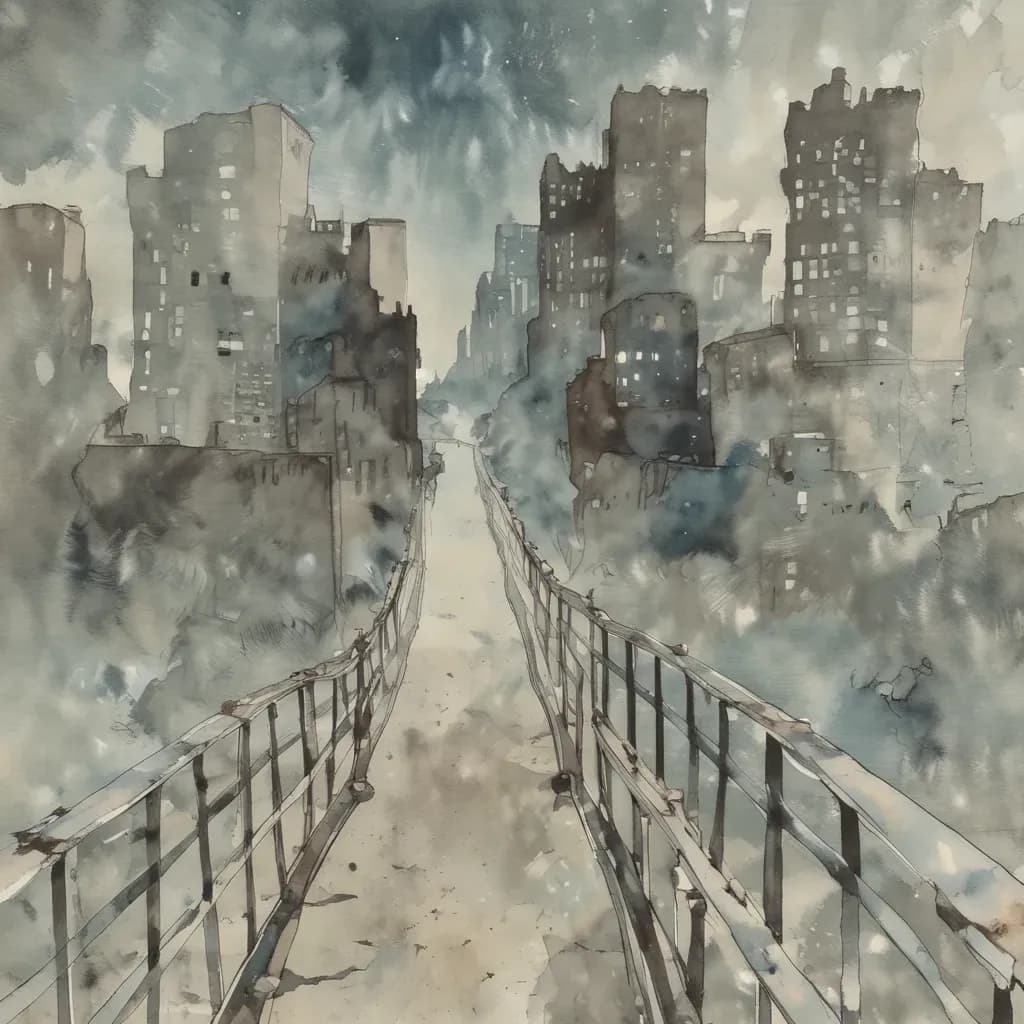
The "lost boys" of the title are drawn from a recognizable cultural image, but Death Grips strips away any romanticism attached to it. These are not rebellious children who chose freedom over society. They are people the system has processed and discarded: the chronically poor, the addicted, those whose lives bear the physical and social marks of sustained exclusion.[3][4]
The song's imagery reaches into the body itself. It attends to the evidence that long-term poverty and addiction leave on the skin, on the physical self. Nothing is aestheticized. The lost boys are not presented as noble outlaws or as objects of pity. They are presented as people in a specific material condition, one the song refuses to look away from.
The recurring motif describing an overwhelming sense of descent, of a vast and widening distance between where these people are and where the world tells them they should be, functions as the song's emotional anchor.[4] It is not a cry for help. It does not appeal to any authority for change. It simply names the distance, and in naming it, implicates the forces that created it.
There is also a current of defiance running beneath the surface. MC Ride does not observe these conditions from a position of safety or remove. The song places the listener inside the experience rather than giving them a viewing angle from outside. This is not journalism. It is immersion.
Sound Built from What Was Already Broken
The production of "Lost Boys" is built on a sample from "Fyrd Up," a track from Death Grips' 2011 EP Live from Death Valley, which itself sampled "Cig Vision" by Zach Hill.[5] The decision to build a major label debut track on recycled material from their underground period was deliberate. Hill described the band's approach as involving a lot of recycling and destruction in the making of their music.[2]
This self-sampling creates a conceptual closed loop. "Fyrd Up," the source material, concerned being rejected by the system, pushed out, deemed unfit for inclusion.[5] The act of bringing that material into "Lost Boys," into a track that specifically names the system's discarded people, turns production technique into argument. The medium and the message fold back on each other.
The broader sonic aesthetic reinforces the point. Zach Hill and Andy Morin built tracks from sources that should not coexist: industrial percussion, electronic noise, fragments of samples from deeply disparate contexts.[1] The result is music that sounds like the world it describes: fragmented, abraded, impossible to smooth into comfort.[6]
Why It Still Lands
The Money Store arrived when hip-hop was fragmenting across stylistic lines, between the maximalist party rap of the era, the introspective turn of Kendrick Lamar's early work, and the provocations of Odd Future.[6] Death Grips occupied none of these categories. Their debt to industrial music, noise rock, and hardcore punk gave them a different vocabulary, and "Lost Boys" demonstrates how that vocabulary could address class and poverty with a directness that the genre's dominant voices were not attempting.
Critical reception was immediate and decisive. Pitchfork awarded the album an 8.7 and a Best New Music designation.[7] Anthony Fantano of The Needle Drop gave it a perfect 10, his first ever on the channel.[8] The album debuted at #130 on the Billboard 200 and reached #14 on the US Rap Albums chart, an unusual commercial footprint for something so aggressively hostile to commercial logic.[1]
In the decade since, the album's influence has calcified into canon. Kanye West's Yeezus, released in 2013, drew directly from The Money Store's industrial-rap fusion.[9] Artists including 100 gecs and JPEGMAFIA have cited the band's influence. Stereogum, on the album's tenth anniversary, called it a Molotov cocktail gleefully launched at a server farm.[8] A 10th anniversary reissue on split vinyl in 2022 confirmed its canonical status.
"Lost Boys" specifically established something that would define Death Grips' legacy: not protest music in any conventional sense, not documentary, but music that embodies the psychological and material reality of living outside the economy's protection, and that insists on doing so without flinching or apologizing.
Another Way to Hear It
Some listeners have read "Lost Boys" less as a sociological portrait and more as a self-portrait. Death Grips came up through Sacramento's underground, a city that does not occupy a central position in the music industry's attention. The experience of building something real in a place the industry overlooks, and then navigating the commercial structure of Epic Records while resisting its logic, maps onto the song's imagery in ways that feel personal as well as political.[10]
The self-sampling reinforces this reading. "Fyrd Up" was underground Death Grips, pre-deal, pre-exposure. "Lost Boys" is the version that arrived after the contract. Folding pre-fame material into the major label album could be read as the band locating themselves within the same geography as their subjects: people shaped by structures they did not choose and cannot entirely escape.
In this reading, the recurring image of descent is not only about the economically marginalized. It describes anyone who has been reached by those structures, ground through their machinery, and emerged marked by the experience.
Still Falling
"Lost Boys" does what the best tracks on The Money Store do: it puts a human cost on the abstract forces the album names. The money store of the title is not just a pawnshop. It is the entire apparatus by which value is extracted from people and places the economy has designated expendable. The lost boys are the people holding the receipts.
A decade on, the song retains its weight. The conditions it describes have not resolved. Death Grips captured something true, and true things do not expire on a schedule. The distance the song names, between where these people are and where they were promised they could be, remains open. The sound built to measure it still fits.
References
- The Money Store - Wikipedia — Release details, Epic Records deal, chart positions, production context
- Death Grips: There's A Lot Of Recycling And Destruction In The Making Of Our Music - The Skinny — 2012 Zach Hill interview on compositional approach and Sacramento environment
- Lost Boys - Death Grips Wiki — Track details, opening trilogy context, lyrical themes, release preview
- Album Breakdown: Death Grips - The Money Store - Boiler Rhapsody — Track-by-track analysis including Lost Boys thematic content and the central hook
- Death Grips Lost Boys - WhoSampled — Self-sampling of Fyrd Up and its thematic connection
- With The Money Store, Death Grips blew up a splintering alternative rap landscape - Crack Magazine — Hip-hop landscape context, production aesthetic analysis
- Death Grips: The Money Store - Pitchfork — 8.7 Best New Music review, critical reception analysis
- Death Grips: The Money Store Turns 10 - Stereogum — 10th anniversary retrospective, Fantano perfect 10, canonical status
- Are Death Grips the Most Important Hip-Hop Act of the Decade? - Highsnobiety — Influence on Yeezus and broader hip-hop trajectory
- Death Grips: Artist of the Year 2012 - SPIN — MC Ride interview on privacy and distrust; band's self-positioning as outsiders