Old Dog
What It Means to Still Be Here
The old dog in the room is never the most dangerous. He is the most certain. He has already survived everything that was supposed to stop him, and he knows it. When J. Cole arrives on "Old Dog," the fourth track on the second disc of his seventh and reportedly final studio album The Fall Off, that certainty is the first thing you feel.[1] This is not a man straining to prove he belongs. This is a man who has long since stopped needing to.
The idiom at the center of the song is double-edged. "You can't teach an old dog new tricks" is usually an insult, a diagnosis of inflexibility. Cole arrives and turns the whole construction inside out.[2] In his reading, the old dog is not a relic. He is a veteran, tested and shaped by time, whose deepest nature is not a limitation but a foundation. The song is built on that premise, and it never lets it go.
The Long Road to Disc 39
The Fall Off was first teased as a concept in 2018, a full eight years before it arrived.[1] Its delayed delivery was not procrastination but accumulation. In the intervening years, Cole grew into fatherhood, watched his Dreamville label mature, and navigated a cultural earthquake in hip-hop that he had not anticipated.
The catalyst that finally brought the album to completion, by Cole's own account, was the fallout from the 2024 Drake-Kendrick Lamar conflict, during which Cole briefly joined the fray before publicly stepping back, calling the whole experience something close to a spiritual reckoning.[3] He later described falling back in love with his craft as a result. The near-miss with rap warfare, it seems, clarified what the album was actually about: not competition, but completion.
"Old Dog" appears on Disc 39, the second half of the album's conceptual architecture. Disc 29 imagines Cole at 29, returning to Fayetteville at a crossroads between his woman, his craft, and his city. Disc 39 revisits that same homecoming at 39, from the vantage point of a man who has made his choices, lived with them, and arrived somewhere approximating peace.[1] "Old Dog" is the sound of that arrival.
Fayetteville on the Map
No analysis of "Old Dog" is complete without acknowledging how much of it is a love letter to Fayetteville, North Carolina. This is not a new subject for Cole, who has returned to his hometown again and again across his discography, but here the tribute takes on particular weight.[4]
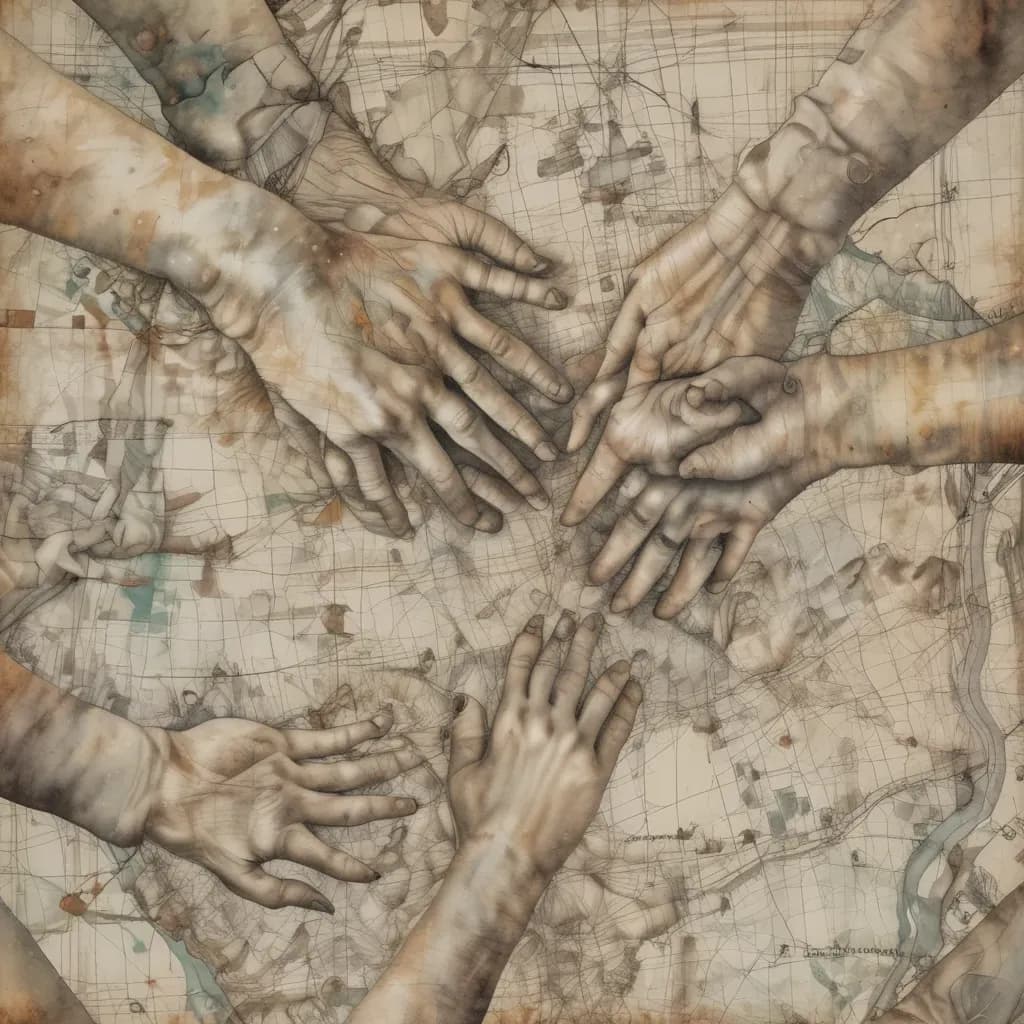
The song closes with what amounts to a neighborhood roll call: specific streets and subdivisions named with the reverence of someone who has never stopped believing that where you come from determines who you are. Tiffany Pines, Fox Fire, Bonnie Dune, Bragg Boulevard, Murchison Road.[2] These are not poetic abstractions. They are coordinates, and Cole delivers them with the gravity of someone placing a flag in the ground.
This geography-as-identity runs through Cole's entire body of work, but in "Old Dog" it functions as legacy rather than origin story. The song does not explain where Cole came from. It celebrates that he was there, that people there remember it, and that he still remembers them.
Petey Pablo and the Generational Handshake
The most emotionally resonant element of "Old Dog" may be the presence of Petey Pablo, the Fayetteville native who achieved national recognition in the early 2000s with "Raise Up," a song so specific to North Carolina pride that it was later proposed as the state's official hip-hop song.[5] For Cole, who was a teenager when "Raise Up" dropped, Petey Pablo was proof that someone from Fayetteville could make music the whole country heard.
On "Old Dog," Cole acknowledges that debt explicitly, crediting Petey as the man who laid the groundwork for everything Cole himself would later build.[2][4] This is not a legacy cameo for the sake of nostalgia. It is a structural argument about lineage. The song positions Cole not as the beginning of something but as the continuation of a tradition that Petey Pablo started. By bringing him into the room, Cole makes the claim that the lineage is real and that it runs deep.
There is something quietly significant about the direction of the tribute too. Cole is the bigger star by virtually every commercial metric. He did not need Petey Pablo on this record. He wanted him there. That want is the whole point.
Southern Lineage in the Sample
The sonic foundation of "Old Dog" is built on a sample from T.I.'s "24's," the opening track on his 2003 album Trap Muzik.[6] The choice is deliberate. T.I. is one of the architects of Southern hip-hop as a commercially and artistically dominant force, and "24's" is one of the songs that people who grew up in the South recognized as theirs.
Sampling it is an act of affiliation. It places "Old Dog" inside a specific tradition: not New York's lyrical formalism, not the West Coast's philosophical cool, but the Southern rap lineage of swagger, specificity, and regional pride. The sample tells you what kind of song this is before Cole says a single word.[6]
It also reinforces the generational logic running through the track. Just as Cole acknowledges Petey Pablo as a predecessor, the T.I. sample nods to the broader Southern rap canon that made it possible for artists from below the Mason-Dixon line to stand at the center of hip-hop's conversation rather than its margins.[7]
The Veteran as Protagonist
What makes "Old Dog" unusual within Cole's catalog is its tone. He has made confessional music, introspective music, music that wages war with itself. This song is not particularly conflicted. The narrator is settled. The question the title raises has already been answered.[4]
This creates a particular kind of listening experience. "Old Dog" is not a struggle song. It is a victory lap, but run at a slow, comfortable pace by someone who has nothing to prove and is genuinely at ease. Cole's delivery reflects that. The urgency that has characterized some of his most celebrated earlier work is replaced here by confidence and warmth.
That shift is the song's most interesting interpretive tension. Some listeners might hear complacency where Cole hears contentment. The line between the two is always a matter of perspective, and the album's critical reception reflected exactly that ambiguity. Pitchfork found the record cautious; NPR and others found it earned.[8]
"Old Dog" lands somewhere in the middle of that argument. It is not a song that challenges you. It is a song that settles over you, like confirmation that something you believed has turned out to be true.
A Video Made by Accident
The music video for "Old Dog" did not begin as a video. It began as a car breakdown. Cole's Honda Civic died in Phoenix, Arizona, while he was driving it across the country for his "Trunk Sale Tour 26," a road trip in which he sold physical CDs out of the trunk and spent time with fans in decidedly non-celebrity fashion.[9][10]
While waiting at an auto repair shop, Cole filmed the video. Fans who recognized him gathered spontaneously. What emerged was an impromptu performance in a garage, surrounded by people who had no reason to be there other than that they happened to find him.[9][10] It is hard to separate that visual from the song's themes of roots, simplicity, and the kind of fame that still allows you to be a person.
The Trunk Sale Tour as a concept is itself an extension of the song's argument. A multi-platinum artist selling CDs from the trunk of a beat-up old car is a deliberate rejection of the machinery of modern celebrity. It is the old dog refusing to learn the new tricks for their own sake.
A Career Completed, or Continued
Cole has said, in conversations following the album's release, that he is at peace if The Fall Off is his final statement, and also that he remains open to creating again if the spirit moves him.[3] This is the kind of qualified farewell that keeps possibilities open while still marking an ending.
"Old Dog" sounds like that: an ending that is also a celebration. It does not close the door on what Cole might do next, but it makes the case that whatever he has already done is enough. The old dog has covered a lot of ground. He knows the territory. He knows where home is.
In that sense, the song's final gesture, the roll call of Fayetteville streets, is not just local nostalgia. It is a coordinates claim. If you want to understand where J. Cole came from, here is the precise address. And if you want to understand why he is still here, after all of it, the answer might be the same.
References
- The Fall-Off, Wikipedia — Album overview, chart performance, and conceptual structure of the Disc 29/Disc 39 framework
- Old Dog Lyrics Meaning, LyricsTubes — Thematic breakdown of the song's lyrics including the Fayetteville roll call and Petey Pablo tribute
- J. Cole Addresses Retirement After The Fall Off, Hot 97 — Cole's statements about the Drake-Kendrick fallout inspiring him and his relationship to future work
- J Cole Old Dog Lyrics Meaning Explained, StayFreeRadio — Review and meaning analysis covering the veteran metaphor and Southern pride themes
- Raise Up, Wikipedia — Background on Petey Pablo's landmark North Carolina anthem and its cultural significance
- J. Cole feat. Petey Pablo samples T.I.'s 24's, WhoSampled — Documentation of the T.I. '24s' sample used in Old Dog
- The Fall-Off Review: J. Cole's Magnum Opus 10 Years in the Making, WCU Quad — Critical review discussing the album's Southern hip-hop lineage and Cole's legacy
- J. Cole Returns a New Man, Old Man and Everyman, NPR — NPR's critical review of The Fall Off and its thematic arc
- J. Cole Films 'Old Dog' Video in Repair Shop After Honda Civic Breakdown, Complex — Story of how the Old Dog music video was filmed during the Trunk Sale Tour car breakdown
- J. Cole Drops 'Old Dog' Video in Repair Shop After 'Trunk Sale' Car Broke Down, HotNewHipHop — Coverage of the impromptu Old Dog video filmed in Phoenix auto repair shop