On GP
"On GP" arrives near the end of Jenny Death, the second disc of Death Grips' double album The Powers That B, and it does something the band almost never does: it speaks clearly. Not with the maximalist scramble of their debut, not with the coded aggression of their middle period, but with the kind of blunt, exhausted clarity that arrives when a person has stopped performing their interior life and started simply describing it.
The title is a key. "GP" stands for "General Principle," a phrase meaning a default position or automatic course of action. To do something "on GP" means to do it without requiring justification, as a matter of course. The song's narrator explains that without a particular anchoring relationship, ending his own life would be that default. That framing, stark and conversational, sets the song apart from nearly everything else in Death Grips' catalog.[1]
Background: The Chaos That Preceded Clarity
Jenny Death was recorded at Sunset Sound Recorders in Los Angeles and officially released on March 31, 2015, as part of the full double album The Powers That B.[2] The disc features guitarist Nick Reinhart of Tera Melos and organist Julian Imsdahl, a former collaborator of Zach Hill's from an earlier band. The result carries a different texture than the first disc, Niggas on the Moon, whose instrumentation consisted entirely of Hill's Roland V-Drum kit layered over chopped and manipulated vocal samples from Bjork. Jenny Death has weight, grit, and gravity in a way its counterpart does not.
The period surrounding the album was among the most theatrically unstable in Death Grips' history. In July 2014, just weeks after Niggas on the Moon was released as a surprise free download, the band announced their breakup via a handwritten note photographed and posted to social media. They withdrew from a tour alongside Nine Inch Nails and Soundgarden and went publicly silent.[3] Then, in January 2015, they released an instrumental album titled Fashion Week whose track titles, read in sequence, spelled out "JENNY DEATH WHEN," a sardonic message addressed to fans waiting for the second disc.
Jenny Death's eventual arrival felt less like a comeback than a reckoning, a full accounting of what the dissolution period had actually meant. "On GP," appearing late in that record, functions as its most emotionally unguarded statement.
Thematic Analysis: Suicidal Ideation and the Thread That Holds
What makes "On GP" so unsettling is not its subject matter but its tone. Suicidal ideation is not rare in popular music, but it usually arrives dressed in metaphor or wrapped in dramatic phrasing that insulates both artist and audience from its full weight. "On GP" refuses that insulation.[1]
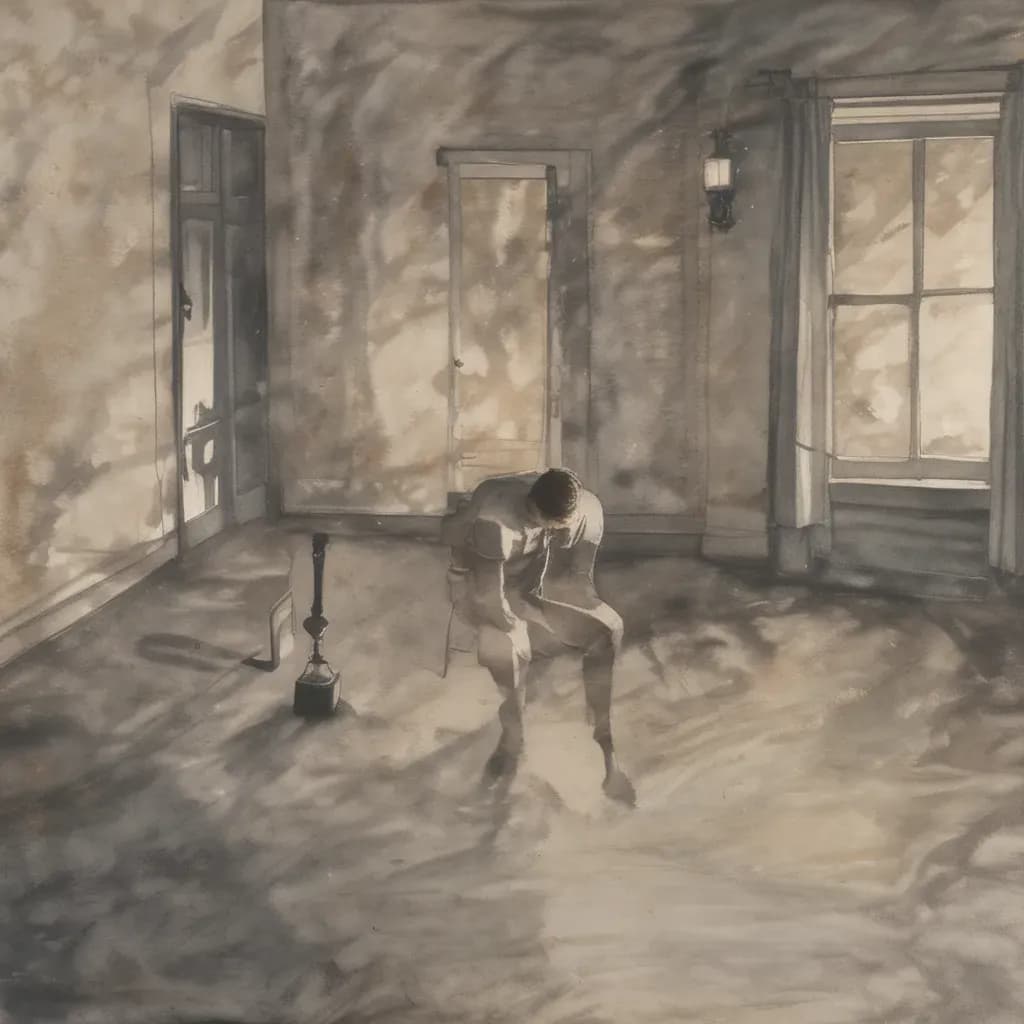
The song's narrator describes a condition of profound, structural exhaustion. The things that are supposed to make life worth living, the rewards, the perks, the incentives of ordinary existence, all feel hollow or inaccessible. MC Ride depicts someone genuinely disengaged from the standard justifications for continuing, someone for whom none of the usual reasons add up.[4]
The refrain at the song's core makes the stakes explicit: without one unnamed relationship or set of relationships, suicide would be the narrator's default response to being alive. He would do it on GP, the way you carry out any natural, unremarkable action. This is not presented as a crisis. It is presented as a math problem, and the variable keeping the math from resolving toward death is love, or something close enough to love that the distinction barely matters.[1]
The imagery of Death as a physical presence, visiting the narrator in the pre-dawn hours, appearing at his front porch and announcing itself with near-casual formality, adds a layer that edges toward folklore and mythology. Death here is not an abstraction. It is a caller, nearly patient, nearly polite. And it knows the narrator's real name.[5]
This is perhaps the most discussed detail in the song: MC Ride, who has maintained near-total public anonymity throughout his career, allows Death to address him by his actual given name, Stefan. It is the only known instance of his real name appearing in any Death Grips lyric.[1] The effect is disorienting. An artist who built his public existence on the abstraction of a stage name suddenly becomes, in the context of his darkest lyric, a person with a name who can be called by it. The persona collapses. What remains is a human being in a specific, terrifying conversation.
The song also contains a direct address to whoever the narrator credits with keeping him alive, an acknowledgment that he has survived many nights specifically because of that person or those people. This accounting of debt and gratitude, expressed in Death Grips' typically raw register, is startling for its directness. There is no irony. There is no armor.[4]
Musical Architecture: Structure as Emotional Argument
Sonically, "On GP" is one of the more legible Death Grips tracks, which is not the same as calling it simple. The production builds around Nick Reinhart's guitar work, Julian Imsdahl's organ, and Zach Hill's drumming, which shifts from metronomic restraint in the verses to a kind of controlled detonation in the choruses.[6]
The song's structure mirrors its emotional logic. The quieter verses are the internal monologue: careful, measured, deliberate. The abrasive, blown-out choruses are what happens when that careful narration breaks down, when the weight of what is being described becomes too much for controlled delivery. The music performs the thing the lyrics describe.
There is also a lo-fi organ interlude whose presence feels almost liturgical, a brief solemn moment that shifts the register from confession to ceremony before the noise returns.[6] The effect is of a song that knows where it is going and is pausing, briefly, to acknowledge the gravity of the destination.
The official video, self-directed by Death Grips and released in March 2015, features Sacramento-based magician Russell Brown performing sleight of hand. The choice resists easy interpretation. It is neither ironic commentary nor random absurdism.[7] It functions more like a counterweight: a performance of controlled wonder, placed against a song about the constant proximity of self-destruction. The magician makes things disappear and brings them back. The song is about what would disappear and not come back.
Cultural Resonance: Mental Health and the Refusal of Resolution
By 2015, conversations about mental health in music were beginning to shift. Artists were speaking more openly about depression, anxiety, and suicidal ideation than at any prior point in mainstream discourse. But Death Grips were not participating in that conversation. They were operating outside it, and "On GP" made no appeal to therapeutic language or public narratives of recovery.
What the song did instead was treat suicidal ideation as a permanent and manageable feature of a life, a background condition held in check not by treatment or transformation but by attachment to specific people. This framing, more pragmatic than clinical, felt closer to how many people actually experience chronic depression than the resolution-oriented narratives that dominate most music about mental health.[4]
Pitchfork awarded "On GP" a Best New Track designation upon its release, and critical coverage across publications noted that it represented something genuinely new in Death Grips' body of work: emotional directness in a catalog defined by coded hostility and deliberate inscrutability.[8] The Boar called it "the most personal song Death Grips have ever released," noting MC Ride's explicit discussion of his own struggle with depression and suicidal thought.[4] This was not a narrative persona battling invented demons. This was a statement about a real person's real relationship with the prospect of his own death.
The song also reflects something specific about the conditions of Death Grips' existence at that point: a band that had publicly dissolved, that had alienated labels and audiences and venues in equal measure, that had spent years operating at the outermost edge of what commercial music could accommodate. If the external world had offered constant friction, the internal calculus was going to reflect that. "On GP" is the sound of that calculus laid bare.
Alternative Readings
The ambiguity that does persist in "On GP" concerns the unnamed "you" that the narrator addresses. Multiple readings are plausible. The presence holding the narrator to life could be a romantic partner, could be close friends, could be the band itself as a collective and creative relationship. The song does not resolve this, and the openness seems intentional.[1]
Some listeners have argued that the "you" is the audience, that the act of making music and performing for people who respond to it is the variable that tips the math. This reading gains some traction from the way the narrator frames his exhaustion: not as personal failure but as a problem of fit, the sense that the world's available rewards are genuinely not calibrated for someone like him. What keeps him here is not the world becoming more livable but specific human connections that persist despite the gap.
Others have read the song as a more general statement about the nature of attachment and mortality, the way the presence of people who care about you changes your calculation about your own life without actually changing the conditions that made the calculation difficult. This is the song's most disquieting implication: the conditions have not improved. They have just been overridden, for now, by something stronger than the math.
The Clearest Thing They Ever Said
Death Grips built a career out of refusing clarity, and for good reason. The scrambled frequencies, the indecipherable passages, the deliberate obfuscations all served real artistic purposes: they created space for listeners to project meaning, they resisted the commodification of personal narrative, and they mirrored the way distress actually sounds from the inside, which is not clean or linear and does not arrive with a convenient summary.
"On GP" breaks from all of that, and the break is not a concession. It is more like what happens when the formal strategy becomes insufficient for the thing that needs to be said. Some statements require plain language, even from artists who have built their practice on the opposite principle.
The song ends as it began: with the math still unresolved, the conditions unchanged, the narrator still present. He should not be, on general principle. But he is. And the reason is specific and human and not complicated at all.
That simplicity, arriving at the end of Jenny Death after all the preceding noise and coded rage and fragmented surrealism, lands with the full weight of everything that came before it. It is the sentence the whole album was building toward. Among everything Death Grips has made, it is the most honest thing they ever said.
References
- Infornography: Death Grips - On GP (Song Analysis) - Inkling Infornography — Detailed analysis of the GP meaning, the Stefan name usage, and thematic structure
- The Powers That B - Wikipedia — Release timeline, recording details, and critical reception for the album
- Death Grips - Wikipedia — Band history, breakup announcement, and career context
- Album Review: Death Grips - The Powers That B - The Boar — Called 'On GP' the most personal Death Grips song; discusses suicidal ideation themes
- On GP - Death Grips Wiki (Fandom) — Details on the Death personification imagery, first-name usage, and recording credits
- Album Review: Death Grips - The Powers That B - Spectrum Pulse — Notes the musical contributions of Nick Reinhart and Julian Imsdahl on Jenny Death
- Death Grips - On GP (Official Video) - Stereogum — Coverage of the self-directed official music video featuring magician Russell Brown
- Death Grips - Jenny Death (Album Review) - Louder Than War — Critical reception context including Pitchfork Best New Track designation