Paintbrush
"Paintbrush" runs for fifty-seven seconds. In a world of three-minute singles and five-minute epics, that barely qualifies as a song at all. Yet within Kero Kero Bonito's debut album Bonito Generation, this tiny interlude carries an almost disproportionate weight. Nestled at the album's midpoint, it functions as a clearing in the woods: a pause, a breath, a moment where the record's coming-of-age story stops to contemplate something fundamental about what it means to make art and, by extension, to make meaning.
Background: An Album's Midpoint Breath
Bonito Generation arrived on October 21, 2016, after more than a year of development.[1] The album was the culmination of Kero Kero Bonito's evolution from their 2014 debut mixtape Intro Bonito, a more homespun affair recorded largely on a Casio mini-keyboard, into something more polished and deliberately ambitious. Producers Gus Lobban and Jamie Bulled developed the production into a maximalist electropop landscape, drawing on J-pop, dancehall, video game music, and the hyperpop-adjacent sounds of the London PC Music scene.[2]
"Paintbrush" sits at track nine of twelve, wedged between "Try Me" and "Trampoline."[1] It was written by Gus Lobban and Sarah Midori Perry. Where most songs on the album deploy Perry's trademark bilingual flow, mixing English and Japanese with fluid ease, "Paintbrush" inverts that balance almost completely. Perry sings almost entirely in Japanese, with the single English word appearing as though borrowed from another language entirely.[3]
This linguistic inversion matters. Perry has described her relationship with her two languages as a single unified resource rather than two separate systems. She grew up speaking Japanese in Hokkaido until age thirteen, then relocated to the UK.[2] The deep bilingualism she brought to the band's songwriting gave their music a texture no other British indie act could replicate. In "Paintbrush," that texture tips decisively in one direction, and it is the direction of childhood.
The Alchemy of Color
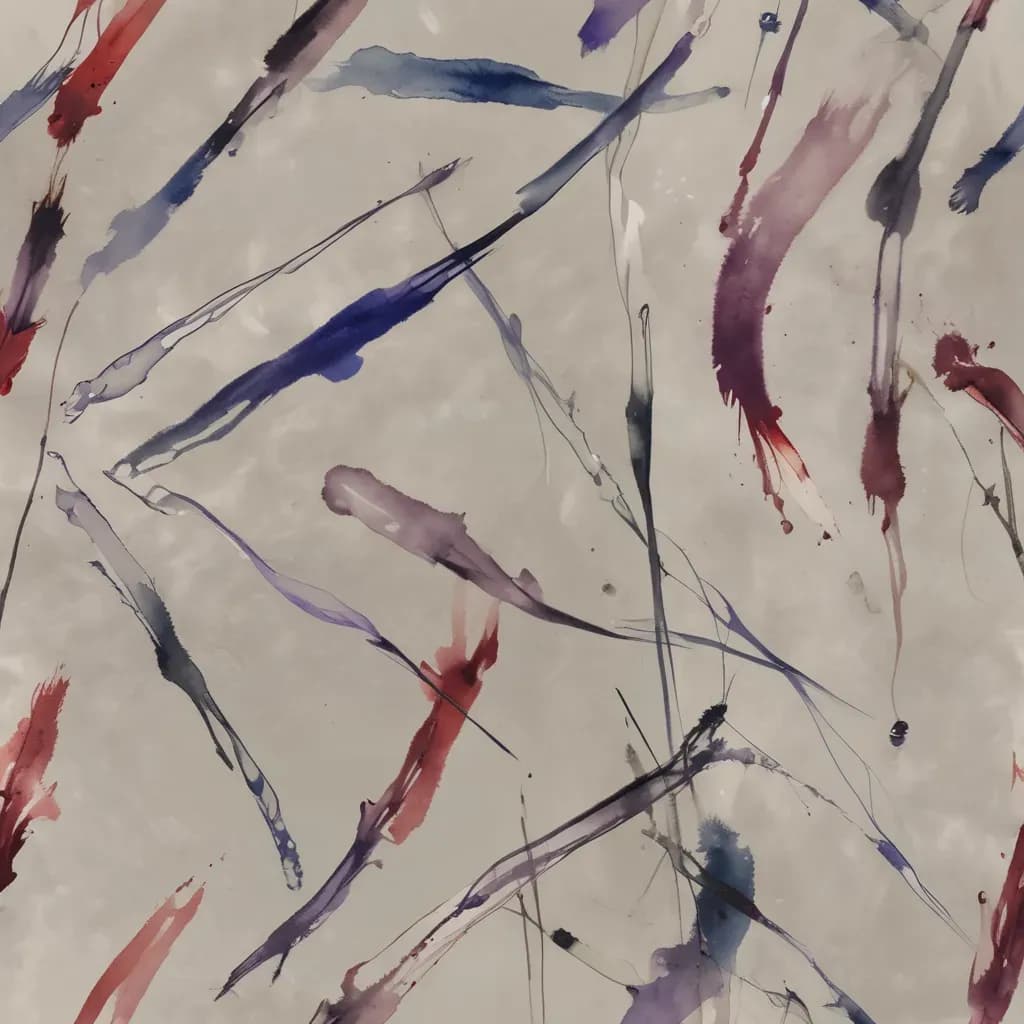
The song's central image is deceptively simple: a paintbrush wielded as an instrument of magic. The narrative action traces an arc from raw potential to realized color. At the outset, the singer faces a blank white world.[3] By the final turn, that world has been transformed into something rainbow-colored. Between those two states, the act of mixing pigments is framed not as mundane craft but as something enchanted, a spell cast through color.
The song names specific colors as its raw materials: red, blue, and purple appear as ingredients rather than outcomes.[3] This grounds the magic in something tactile and real. Mixing primary colors to produce new ones is one of the first experiments a child performs. The song recovers that childhood discovery and reframes it as an act of creative power.
The pivotal moment arrives when yesterday's dream is described as becoming today's reality. This transformation is what the song is ultimately about. The act of picking up the brush and applying color is what converts imagination into the world.[3] Art, the song implies, is how dreams become material. It is also how a blank world, daunting in its blankness, becomes habitable.
This theme fits perfectly within the album's broader arc. Bonito Generation is a record preoccupied with early adulthood: graduation anxiety, city life, job applications, social media, and belonging.[4] It is an album about people standing at a threshold, uncertain what lies ahead. "Paintbrush" offers a quiet but powerful response to that uncertainty. Pick up the brush. Make something. Transform the blank canvas into color.
Language as Home
Perry has spoken in interviews about her approach to language in a way that illuminates "Paintbrush" directly. She does not experience English and Japanese as two separate languages requiring translation between them, but as a single, unified palette of expression.[5] Growing up bilingual in Japan before coming to the UK gave her, in her own words, twice as much material to work with when writing lyrics. In "Paintbrush," that doubled palette is deployed in one direction.
The song's almost entirely Japanese text is unusual even within the KKB catalog, which typically balances both languages throughout a track. That choice, to commit so fully to Japanese for a song about color, creativity, and childlike wonder, has an emotional logic. Perry's childhood, and the first experiences of making things with paint and brush, happened in Japan. The language in which one first discovers that mixing blue and red makes purple is the language in which that discovery feels most immediate. "Paintbrush" is sung in the language of origin, and that gives its imagery an intimacy that English alone could not carry.
Perry has an art background and came to music by a roundabout route, having previously pursued visual art and novel-writing before responding to Lobban and Bulled's recruitment advertisement.[2] The paintbrush of the song's title is not only a metaphor for artistic creation in the abstract. It is a specific, familiar object to someone who spent years drawing and painting before picking up a microphone. The song may be short, but the object at its center carries a biographical weight.
Kawaii as Radical Act
Kero Kero Bonito emerged at a particular moment in Western awareness of Japanese pop aesthetics, specifically the kawaii tradition, in which cuteness functions as both cultural currency and subtle subversion. The Japan Society UK described the band as "Lily Allen meets J-pop," capturing their unusual position at the intersection of London indie and Japanese pop sensibility.[2] Critics regularly noted the layering in their work: a bright, candy-colored surface over something more emotionally complex beneath it.
"Paintbrush" is the most purely kawaii moment on Bonito Generation: a short, weightless piece in Japanese about mixing colors and casting magic spells. But Lobban has noted in interviews that when the band started making music together, positivity in pop was genuinely radical. To offer joy without irony, to make something small and bright without apology, was to resist the prevailing mood of knowing detachment.[6] "Paintbrush," in its fifty-seven-second refusal to be anything other than what it is, participates in that resistance.
One essayist, writing shortly after the album's release, identified the song's specific color references as part of the album's broader visual palette, connecting its imagery to the neon tints and pastel smears of turn-of-the-millennium Japanese pop culture aesthetics.[7] Read this way, the song is not only about making art but also about inhabiting a particular aesthetic universe, one descended from the late-1990s and early-2000s Japanese pop that shaped Perry's childhood. The colors named in the song are the colors of that world.
Clash Magazine, in their 9/10 review of the album, described KKB's approach as combining a genuine love for giant hooks with zero-inhibition songwriting.[8] "Paintbrush" is the zero-inhibition heart of that description. It does not try to be more than it is. It states its belief in the transformative power of making something and then steps back, leaving the rest of the album to prove the point.
Other Readings, Other Colors
The most compelling alternative reading of "Paintbrush" frames the blank white world not as a neutral canvas but as the specific blankness of young adulthood. Bonito Generation is, among other things, a record about the anxiety of standing at the start of a life with nothing yet written. The album moves through graduation, job applications, city apartments, and social media performance, all of which are forms of trying to give shape to an open-ended future. "Paintbrush" offers the same project in miniature: here is a white world; here is a tool; here is what happens when you use it.
There is also a reflexive reading, one that turns the song's eye back toward the album that contains it. By the time "Paintbrush" appears at track nine, Bonito Generation has already demonstrated eight different ways of doing what the song describes: taking a musical blank page and filling it with color. The interlude, heard in this light, is the record pausing to acknowledge its own creative project. Lobban, Bulled, and Perry have been wielding their own paintbrush all along.
As a formal object, the pop interlude has a distinguished history, from the classical song-cycle tradition through the Beatles' Abbey Road medley to the brief segues on hip-hop concept albums. KKB use the form here not to transition or experiment but to concentrate. "Paintbrush" is what happens when you take the album's central argument and compress it to its simplest possible statement.
A Small Song About a Big Idea
There is something quietly affecting about a song this short saying something this complete. "Paintbrush" does not build toward a climax or subvert expectations. It offers an image, traces a transformation, and ends. That the transformation it describes is precisely the one Kero Kero Bonito were enacting during the making of Bonito Generation, turning the blank page of their early promise into a full-color debut, gives the song a reflexive quality that deepens on repeated listens.
In fifty-seven seconds, the song encodes a complete creative philosophy: the world begins white, creativity is a form of magic, and the result of that magic is a rainbow. For a band whose early output was sometimes dismissed as surface-level brightness, "Paintbrush" offers a quiet rebuttal. The brightness, it suggests, is the point. The colors are the argument. And anyone can pick up the brush.
References
- Bonito Generation - Wikipedia — Album history, track listing, release details, and critical reception
- Kero Kero Bonito - Wikipedia — Band biography, formation history, members, and discography overview
- Paintbrush - Kero Kero Bonito lyrics translation (LyricsTranslate) — Japanese lyrics with English translation, confirming the song's near-total Japanese language content and core imagery
- My Generation: Kero Kero Bonito interview - DIY Magazine — 2016 interview covering the album's generational themes, early adulthood anxieties, and creative process
- Kero Kero Bonito interview - BeatRoute Media — Interview with Perry and Lobban covering bilingualism, language as unified resource, and album development
- Positivity Is Punk AF: Kero Kero Bonito - Vice — Interview covering Lobban's statement on positivity as radical, Perry's Japanese upbringing, and the band's cultural positioning
- Kero Kero Bonito and the Persistence of Memory - Funky Dungeon — Extended critical essay connecting Paintbrush's color imagery to the album's neon-pastel aesthetic universe and millennial themes
- Kero Kero Bonito - Bonito Generation review - Clash Magazine — 9/10 review praising hooks, zero-inhibition songwriting, and emotional wit