Pyramids
Nearly ten minutes is a long time to ask a listener to stay with one song. "Pyramids" spends that time moving between millennia, from a queen in ancient Egypt to a worn-out motel in present-day Los Angeles, and it never quite lets you decide whether you are hearing a history lesson, a love story or a confession. It is a pop song the way a short film is a music video: the form is borrowed, then stretched until it nearly snaps.
What holds it together is a single figure. Cleopatra appears twice, once as a ruler and once as a woman selling her time, and the song keeps asking what separates the two.
The song that introduced an album
Ocean posted the track on 7 and 8 June 2012, after teasing it with a short clip of an expensive-looking car that promoted a project he had not yet named.[1] It was his first release in more than a year and the second single from Channel Orange, following "Thinkin Bout You".[1] The album itself arrived in July on Def Jam, and it debuted at number two on the Billboard 200 before collecting some of the best reviews of the year.[6]
Ocean began writing Channel Orange in early 2011 alongside his friend and collaborator Malay, and the two chose live instrumentation over the sample-heavy approach of his earlier mixtape.[6] "Pyramids" is credited to Ocean and Malay as writers, with Ocean, Malay and Om'Mas Keith producing, and John Mayer contributes an uncredited guitar solo near the end.[1] According to the album's background, it was one of only three songs recorded at a rented Beverly Hills mansion Ocean had hoped to use for the whole project.[6]
The timing matters. Channel Orange was released days after Ocean published an open letter describing an unrequited first love for another man, which turned the album into a very public coming-out moment.[6] "Pyramids" had already been released by then, but listeners returned to it with that story in the background. A song about desire, power and ownership read differently once its author had spoken so openly about wanting someone who could not want him back.
Two halves, one queen
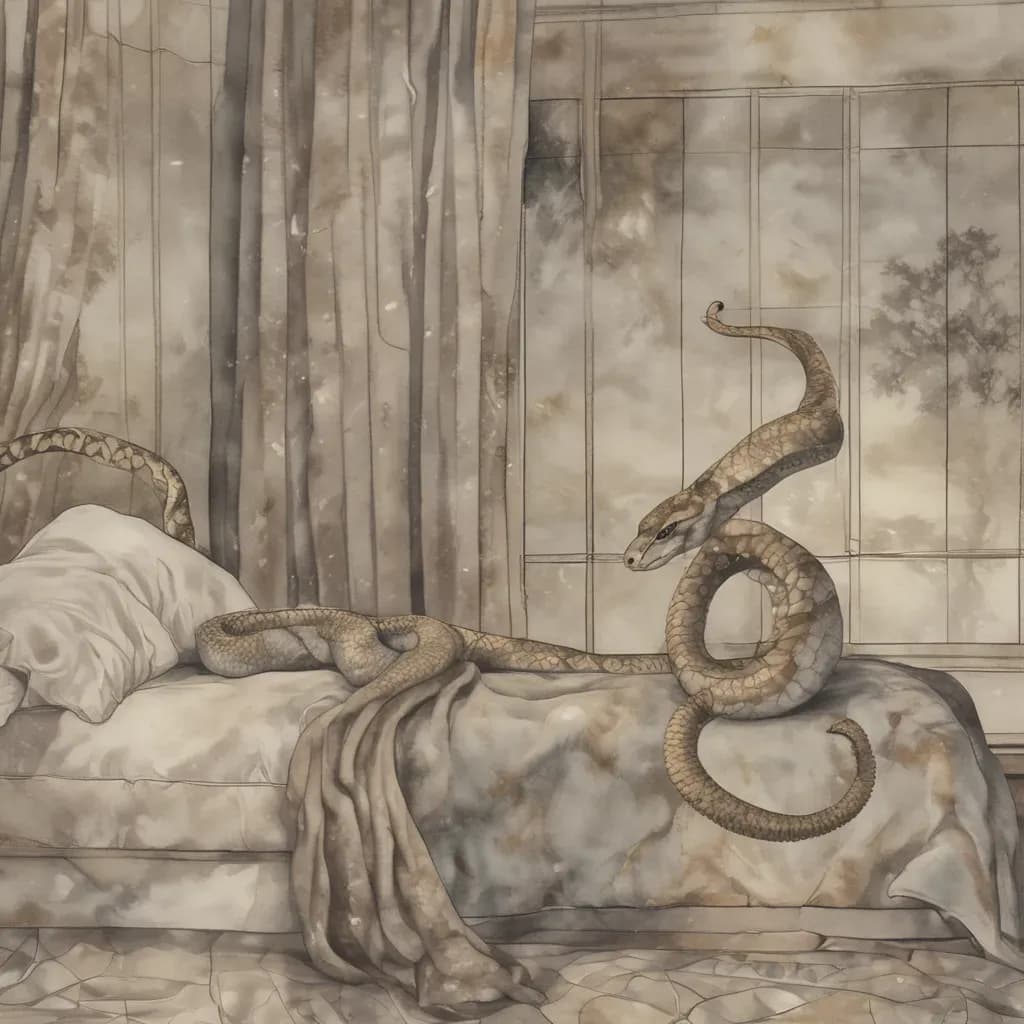
The song is built in two large movements, and the seam between them is where its meaning gathers. One reviewer described it as split into two distinct halves: an ancient-world story first, then a contemporary one.[2] The first half belongs to the Egyptian queen. A lover mourns her, recalls her magnificence and watches her fall, and the tale ends the way the legend does, with a fatal snakebite.[2][5]
Then the music dissolves and reforms, and the story resumes in a world of neon signs, cheap rooms and unpaid bills. Now the narrator is a pimp, and the woman he manages is another Cleopatra, working at an establishment called the Pyramid. The song moves from a historical romance to a modern one without changing the emotional shape: a man loves a woman who belongs, in practice, to everyone but him.[2]
The twist, as one critic framed it, is that the pimp falls for the woman he profits from, loses her to her customers, and slides into the position of just another man waiting for her attention.[2] The business he runs has rules, and his feelings are no match for them.[1]
Cleopatra as a symbol
Why Cleopatra? Part of the answer is that she is among the most recognizable examples of a powerful woman whose story has always been told through the men around her. She ruled a kingdom, yet her legend is mostly about her lovers. One reading of the song takes that observation and turns it into the central idea: women with sexual or political power are routinely reduced to what they mean to men.
Other writers push the symbolism further. A 2020 retrospective reads Cleopatra as a figure for the endurance of Black women, and argues that the song gives her agency rather than pity.[3] The same piece notes that the first half ends with the queen's death while the song carries on, and takes that as a sign that she, like desire itself, never really dies. The final image of her still at work at the Pyramid supports the idea: the present tense suggests a job that has no end.[3]
Another critic, writing the week the song appeared, heard Shakespeare in it, a collision of Othello and Antony and Cleopatra.[5] On that reading the snake is a double symbol, at once a sexual image and a carrier of betrayal, and the story is really about a lover cheated on by someone his money cannot hold.[5] The critic also noticed how the language of labor, with its echoes of building monuments for a ruler, sets the narrator's luxury against the idea of slave-like work.[5]
None of these readings cancel the others. The song is built to hold several stories at once, and the pleasure of returning to it lies in noticing which one has moved to the foreground.
Fantasy built on real ground
Ocean has been clear that the story is not autobiography in any simple sense. Speaking to The Guardian, he said the song was inspired by real events: when he lived in Los Angeles he lived alongside pimps, and the narrative is a fantasy built off that dynamic, though he added that a writer can only draw on what he knows up to a point.[1] The pimp is therefore a character observed from a nearby apartment rather than a mask Ocean wears.
That distance suits his habits as a writer. Of his work more generally, he has said that the stories are the point, that the darker colors in them were simply what he had to work with on certain days, and that his role is to bear witness.[6] "Pyramids" fits the pattern. It watches a transaction closely and refuses to moralize about it. DJBooth observed that Ocean neither pities Cleopatra nor lectures about her work, and acts instead as a vessel for her story.[3]
Still, the same writer concedes that the male gaze cannot be removed from the song entirely, since the narrator is a man looking at a woman and telling us what he sees.[3] The honest version of the song is one that knows this. The pimp's grief is real, but it is also the grief of someone who thought he owned something.
The sound of a story changing eras
The music does narrative work of its own. The track opens with warped R&B, and moves through electro-house synths, pop melodies reminiscent of Michael Jackson, electronic transitions, bass-heavy breaks and saxophone before arriving at a slow-jam second half and Mayer's guitar.[1] Critics reached for comparisons to Prince's early-eighties records, to the storytelling sweep of a Bob Dylan epic, and to Radiohead's "Paranoid Android" as an R&B equivalent.[1]
Listeners heard the structure as a kind of cinematic cross-dissolve. One reviewer said it plays like a music-video treatment built into the arrangement, running from ancient Egypt to a shabby motel suite, and called the idea ridiculous in a way that works.[4] The synthesizer progression of the first half sounds spacey and futuristic, which is a deliberate contrast to an ancient subject, while the calmer second half matches the exhausted, intimate mood of the motel.[2]
This is also why the length feels earned to those who love it. DJBooth argued that in an age of shrinking songs and attention spans, the track demands full attention and rewards it, and that Ocean stitched two songs together on purpose rather than releasing them separately.[3]
Not everyone was convinced
The reception was overwhelmingly positive. The track was named Song of the Week by Complex, earned a Best New Track from Pitchfork, and was praised by critics from the Telegraph to Time.[1] Yet a panel at The Singles Jukebox gave it a middling average of 6.56 out of 10, and its members split sharply.[4] Some scored it a perfect 10. Others found it closer to two linked album tracks and an instrumental than to one coherent epic, and one complained that quality control slips over ten minutes.[4]
The Guardian's critic found it ambitious to the point of sounding slightly daft, while conceding that nothing else in current R&B sounded like it.[1] That mix of admiration and unease is useful. A song this willing to be absurd will always sit near the line between grand and silly, and part of its character comes from standing there on purpose.
An alternative reading: the song as self-portrait
Because Ocean disclosed his own history of unrequited love so soon after the single, some listeners map the narrator onto him. On this view the pimp is less a Los Angeles character than a figure for any person who has built a life of appearances, with the flashy chain and the car that cannot run, and who discovers that the thing he wanted most is not for sale.[2]
This reading should be held loosely, since Ocean himself has described the story as a fantasy.[1] Yet it explains why the song feels so emotionally precise despite its outlandish setting. The pimp and the queen are different from Ocean, but the loneliness of loving someone who is always working, always elsewhere, always owed to somebody else, is familiar ground for a writer who had just described exactly that feeling in his own life.[6]
Why it endures
More than a decade on, "Pyramids" has gone gold in the United States and platinum in several other countries, and it remains a reference point for what an ambitious R&B single can attempt.[1] Its legacy is partly formal. It showed that a mainstream-adjacent artist could release a ten-minute, multi-part narrative and be rewarded for it.
Its deeper hold comes from the way it compresses a very old problem into a very specific setting. Power and desire have always been tangled up, and the people who sell attention or intimacy for a living have always been the ones whose stories get told by someone else. Ocean lets the story be told by a man who is complicit and heartbroken in equal measure, and who cannot tell which feeling is more honest.
By the time the guitar takes over and the song fades with the queen still at work, the point has quietly been made. The monuments change, the names change, and the labor goes on. What Ocean offers is not a verdict but a long, strange, beautifully produced look at the cost of that continuity.
References
Keep reading
More Progressive Soul
- Jesus Children of America Stevie Wonder
- Pastime Paradise Stevie Wonder
- What's Going On Marvin Gaye
- Living for the City Stevie Wonder