Qualia
Some words arrive in a pop song carrying a lot of baggage. Qualia is one of them. It belongs to philosophy seminars and arguments about consciousness, not to the world of distorted guitars and pub rehearsals. When a young London band puts that word on a single, you can fairly ask what it is doing there.
The answer, as far as the band has said, is both smaller and stranger than you might expect. The song is a loud, dreamy ballad that rests on a borrowed idea about place, and its frontman describes it as a return that has not been resolved.[2] That modest description turns out to be a good way into everything else the track seems to be doing.
Where the song came from
Humane are an East London five-piece that began as the solo recording project of Max Hanley and grew into a full band over two self-released EPs and a steady run of UK shows.[1] An earlier interview, from the period when the project still went by a longer name, shows a songwriter who wanted something more visceral than the mellow bands of his youth. He pointed to Fontaines D.C. as the catalyst, and to the idea that energy and message can matter more than technical polish.[6]
"Qualia" itself began in a quieter form. According to the press coverage around its release, it started life as an acoustic song. Hanley then played it to the rest of the band in a pub, and it was reworked into what several writers describe as distorted balladry.[2][4][5] That path, from private sketch to shared noise, matters for how the song feels. It sounds like something intimate that has been turned up until it fills a room.
The single arrived on 16 November 2026 as one half of a double release with a track called "Pebble Dash", and both songs were co-produced by Finn Billingham.[1] Both come from the band's debut album, expected in early 2027.[2] The release followed a run of singles that had earned radio play on BBC Radio 1 and BBC 6 Music, so "Qualia" lands at a moment when the band's audience is growing quickly.[1]
A borrowed idea about place
The most useful fact about the song comes straight from Hanley. He has said that it is built around a line from Slowdive's "When The Sun Hits", which the band borrowed for the closing line of the chorus.[2] In the Slowdive original, the line makes a simple claim about how location shapes meaning: where you stand changes what the moment is. I will not repeat the words here, but the idea is easy to grasp. It is a thought about context, about how a feeling cannot be separated from the room, the street or the town in which it happens.
"When The Sun Hits" sits on Souvlaki, the 1993 album that was met with lukewarm reviews on release and has since been hailed as a classic of shoegaze.[8] That makes the borrowing a quiet act of lineage. Humane are a post-punk band by most descriptions, but one reviewer hears New Order-style post-punk, shoegaze and alternative rock all in the same mid-tempo anthem.[3] Taking a thought from Slowdive and placing it at the emotional peak of a chorus is a way of saying so out loud.
There is also something fitting in the way the borrowing works. A line lifted from another song is itself an experience of context: the same words mean one thing in a 1993 shoegaze record and something else in a 2026 post-punk chorus. The song enacts its own idea.
What the word means
The title does heavier lifting. In philosophy, qualia are the felt qualities of experience, the particular way red looks or a sore tooth aches, the part of consciousness that seems to resist being described from the outside.[7] The classic puzzle is that two people can agree on every observable fact about a moment and still have no way of knowing whether they lived it the same way.
Hanley has not, in anything I could find, explained why he chose the title, so what follows is interpretation rather than report. But the fit with the band's stated idea is striking. If where you are shapes what a moment is, then experience is irreducibly local and personal. Nobody else can stand exactly where you stood. The word in the title and the borrowed idea in the chorus are pointing at the same thing from two directions: one from academic philosophy, the other from a beloved record about dissolving into sound.
A song titled this way also makes a quiet promise about intimacy and its limits. It offers a private experience to the listener, while admitting that a song can only point toward the feeling, never hand it over.
An uncertain return
Hanley's own summary is that he sees the song as an uncertain return rather than a resolution.[2] That phrase deserves attention, because it rules out the two most common shapes a song about coming back can take. It is not a triumphant homecoming, and it is not a clean goodbye. It is somebody arriving, or trying to, without knowing whether arrival will change anything.
One review calls the lyrics earnest and lived-in, which suggests a song grounded in specific personal territory rather than abstraction.[3] Combined with the title, that points to a narrator measuring the distance between who they were in a particular place and who they are now. Returning to somewhere, whether a relationship, a town or a version of yourself, is a classic way of discovering that the place has not changed but you have, or the reverse. The philosophical word and the ordinary human feeling meet in that gap.
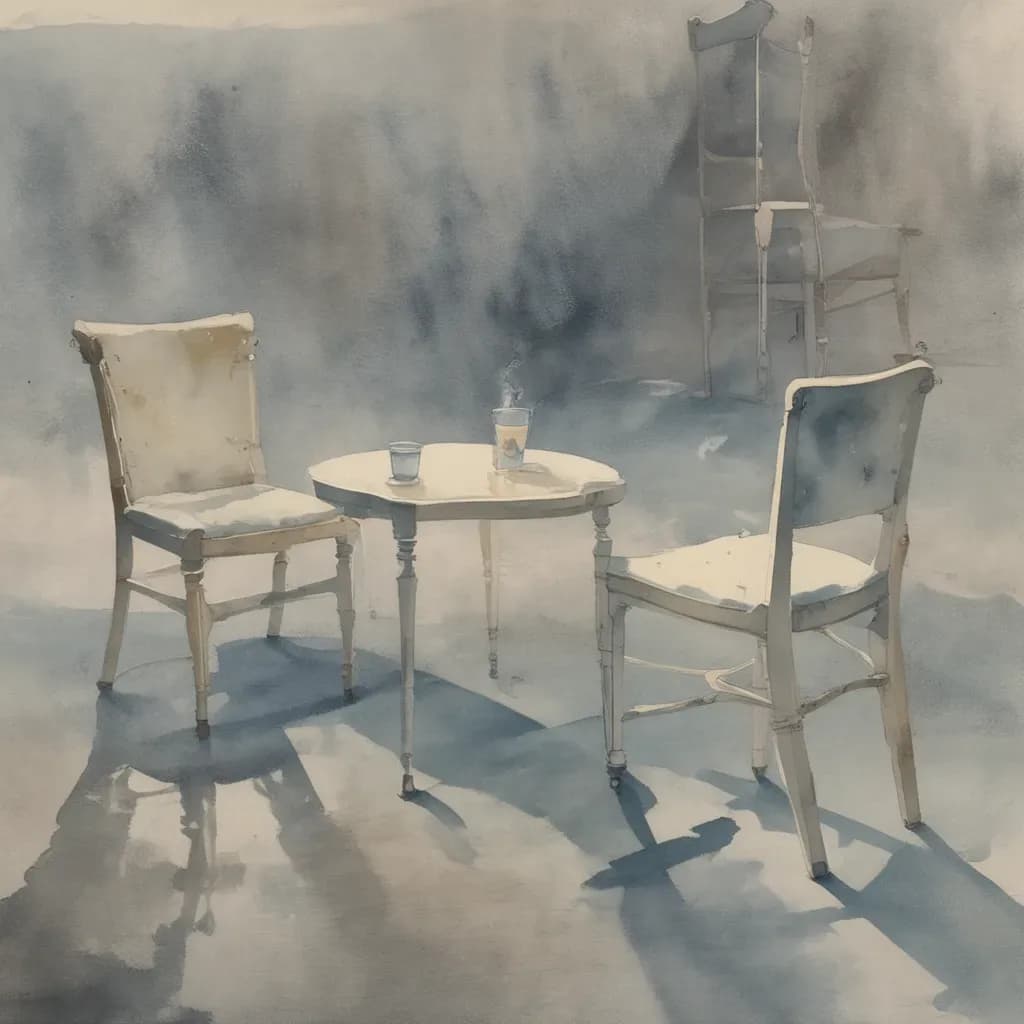
The musical choices support this reading. Reviewers note that the band has set aside the frantic energy of its recent singles for something dreamier, a mid-tempo pace with big, punchy choruses.[3][5] A slower tempo gives a song room to hesitate. Distortion, meanwhile, blurs outlines the way memory does. The result is a sound that feels like standing in a familiar place and seeing it slightly out of focus.
The other side of the single
The double-single format invites comparison. "Pebble Dash" is described as the more sober half, built around a repeated line that the narrator pushes until he reaches a breaking point.[2][4][5] If "Qualia" is about the uncertain act of returning, its companion seems to be about the strain of living inside someone else's story. Together they hint at the concerns reported for the album, which reportedly deals with the fragile psychology of modern life, and in particular the gap between becoming someone and disappearing altogether.[3]
Read that way, "Qualia" is the gentler entry point. It asks what it means to be present somewhere, while its partner asks what it costs when presence turns into performance. One song wonders whether you can come back. The other wonders who is doing the coming back.
Still Listening describes these releases as the start of a darker, more expansive turn for the band.[5] That fits the picture. The tempo has slowed, the sound has widened, and the subject matter has moved inward.
The priory
The video, titled "Qualia, From the Priory", extends a series of clips the band has filmed at an abandoned priory, and was directed by Hannah Jane Murrell.[3][4][9] The setting is worth a thought in light of the song's themes. A ruined religious building is a place whose meaning has been emptied and refilled many times. It is exactly the sort of location that supports the idea that where you are changes what is happening, since the same stones once meant devotion and now mean decay and echo.
It is also a place built for sound. Large stone spaces reward the kind of swelling, reverberant music that Humane have moved toward. Whether by design or happy accident, the visuals and the song seem to be working on the same question.
Other ways to hear it
Because the band has said so little about the lyrics, the song stays open. A listener could hear it as a romantic return, a reconciliation that may or may not take. Another could hear a homecoming to a hometown, where the narrator discovers that being in a place and belonging to it are different things. A third might take the title almost literally and hear a song about the impossibility of sharing inner experience, with the chorus as a plea to be understood across that gap.
These readings do not compete so much as stack. The song's own governing idea, that context shapes meaning, practically invites each listener to bring their own location to it. A person hearing it on a night bus will hear a different song from the one heard at a gig in Hackney, and the song seems comfortable with that.
It is worth saying plainly that this is a new release with limited commentary. The band is at the start of an album cycle, with a US debut planned at New Colossus in New York in March 2027, and deeper explanations may follow.[2][5] Any reading offered now should be held loosely.
Why it lands
What makes the song effective is the economy of its ambition. It takes a heavy philosophical word, a borrowed thought from a landmark of 1990s guitar music, and a plain statement of emotional uncertainty, and combines them into something a listener can feel before they can explain it. That is exactly what the word in the title describes: the part of experience that is felt first and argued about afterwards.
For a young band moving from a solo bedroom project to a five-piece with radio support, there is a nice symmetry in writing about return and uncertainty at the moment of growth. Hanley's earlier comments about wanting songs that work live, that release something for the band and the crowd, suggest an artist who cares more about shared feeling than about precision.[6] "Qualia" delivers that in a form that is both private and communal.
Conclusion
"Qualia" is a song about the stubborn privacy of experience, delivered in a form designed to be shared by a crowd. Its central gesture, borrowing a thought about place from Slowdive and sitting it at the heart of a chorus, ties a new band to an old tradition while insisting that the meaning belongs to wherever you happen to be listening.
Hanley called it an uncertain return rather than a resolution, and the description is honest. The song does not tell you that coming back fixes anything. It stands in the doorway, a little blurred and a little loud, and lets you decide what it felt like to arrive.
References
Keep reading
More Post-Punk
- Hard to Change Truth Club
- Seeli Truth Club
- Pride (In the Name of Love) U2
- With or Without You U2
- Blue Monday New Order
- Roxanne The Police