Queen of Hearts
A love song at the start of a catastrophe
Most rock operas open with a thesis. David Comes to Life opens with an instrumental, and then, on its second track, it gives you something much simpler: two people falling for each other.[1] "Queen of Hearts" is the moment in the story where nothing has gone wrong yet, and the song knows it. It is bright, fast and a little breathless, the sound of someone who cannot believe their luck.
That innocence is the whole point. Everything that makes the album devastating later depends on this song being sincere. If the love were ironic or guarded, the loss that follows would be an event in a plot. Because the love is real, the loss becomes something you feel.
Where the song sits in the story
David Comes to Life is a rock opera set in a fictional English factory town in the late 1970s or early 1980s. Its hero, David Eliade, works at a light bulb factory. He meets Veronica Boisson, an activist, and the two fall in love. Their attempt to bomb the factory ends with her death, and the later acts follow David through grief and a kind of rebirth.[1]
"Queen of Hearts" belongs to the first act, which the album's own structure frames as love followed by tragedy.[1] It is the "love" half of that sentence. In the A.V. Club's account of the plot, the song is the scene where David meets Veronica, who hands him a pamphlet, and he falls for her instead of having a political awakening.[2] That small twist matters. David does not fall in love because he has been converted to a cause. He falls in love with a person, and the cause comes along behind her.
The band's Sandy Miranda has described the story as loosely told, something the listener has to piece together, and at heart a classic tale of love, loss and revelation.[3] The first act is where the love part of that tale gets its clearest statement.
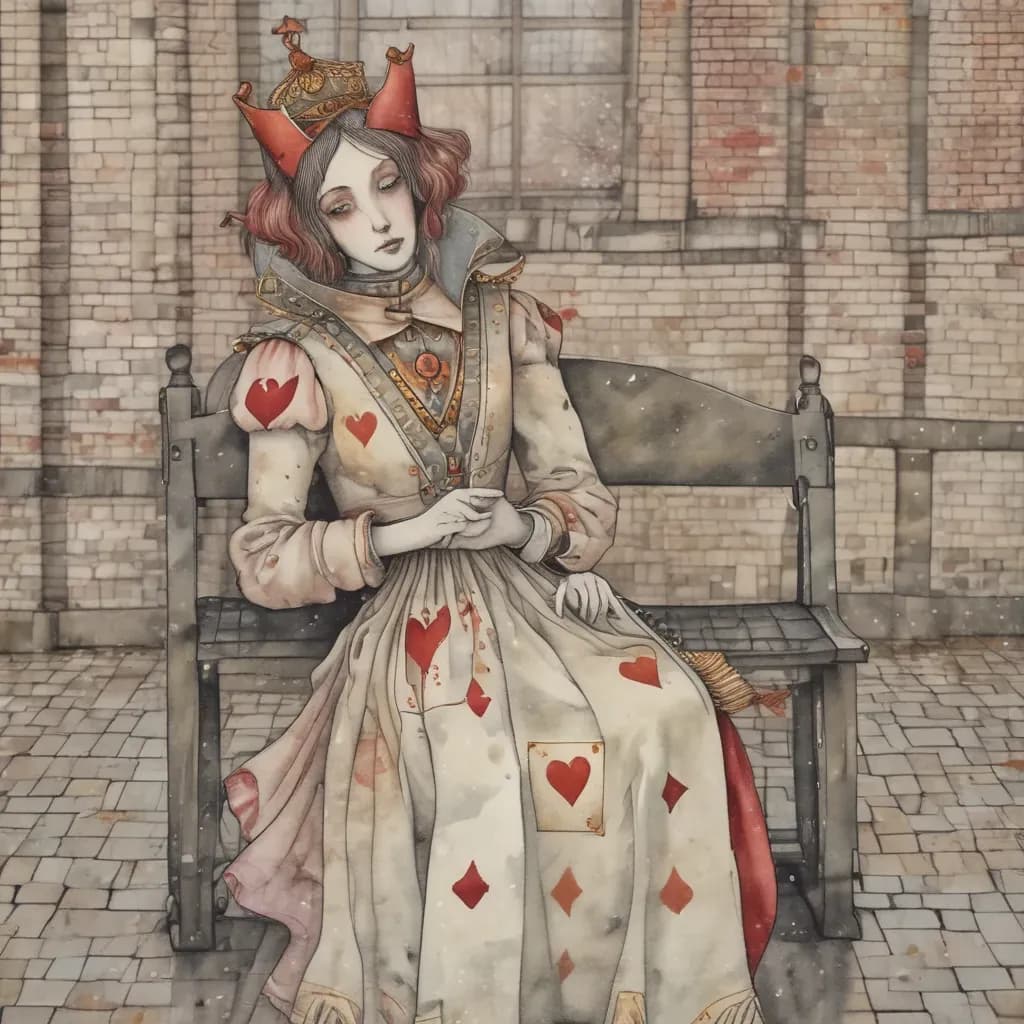
The most personal lyrics the band had written
It would be easy to treat all of this as costume drama. Damian Abraham, who wrote the lyrics, has said otherwise. He told the A.V. Club that these were the most personal lyrics he had written, and that it was the first time he sang about real relationships he had been in.[2] He also described a constant fear that good things will fall apart.[2]
That fear gives "Queen of Hearts" its undertone. A love song written by someone who expects loss is different from one written by someone who does not. The joy here has an edge of urgency, as though the singer is trying to hold the moment still while it happens. When you know the story, the brightness starts to sound like bargaining.
Abraham has also said that David is as much himself as anyone, and he has been quoted as saying the band could hide behind characters like David and Veronica while really talking about his own breakup.[1][2] The opera costume, in other words, works as a way to say something exposed. A frontman known for physical, confrontational performance gets to be tender by speaking through a factory worker in a made-up town.
Veronica as a person and as an idea
Abraham has described Veronica as both a real person and an idea: the notion of taking control of your own destiny. He compared her to the moment a kid first realizes that other musical or political systems exist.[2] Seen that way, the title makes a certain sense. A queen in a card game is not a worker or a citizen. She is an emblem, someone who changes the rules of the table.
This double life is what keeps the song from being a simple romance. David loves a woman, and he also loves what she shows him: that the factory, the town and the life laid out for him are not fixed. Falling in love and waking up are tangled together so tightly that he cannot tell which one is happening.
It is also a familiar feeling for anyone who found a scene, a band or a set of ideas through another person. The first person who introduces you to a bigger world tends to become, in memory, inseparable from the world itself. The song captures that fusion of affection and revelation at the point where it still feels purely good.
Politics, loss and what Veronica's death means
Abraham reads Veronica's death as symbolic of the decline of organized labor under Reagan and Thatcher, while insisting that the album is also a love story.[2] Both readings run through the opening act. The factory setting is not decoration. It places the lovers inside an economy where the work is dull, the future is narrow and radical action can look like the only honest response.
"Queen of Hearts" does not argue any of this directly. It does not need to. Its role is to make you care about the people before the history lands on them. Political defeat in the abstract is easy to shrug at. A defeat that takes away someone you have just watched fall in love is harder to dismiss.
A hardcore band writing a pop-punk-sized hook
The song also changes how Fucked Up sound. The band emerged from Toronto's hardcore punk scene and had built a reputation on abrasion and long, ambitious records.[4] "Queen of Hearts" is one of their most immediately welcoming songs. The A.V. Club's interviewer called it a straight-up love song and compared its accessibility to the popular pop-punk of bigger bands.[2]
There is a tension in that choice. The rock opera began, by Abraham's account, as a running joke, a way of testing what a band could do when expectations had already become impossible to meet after the acclaim for The Chemistry of Common Life.[2] The album is huge, long and deliberately pretentious. And yet at its heart sits a simple emotion that anyone can recognize on the first listen. The grandeur is the frame. The song is the picture.
Abraham said the music was finished before there was a story, and that he, Mike Haliechuk and a third bandmate sketched the characters and plot over a few weekends in a Toronto mall food court.[2] That origin story is oddly fitting. A song about a young couple falling in love was shaped in a place as ordinary as the factory town it describes.
The video and the sound of many voices
The 2011 video for the song was directed by Scott Cudmore and shot in rural Ontario. It features a children's choir singing the song, with the boys taking Abraham's part and the girls taking the part sung by Madeline Follin of Cults.[1] SPIN described it as sitting somewhere between a polished viral choir clip and the disaffected schoolchildren of a famous rock-opera set piece, and noted that it makes no attempt to explain the album's complicated storyline.[5]
The choice is revealing. Putting young voices on a song about first love turns it from one couple's story into something communal and a bit eerie. The feelings are the oldest ones there are, and children sing them without irony, which is exactly how the song itself wants to be heard. It also hints at what the album is circling: love as something you inherit and repeat, not something you invent.
Follin's guest vocals on the track, together with the fact that the album uses guests mainly for its female roles, give the song a conversational shape.[1][2] David's feelings are answered by another voice, which makes the love feel mutual and alive rather than a monologue.
Other ways to hear it
One reading treats the song as pure foreshadowing. On a first listen it is a joy. On a second, knowing that Veronica dies, nearly every bright moment turns into a countdown. This is the reading that makes the song feel like the most tragic on the record, even though it is the happiest.
A second reading focuses on David's passivity. In the A.V. Club's summary, David falls in love instead of being politicized.[2] You could hear the song as the first sign of his central flaw: he follows rather than decides. Veronica gives him a pamphlet and he gives her his heart, but the idea of acting on his own conviction is still a long way off. That fits an album whose last stretch is about David finally having to stand up as himself.
A third reading is autobiographical, and the band invites it. If David is as much Abraham as anyone, and the characters are a mask for a real breakup, then "Queen of Hearts" is a memory of what it felt like before the ending.[1][2] The song becomes a photograph of a period the singer cannot get back, rendered in the largest possible frame so that he can look at it directly.
Why it lasts
The album drew strong reviews on release. It holds a Metacritic score of 86, earned a Best New Music designation from Pitchfork, was named the best album of 2011 by SPIN and was a 2012 Polaris Prize nominee.[1] Plenty of that praise went to its ambition. But the song that opens its human story endures for a simpler reason: it makes a very large project feel intimate.
The song has also kept a place in the band's wider culture, including an appearance in a 2016 video game, Loud on Planet X, alongside avatars of the band.[4] In a catalogue of dense and difficult work, this is the track people can enter without a map.
Conclusion
"Queen of Hearts" is the sound of a world before it breaks. It captures the specific kind of happiness that arrives with someone who changes how you see everything, and it does so inside an enormous, knowingly overblown rock opera. Its sincerity is the reason the rest of the story hurts.
Abraham's fear that good things fall apart hangs over it, and so does the weight of a story about labor, grief and the cost of acting on your beliefs. But the song itself refuses to be sad. It holds the moment up and lets it shine, which is the most human thing a love song can do.
References
Keep reading
More Hardcore Punk
- Shedding Season Comeback Kid
- Camp Orchestra Show Me the Body
- I Got Heaven Mannequin Pussy
- Of All People Foo Fighters
- Brick Alex G
- Shitshow Death Grips