Quik Stop
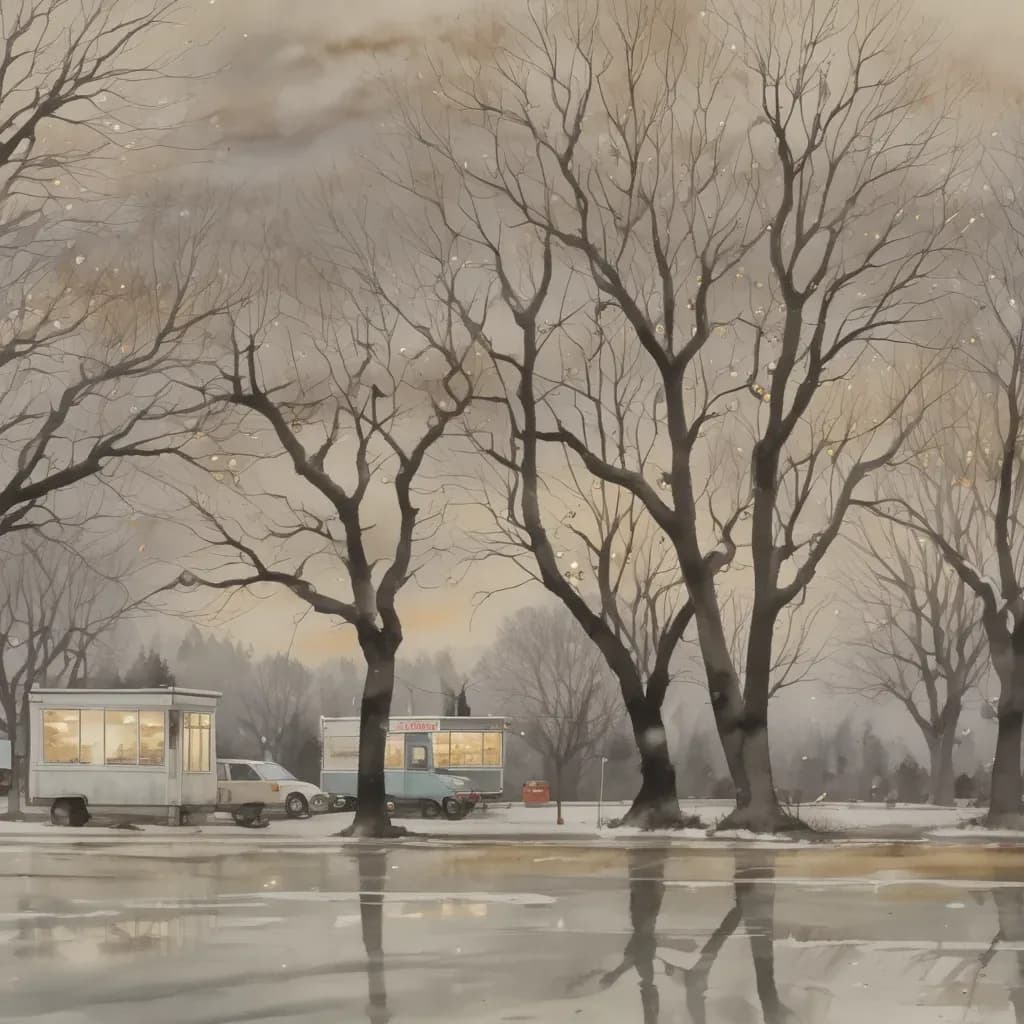
The gas station is one of the few genuinely democratic spaces left in American life. You stop because you have to, not because you want to be there. Nobody arrives with an agenda. It is a place of transition, of small necessities, of strangers whose lives briefly overlap without ceremony. When J. Cole pulls into one of these ordinary corners of the world wearing the hoodie he uses to keep the public at bay, he is searching for exactly that kind of uneventful anonymity. "Quik Stop," the tenth track on Disc 39 of his seventh and purportedly final studio album, "The Fall Off," is about what happens when that anonymity collapses in the best possible way.
It is a quiet song about a loud question: what is any of this for?
A Career in Its Final Chapter
"The Fall Off" arrived on February 6, 2026, a release date that was never accidental.[1] The digits "2-6" are the shorthand fans and Cole himself have long used for his hometown of Fayetteville, North Carolina, making the date as much a statement of identity as a calendar choice. The album is structured across two discs, each organized around a different age: Disc 29, which imagines Cole at twenty-nine, caught between his woman, his craft, and his city; and Disc 39, which returns to those same tensions from the vantage point of a man who is now a husband, a father, and the self-declared author of a completed body of work.
"Quik Stop" lives on Disc 39. That placement matters. The songs on this half of the album carry the weight of retrospection, of a man taking stock rather than staking claims. They are not the songs of someone still trying to prove himself. They are the songs of someone who has been watching himself age in the mirror of his own catalog and is now asking whether the life built around the music was the right life to build.
Cole had described "The Fall Off" publicly as his final formal studio statement in the traditional format, a project intended as a creative capstone while signaling his intention to continue making music on his own terms afterward.[1] That framing transforms every track into something slightly elegiac. Even the upbeat ones carry the faint undertone of someone wrapping things up.
The Encounter
The song is built around a narrative that operates almost like a short story. Cole describes his own preference for anonymity in public, the hoodie pulled low, the low profile maintained not from arrogance but from a genuine desire to move through the world without friction.[2] The gas station stop, as he frames it, is the kind of errand that feels like a small relief from the larger machinery of being famous.
A stranger approaches. The initial context of the interaction is mundane at best, slightly awkward at worst. Then recognition lands. And what follows is not a request for a photo or a handshake. The stranger tells Cole what his music has meant: not in the abstract language of fandom, but through the specific texture of lived suffering. The stranger describes periods of homelessness, of loss, of profound loneliness, and explains how Cole's verses served as a kind of company during those periods, a voice that felt like it understood.[3]
It is a small encounter in the physical sense. Nothing changes in the world. No contract is signed. No milestone is reached. But Cole treats it with the weight of something transformative, because for him, in this song, it is.
Purpose, Fatigue, and the Weight of Impact
The emotional core of "Quik Stop" is a meditation on creative fatigue and the fragility of purpose. Cole does not present himself here as someone who is thriving on the attention his career brings. The song opens on a note of weariness, of cycles grown repetitive, of the performance aspects of rap life feeling increasingly hollow.[3] He reflects on the predictable behaviors the industry rewards, the signifiers of success that no longer feel like success to him.
What the fan at the gas station does, without knowing it, is interrupt that fatigue. The testimony is so specific, so unperformative, so rooted in actual experience that it cuts through whatever distance Cole had constructed between himself and the reason he started making music in the first place.[4] He articulates this directly in one of the song's most emotionally resonant passages: an acknowledgment that even he, the artist, needs reminders of his own purpose. That living inside the work, being the source of it, does not protect you from losing sight of why it matters.
This is not a common admission in rap. The genre is structured, in large part, around projections of certainty. You know who you are, what you're worth, what you've earned. Doubt is weakness. Vulnerability is risk. Cole upends that convention here quietly and without apology, presenting himself as someone who can go blank, who can lose the thread, and who finds it again not through another accolade but through a stranger's honesty in a parking lot.
Wealth, Simplicity, and What Success Actually Looks Like
Running alongside the central encounter is a secondary meditation on what it means to have money and choose not to perform it. Cole notes the simplicity of his own habits, the ordinary clothes, the low-key routines, as evidence that wealth does not have to reshape a person's relationship with the world.[2] This is a long-standing thread in his work, but in "Quik Stop" it arrives with fresh conviction because the gas station setting embodies it perfectly. He is here, in this place, because he is a person who stops at gas stations like everyone else.
The song pushes this into something philosophical. True value, Cole argues, is not denominated in dollars or streaming numbers or chart positions. It is measured in the moments when another person tells you that what you made reached them when they needed it most.[5] The gas station encounter is Cole's proof of concept: here is a person whose life was touched by his music in a way no royalty check could capture, and here is Cole, genuinely moved, because at some level he had forgotten that such people exist and that such moments happen.
Sound as Statement
The production of "Quik Stop," co-crafted with Omen and DZL, is inseparable from its meaning. Acoustic guitar forms the backbone of the track, grounded and unhurried, while live saxophone enters at key emotional peaks, lifting the song without overwhelming it.[5] Subtle strings and ambient textures fill the space around Cole's voice without competing for attention. The overall effect is spacious and intimate at once.
Rolling Stone described the track as a welcome throwback that recalls the freewheeling, reflective spirit of Cole's mixtape era.[5] That comparison is earned. The instrumentation does not signal polish or budget; it signals presence. It places Cole in a room, telling a story, rather than in a studio constructing one. For a track about stripping away pretense, the production does exactly the right thing: it gets out of the way.
The Needle Drop's "Sleeper Hit Support Group" column highlighted "Quik Stop" as one of the album's overlooked gems, noting that while Cole avoids discussing public conflicts anywhere else on "The Fall Off," this track comes closest to offering candid insight into how he understands his own legacy and prospective place in the culture.[4]
Why the Song Resonates
Hip-hop has a complicated relationship with the artist-fan dynamic. The genre can celebrate fame with exuberant sincerity while simultaneously treating fan proximity as something to be managed, monetized, or deflected. Cole has always inhabited a peculiar position in that ecosystem: he built a career on lyrics that feel confessional and community-minded, yet he guards his private life with unusual discipline. "Quik Stop" represents the tension between those two postures resolved, however briefly, by an unrepeatable human moment.
There is also the broader context of where Cole was in his career when this album arrived. The prior year had seen him publicly withdraw from a high-profile conflict with a fellow rapper, choosing restraint over combat in a way that many in hip-hop's competitive culture found difficult to understand.[6] That decision is entirely consistent with the worldview "Quik Stop" articulates: that the things worth protecting in this life are not reputations but relationships, not wins but connections.
The Trunk Sale Tour 26, which Cole undertook to promote "The Fall Off" through a cross-country road trip selling physical CDs directly to fans, was in some ways the same gesture as "Quik Stop" scaled up: a deliberate choice to prioritize face-to-face contact over mediated celebrity.[1] The song and the tour tell the same story. Showing up in person still means something.
A Counterpoint: Authenticity and Its Limits
Not every listener will take the song at face value. Critics who found "The Fall Off" overly mannered, Slant Magazine among them, argued that Cole can be so careful and self-aware in his humility that it starts to feel like another kind of performance.[6] There is a version of "Quik Stop" that reads as a perfectly calibrated story about a perfectly humble superstar who happens to have a perfectly timed revelation in a perfectly ordinary setting.
It is a fair critique. Cole is a meticulous craftsman. Very little in his work is accidental. The question of whether that meticulousness extends to the emotional content, whether the gas station story is curated or spontaneous, whether the vulnerability is felt or constructed, is one that each listener has to settle individually.
Album of the Year's critics noted that the album is most compelling when Cole allows moments of genuine uncertainty to land without immediately resolving them.[7] "Quik Stop" earns more trust than some of the album's more explicitly reflective moments because the anecdote it tells has the texture of specificity. The approach of a stranger offering to sell something, followed by the hard pivot into personal testimony: that is not a scene a careful lyricist invents to make himself look good. That is the shape of how real life actually works.
The Quiet Ones
"The Fall Off" is a long album. At 24 tracks and over 100 minutes, it asks a great deal of its audience, and not every track sustains attention at the same level.[1] The songs that stick tend to be the quiet ones, the ones where Cole is not making an argument but telling a story.
"Quik Stop" is the quiet one. It does not announce itself. It does not build to a moment of rhetorical grandeur. It describes a chance meeting at a gas station, sits in that meeting for a few minutes, and then asks what it means to have made something that mattered to another person without knowing it mattered. That is a simpler question than most of the album poses, and "Quik Stop" is better for it.
In the context of a career defined by ambition, by the sustained pressure to be meaningful and rigorous and consequential, "Quik Stop" is something close to relief. A man in a hoodie, a stranger with something to say, and the recognition that the work reached someone when they needed it. That is not a conclusion. That is a reminder. Sometimes those are the same thing.
References
- Review: The Fall-Off Is J. Cole in All of His Flawed Humanity — Rolling Stone full album review, 3.5/5 stars, context for the album's overall arc and Cole's career capstone framing
- Quik Stop Lyrics Meaning: J. Cole's Introspective Moment on Purpose, Routine, and Human Connection — Detailed thematic breakdown of the song's narrative and philosophical themes
- J Cole Quik Stop Lyrics Meaning Explained — Analysis of the gas station encounter, themes of humility and creative fatigue
- Sleeper Hit Support Group: Quik Stop by J. Cole — The Needle Drop's feature on the track as an overlooked album highlight with commentary on Cole's legacy perspective
- The 7 Best Songs From J. Cole's The Fall-Off Album — Rolling Stone on Quik Stop as one of the album's strongest moments, praising its mixtape-era spirit and production
- J. Cole The Fall-Off Review: A Long-Winded Closing Chapter — Slant Magazine critique noting Cole's self-aware humility can tip into performance
- J. Cole - The Fall-Off - Reviews - Album of The Year — Critical aggregation and review commentary on the album's moments of genuine vulnerability