Raina
There is a particular kind of longing that only surfaces after dark. It is the feeling of lying awake when the world has gone quiet, aware of things you cannot quite name, things you have not yet found the words for. Raina, the Hindi word for night, begins in exactly that space. It is quiet, patient, and unresolved, and it arrives at a moment when the voice singing it has chosen, for the first time, to speak entirely for himself.
The Voice That Retired, and What It Said Next
On January 27, 2026, Arijit Singh posted a message to Instagram that sent shockwaves through Indian music. He was retiring from Bollywood playback singing.[1] The announcement was gracious but final, thanking listeners for years of support while declaring he would take no new assignments as a commercial vocalist. The news was startling, yet perhaps inevitable.
Singh had spent more than a decade as the dominant voice of Bollywood romance, recording hundreds of tracks for major films, becoming the face of an era in Hindi cinema music. But creative exhaustion had accumulated. He cited the repetitive demands of commercial playback work as leaving little room for the kind of musical honesty he craved.[1]
Thirty-one days after that announcement, he returned with Raina. Released on February 27, 2026, on Garuudaa Music (the independent label founded by composer Shekhar Ravjiani, one half of the celebrated Vishal-Shekhar duo), the song announced itself not as a comeback in the conventional sense, but as a beginning.[2] It was Arijit Singh's first independent single, composed by Ravjiani and written by lyricist Priya Saraiya.
From Jiaganj to the World's Earbuds
Singh grew up in Jiaganj, a small town in West Bengal's Murshidabad district, in a home where music was inherited rather than merely taught.[3] His maternal grandmother sang; an aunt trained in classical music; an uncle played tabla. He pursued formal instruction in Indian classical music, tabla, and Rabindra Sangeet, the vast song tradition associated with Nobel laureate Rabindranath Tagore, from a young age.
When his guru encouraged him to compete on the televised talent competition Fame Gurukul in 2005, the 18-year-old Singh stepped onto a national stage for the first time.[3] He moved to Mumbai the following year and spent years as a background musician and producer, programming for advertising and television, working quietly alongside major composers before he became the voice that listeners adored.
His breakthrough as a lead vocalist came with a wave of songs in 2013 that became synonymous with a certain texture of Bollywood emotion: warm, intimate, slightly aching.[3] He became, in the phrase that followed him everywhere, the voice of a generation. His influences were classical and ghazal-rooted. He has named Ghulam Ali, Jagjit Singh, and Mehdi Hassan as formative artists, and those deep-listening traditions informed the control and restraint that distinguished his commercial recordings from more flamboyant contemporaries.[3]
What the years of Bollywood success never fully captured was the quieter, more classical singer underneath. Raina suggests that person was always there, waiting for the right moment and the right kind of freedom.
The Night as Protagonist
Raina constructs a portrait of a woman who exists at the threshold between feeling and expression. The night is not merely the setting for the song; it is its central character, a presence that mirrors and amplifies the inner life of the person being described.[4]
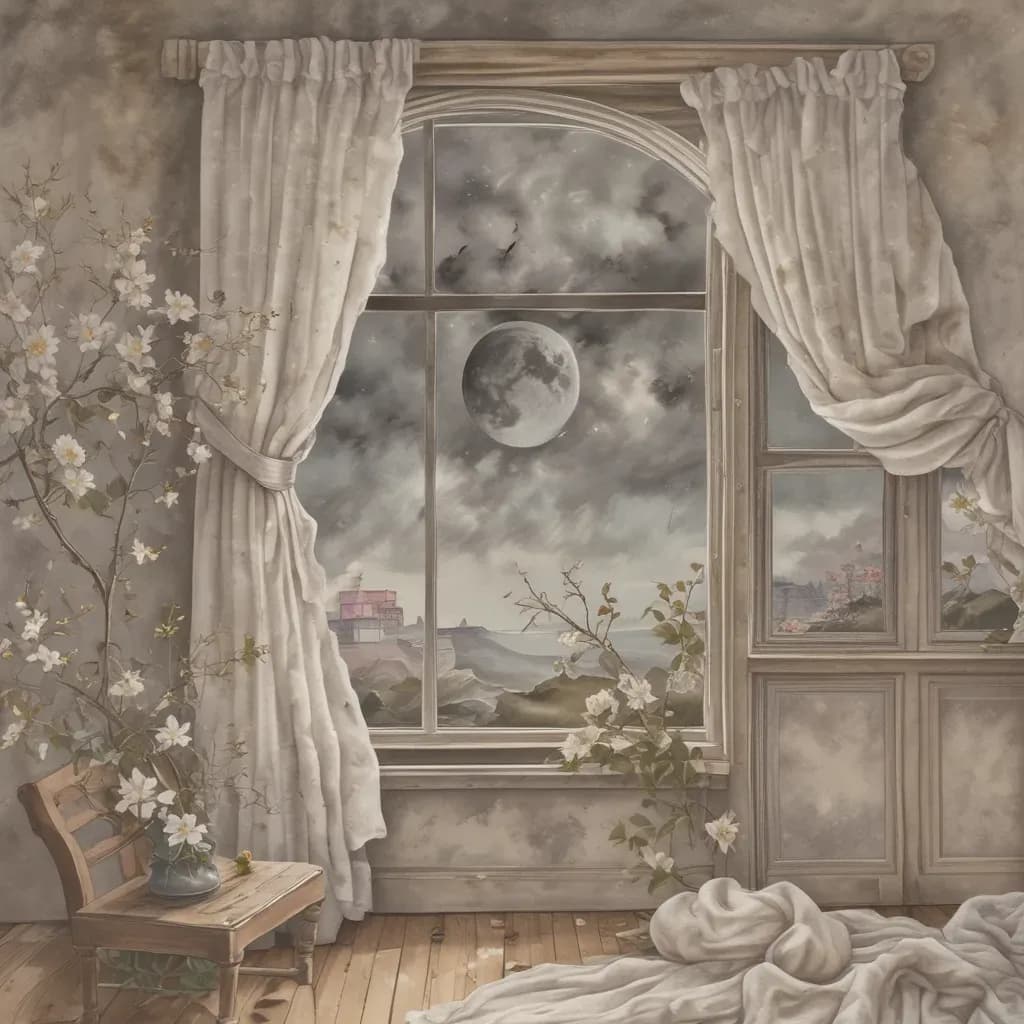
The imagery draws on classical visual vocabulary: kohl-lined eyes, the moon obscured by clouds, the hushed stillness of the late hours. But the song wears this tradition without heaviness. There is a silken quality to the protagonist's laughter that sits in uneasy contrast to the sharpness of her unfinished sentences. She is knowable and unknowable at the same time, someone who reveals herself precisely through what she withholds.
What makes the thematic work distinctive is its investment in the gap between feeling and speech. Again and again, the song returns to the approach of dawn and the continued inability to name what needs to be named.[4] This is not depression or despair; it is the subtler condition of emotional literacy that has not yet found its language. The narrator does not blame or lament. He observes, with something approaching tenderness.
The song is built around a kind of restlessness that is also a form of searching. The woman described is neither happy nor unhappy in any simple sense. She is both present and absent, laughing and silent, near and unreachable. The night holds all of these contradictions without resolving them, and that refusal to resolve is precisely the point.
Music Stripped to Its Essentials
The production of Raina enacts the same dynamic as its lyrics. Electric guitars and bass provide a contemporary texture, while sarod and flute carry in a classical inheritance.[5] The arrangement breathes rather than fills every available space. This is not the lush orchestration of a big-budget Bollywood score; it is music designed to let silence speak.
Shekhar Ravjiani, who composed the song, has built his reputation on bridging India's classical traditions with contemporary production. Raina is a realization of that ambition: it sounds like a song that could exist both in a late-night private listening session and on a centuries-old formal stage.[6]
Singh's vocal performance is measured, unhurried, and precise in its dynamics. He does not push for emotional effect; he allows the notes to find their own weight. This is the ghazal tradition applied to a contemporary song, and it is an approach he could not easily have maintained within the pressure-driven timelines of commercial film production.
Reception and Resonance
The release arrived at a culturally charged moment. Independent music in India has been growing steadily, building audiences outside the film industry ecosystem, but the sheer scale of Arijit Singh's audience meant that his participation carried symbolic weight. A voice that had soundtracked hundreds of millions of evenings was now making music on his own terms, without a film's emotional arc to serve or a studio's commercial requirements to meet.
Social media responded with something close to relief. Hashtags trended; fans described experiencing emotions from his voice that they had not felt in years. Multiple outlets framed the release as a statement about artistic autonomy in Indian music.[7]
The streaming numbers were more modest. Music Ally reported approximately 318,000 Spotify streams in the first week, around 53,000 daily, and the song did not chart on Spotify India's Top Songs.[8] A concurrent soundtrack track outperformed it commercially, though analysts attributed the gap to marketing budget differences rather than any failing of the music itself. Independent releases, even from the most recognizable voices, reach smaller initial audiences than studio-backed productions.
But chart positions are a narrow lens for a song like this. Raina is not competing for attention in the way a Bollywood blockbuster soundtrack does. It is asking for a different kind of listening: slower, more patient, more rewarded by repetition.
Many Ways to Read the Night
The most immediate reading of Raina is intimate and personal: a love song that observes rather than declares, that finds meaning in what is not said rather than what is. But the song's layers support other interpretations.
Some listeners have heard it as autobiographical, Singh's own meditation on the gap between his public voice and his private self. He has been described consistently as a conspicuously private man whose emotional communication has run almost entirely through other people's words in other people's films. Raina might be read as the first time he is really speaking, through a character who happens to share some of his qualities.
There is also a reading grounded in classical North Indian poetic tradition, where the night is a recurring archetype of separation (viraha), where longing intensifies precisely when the beloved is absent or unreachable. Raina, in this context, connects the song to a lineage of devotional and romantic poetry that runs from the Bhakti movement through the ghazal masters Singh grew up revering.[3]
None of these readings cancel out the others. The song accommodates all of them, which is perhaps the most reliable sign of a lyric that is genuinely well made.
What the Night Holds
Whether Raina is ultimately a love song, a self-portrait, or a meditation on the classical tradition of nocturnal longing, it marks a genuine threshold moment in one of Indian music's most significant careers. Singh did not retire to silence. He retired toward something: toward music where the night could speak on its own terms, without compromise or commercial pressure.
The song is a statement, though a quiet one. It says that the most interesting work may still be ahead. It says that a voice shaped by classical tradition and refined through years of commercial practice has things to express that no film brief could ever contain.
Raina asks the listener to sit with what is unresolved, to stay in the night a little longer, to resist the push toward easy resolution. For a song called Night, there is something fitting about that. The night never fully explains itself. It just holds what the day cannot.
References
- Arijit Singh releases 'Raina' following playback retirement - NewsBytesApp — Coverage of the retirement announcement and Raina's release as first independent single
- Arijit Singh Releases First Independent Song Raina After Bollywood Retirement - 8PM News — Details on Garuudaa Music label, composer Shekhar Ravjiani, and release date
- Arijit Singh - Wikipedia — Biographical details: upbringing, training, career trajectory, and musical influences
- Raina Lyrics With English Translation - LyricsRaag — Lyrics translation revealing central themes of nocturnal imagery and unspoken feelings
- Arijit Singh releases Raina as first independent track after retirement - Hungama Express — Musical production details including instrumentation: sarod, flute, electric guitars
- Arijit Singh marks independent music comeback with Raina - The Siasat Daily — Critical framing of the release as a soulful new chapter and statement about artistic autonomy
- Arijit Singh's Raina Marks a Soulful New Chapter - Social News XYZ — Social media reception and fan response to the independent release
- How well has Arijit Singh's most recent non-soundtrack pop song done? - Music Ally — Streaming performance analysis: 318,000 Spotify streams in first week, chart position context