Riders on the Storm
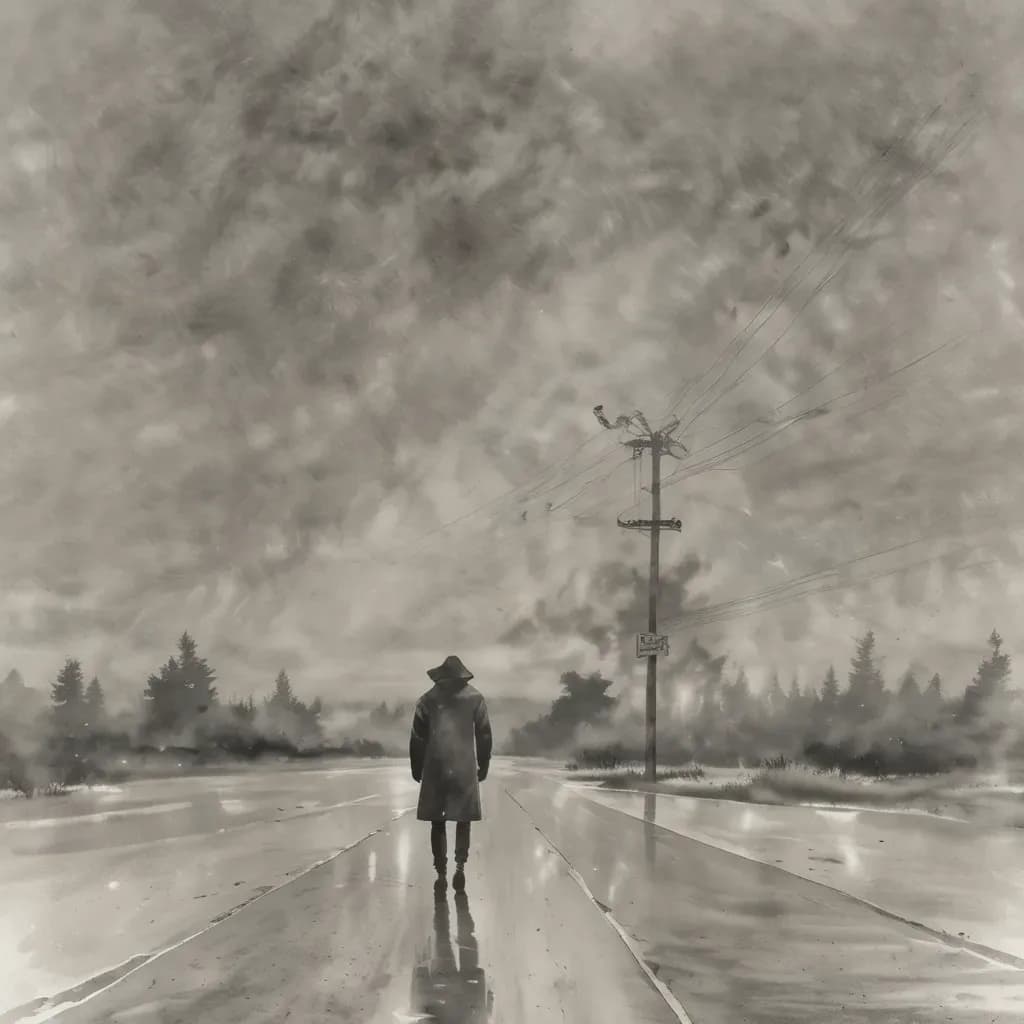
Some songs feel like a destination. "Riders on the Storm" is more like a crossing, a slow passage through darkness with no guarantee of arrival. From the first crackle of thunder on the recording, the listener is transported to a wet highway at night, somewhere between safety and the unknown. It is one of the most atmospheric tracks in all of rock music, and it earns that atmosphere honestly: every element serves the mood, from Ray Manzarek's shimmering Fender Rhodes to Jim Morrison's ghostly, doubled voice. This is a song that pulls you in without raising its voice, and that quiet authority has kept it compelling for more than fifty years.
The Last Recording
By late 1970, The Doors were under considerable pressure. Jim Morrison had survived a tumultuous stretch that included a 1969 arrest in Miami on indecent exposure charges, a conviction, and an ongoing appeal. The band's previous album, Morrison Hotel (1970), had marked a creative recovery, but the sessions for what would become L.A. Woman began in crisis. Their longtime producer Paul Rothchild, who had shaped the band's sound across five albums, listened to the early demos and declared them "cocktail music." He walked out of the project, specifically citing "Riders on the Storm" as one of the tracks he had dismissed.[1]
The band's response was to retreat to familiar ground. They moved their sessions to the Doors Workshop, their own rehearsal space on Santa Monica Boulevard in West Hollywood. Engineer Bruce Botnick stepped up as co-producer. Session musicians Jerry Scheff on bass and Marc Benno on rhythm guitar joined to fill out the sound.[2] Robby Krieger later noted that Morrison was unusually punctual and professional during these sessions. Working in their own space, without Rothchild's overbearing presence, brought a loose, organic quality to the performances.[3]
"Riders on the Storm" grew out of a jam that began with the band improvising loosely around "Ghost Riders in the Sky," the 1948 Stan Jones cowboy ballad. Manzarek built a bassline and piano figure around the groove. Morrison, according to Manzarek, already had lyrics written and was waiting for the right music to receive them. When the piece locked into shape, it did so quickly.[4] The final recording captures that spontaneity: the track breathes and drifts rather than marching forward.
The rain and thunder effects were not part of the original tracking. Botnick sourced them separately and placed the thunderclaps during the mixing sessions at Poppi Studios in January 1971.[5] Morrison was not present for most of the mixing, but Manzarek called him in for one final task. At the microphone, Morrison whispered an overdub beneath his own lead vocal, a shadow layer running just below the surface of the song. According to Manzarek, that whispered overdub was the last recording Jim Morrison ever made.[5][6]
Within two months, Morrison had left for Paris with his girlfriend Pamela Courson. On July 3, 1971, she found him dead in their apartment bathtub. He was 27. Because no autopsy was performed, the official cause of death, listed as heart failure by French authorities, has remained disputed for decades. The timing was almost unbearable: the single "Riders on the Storm" entered the Billboard Hot 100 chart in the same week Morrison died.[7]
A coda to the song's recording history arrived decades later. While preparing the 50th-anniversary edition of L.A. Woman, Botnick discovered an unlabeled reel containing a previously unknown demo of the track. It had been recorded backwards on the tape and required electronic correction to be heard. The demo moves at a faster tempo than the released version and features Manzarek playing piano bass rather than Scheff's electric bass, giving it a rougher, more improvised feel. It appeared on the three-disc deluxe anniversary edition.[8]
Into This World We're Thrown
Morrison had studied philosophy extensively at UCLA's film school, and the intellectual scaffolding of "Riders on the Storm" is unmistakably existentialist. The opening lines describe human beings cast into existence without consent, thrust into a world of instability and danger they did not choose. This maps closely onto the Heideggerian concept of "thrownness" (Geworfenheit), the condition of arriving in a world already in progress, subject to forces entirely beyond one's control.[9] Drummer John Densmore once claimed that Nietzsche "killed Jim," and the philosophical preoccupation shows throughout: the imagery of the opening treats life as perilous transit rather than comfortable habitation.[10]
But the song is not a philosophy lecture. It is also a genuine thriller. The middle section describes a murderous stranger moving along the road and warns against offering him a ride. Manzarek was explicit that Morrison based this figure on Billy Cook, a real-life spree killer who murdered six people during a 22-day cross-country rampage in December 1950 and January 1951.[11] Morrison had been obsessed with this archetype for years. His 1969 experimental film HWY: An American Pastoral centered on a hitchhiker character named Billy, a direct Cook reference. Morrison's notebooks, by multiple accounts, returned repeatedly to the image of a lone figure on the road, simultaneously drifter and predator. Manzarek described the song plainly as "a very filmic song about a serial killer."[4]
This is where the song's central tension lives: between the philosophical abstraction of the opening and the visceral, physical threat of the middle. The riders in the title are all of us, attempting to navigate an indifferent universe that contains both natural danger (the storm) and human danger (the killer at the roadside). Neither can be outrun. The only answer the song offers arrives in its final section, a quiet turn toward love and commitment. Manzarek described this pivot as the song's true emotional center, the genuine spiritual conviction underlying the surrounding darkness.[4]
The rain and thunder that frame the entire track are not decoration. They enact the song's meaning. The storm has always functioned as a metaphor for forces beyond human control, and here the steady downpour insists that the journey is always happening in bad conditions. Manzarek's Fender Rhodes part evokes something aqueous and uncertain, its arpeggios cycling like water over stone. Morrison's main vocal is already somewhat detached and spectral. The whispered layer beneath it is something else entirely, a subliminal presence that blurs the line between singer and shadow. By the end, it is not entirely clear whether the rider and the storm have merged.
A Shadow Cast Forward
"Riders on the Storm" reached No. 14 on the Billboard Hot 100 and No. 22 on the UK Singles Chart when released in June 1971.[7] In 2010, the Recording Academy inducted it into the Grammy Hall of Fame as a recording of "lasting qualitative or historical significance," placing it alongside a small number of rock tracks considered genuinely foundational.[12]
Critics and musicians have consistently cited it as a precursor to gothic rock, the genre that emerged in the early 1980s around artists such as Bauhaus, The Cure, and Siouxsie and the Banshees. The combination of dark atmosphere, existentialist lyrical preoccupation, and a deliberately slow, hypnotic groove anticipates that aesthetic by a full decade. The Doors were not primarily a gothic rock band, but this song plants a flag in territory that later became well-traveled.[7]
The track has moved through subsequent decades with surprising versatility. British singer Annabel Lamb recorded a version in 1983 that reached No. 27 on the UK Singles Chart. A remix featuring Snoop Dogg became the main theme for the video game Need for Speed: Underground 2 in 2004, introducing the track to an entirely new generation. It has appeared in films including The Hitcher (1986) and Point Break (1991), both of which share the song's preoccupation with road danger and anonymous threat.[7]
Who Is the Rider?
There is a persistent reading in which Jim Morrison is not simply the narrator warning listeners about the killer on the road, but is also, in some sense, the killer. This interpretation takes seriously Morrison's long-standing identification with the outlaw-drifter figure, his hitchhiking years in adolescence, and his sustained creative obsession with the Billy Cook archetype. Morrison spent years writing poetry and making film around the idea of the dangerous stranger on the highway. By the time he recorded "Riders on the Storm," he had been living with this figure for most of his adult life.[4]
The whispered vocal layer supports this ambiguity. There is something about the doubled voice, one audible and one just below the threshold of conscious hearing, that suggests a divided self. Morrison spent much of his creative career examining the thin membrane between civilization and its opposite. In "Riders on the Storm," that membrane is the car window: the narrator extends a warning, but the warning is intimate, as though spoken from experience rather than from safety.
A third interpretation reads the song primarily through the lens of Morrison's own imminent departure. He knew he was leaving for Paris. His health had been deteriorating for years, and Los Angeles had become associated with legal trouble, overexposure, and constraint. In this reading, the storm is the condition of his life at that moment: famous, artistically restless, and hurtling toward something he could not name. The final section's plea for love and connection carries an urgency that makes more sense if the singer suspects he is not coming back.
A Whisper Into Eternity
Ray Manzarek described the whispered overdub as "a whisper fading away into eternity," and that phrase captures something essential about the song's place in history.[5] It is the closing note of a life, recorded without drama in a mixing session, before Morrison left for a city where he would die. There is nothing theatrical about the whisper. It is simply there, underneath everything, easy to miss on a casual listen and impossible to forget once you have heard it.
L.A. Woman as an album is the sound of a great band rediscovering what they were when no one was watching: blues players with a philosopher at the microphone and nothing left to prove. "Riders on the Storm" is the album's final track and its most complete statement, beauty and dread coexisting without resolution, a journey undertaken with no guaranteed destination, love offered in the middle of catastrophe.
More than fifty years on, the rain still falls at the start of the track and the whisper still runs beneath the vocal, and there is still no comfortable answer to the question the song poses: what do you do when you are thrown into a world this dangerous and this beautiful? The Doors' answer, by the final verse, is to love your man. It is not much. It might be everything.
References
- L.A. Woman - Wikipedia — Rothchild's departure, recording at the Workshop, album reception
- How the Doors Rebounded on Their Last Album With Jim Morrison — Session atmosphere, musicians, Krieger on Rothchild's absence
- Doors' L.A. Woman: 10 Things You Didn't Know — Session details, musicians, Botnick's role
- The Story Behind The Song: Ray Manzarek Explains 'Riders on the Storm' — Manzarek on the Ghost Riders jam origin, the killer on the road, and the song's spiritual dimension
- The Story Behind 'Riders on the Storm': A Whisper Fading Away Into Eternity — Making-of account: rain effects, whispered overdub as Morrison's last recording
- Jim Morrison's Isolated Vocals in The Doors' Final Recording — Analysis of the whispered overdub as Morrison's last studio performance
- Riders on the Storm - Wikipedia — Chart history, Grammy Hall of Fame, cultural legacy, Morrison's death timing
- Hear The Doors' Long-Forgotten, Raw-Sounding 'Riders on the Storm' Demo — Discovery of the original demo on an unlabeled reel for the 50th anniversary edition
- Meaning Behind the Haunting 'Riders on the Storm' by The Doors — Existentialist reading, Heideggerian thrownness, thematic analysis
- How Friedrich Nietzsche Influenced Jim Morrison — Morrison's philosophical background and Nietzsche's role in his worldview
- Billy Cook (criminal) - Wikipedia — Background on the real-world killer who inspired the song's central verse
- Beach Boys, Doors Recordings Join Grammy Hall of Fame — 'Riders on the Storm' inducted into Grammy Hall of Fame in 2010