Rockland
Something particular happens to the grief of the person who ended the relationship. They don't get sympathy. They made the choice, so there is no one to blame, no villain to curse. There is only the strange, private ache of watching damage they caused and not being permitted, by anyone including themselves, to mourn openly. "Rockland" by Gracie Abrams lives inside that ache with a precision that is almost uncomfortable to witness.
The narrator has walked away from someone. She knows what she did. The song does not excuse it, does not explain it, does not try to make the listener feel better about it. It simply documents the texture of what remains when you are the one who caused the hurt and have to live inside the consequences of that.
Written in Maine, Felt Everywhere
Released on October 22, 2021, "Rockland" arrived as the second single from Abrams' second project, This Is What It Feels Like, which followed the next month on Interscope Records.[1] The song was co-written with and produced by Aaron Dessner of The National, their first collaboration together.[2] Its title refers to Rockland, a location in the region of Dessner's Long Pond Studio, which gave the recording its landscape and its name.[3]
The collaboration began over Zoom during the COVID-19 pandemic, with Abrams and Dessner trading ideas remotely before it became safe to record in person. Once they could travel, they worked at Long Pond at a remarkable pace, completing roughly two songs per day over the course of a week.[4] For Abrams, the experience carried a particular resonance. She had first encountered The National in an art class at age thirteen, and was now working in the same studio where Dessner had recently co-created Taylor Swift's folklore and evermore, albums that had redefined what was possible in the space between indie folk and pop.[4]
Abrams was twenty-two years old and fully committed to music, having left Barnard College after her freshman year to pursue her career after her debut EP Minor (2020) had built an organic following.[5] The pandemic years had pushed her writing further inward. She described the whole This Is What It Feels Like project as a time capsule, a home for the different emotional stages she had moved through across a year of uncertainty and disruption.[4] "Rockland" was one of the sharpest crystals in that collection.
The Architecture of Guilt
"Rockland" is notable for the direction it refuses to take. In a cultural moment saturated with songs about being wronged in relationships, Abrams plants herself firmly on the other side of the equation. The narrator is the one who walked away. The song acknowledges the damage caused without ambiguity, and then stays inside the consequences of that acknowledgment without offering any easy exit.
What makes this so striking is the absence of justification. The narrator does not explain her reasons, does not invoke self-preservation or incompatibility. There are no softening clauses about needing space, no reassurances that it was better for everyone involved. She simply sits with the wreckage she created and the knowledge that she created it. Bleached Is The Word's review of the single noted how the song demonstrates genuine self-accountability in a genre not always known for it.[6]
Emertainment Monthly observed that Abrams manages the difficult trick of making her narrator sound both completely terrible and completely relatable simultaneously, which is precisely the quality that gives the song its staying power.[7] The persona she inhabits is not sympathetic in any conventional sense. But she is achingly human, caught in the aftermath of a choice that cannot be undone and cannot quite be accepted.
Place as Wound
The use of a specific place is central to how "Rockland" works. The song is anchored in roads and neighborhoods that carry particular associations, locations that have been colonized by shared memory and can no longer be navigated neutrally. The narrator's presence in these physical spaces is itself a form of self-inflicted suffering, a choice to remain in proximity to something she can no longer have.
Place in "Rockland" is not scenery. It functions as a vessel for emotional history, the kind of geography that becomes impossible to visit without also revisiting everything that happened there. The specificity of the setting (a coastal Maine landscape, quiet streets, a house that used to be familiar) grounds an abstract emotional state in concrete sensory detail.
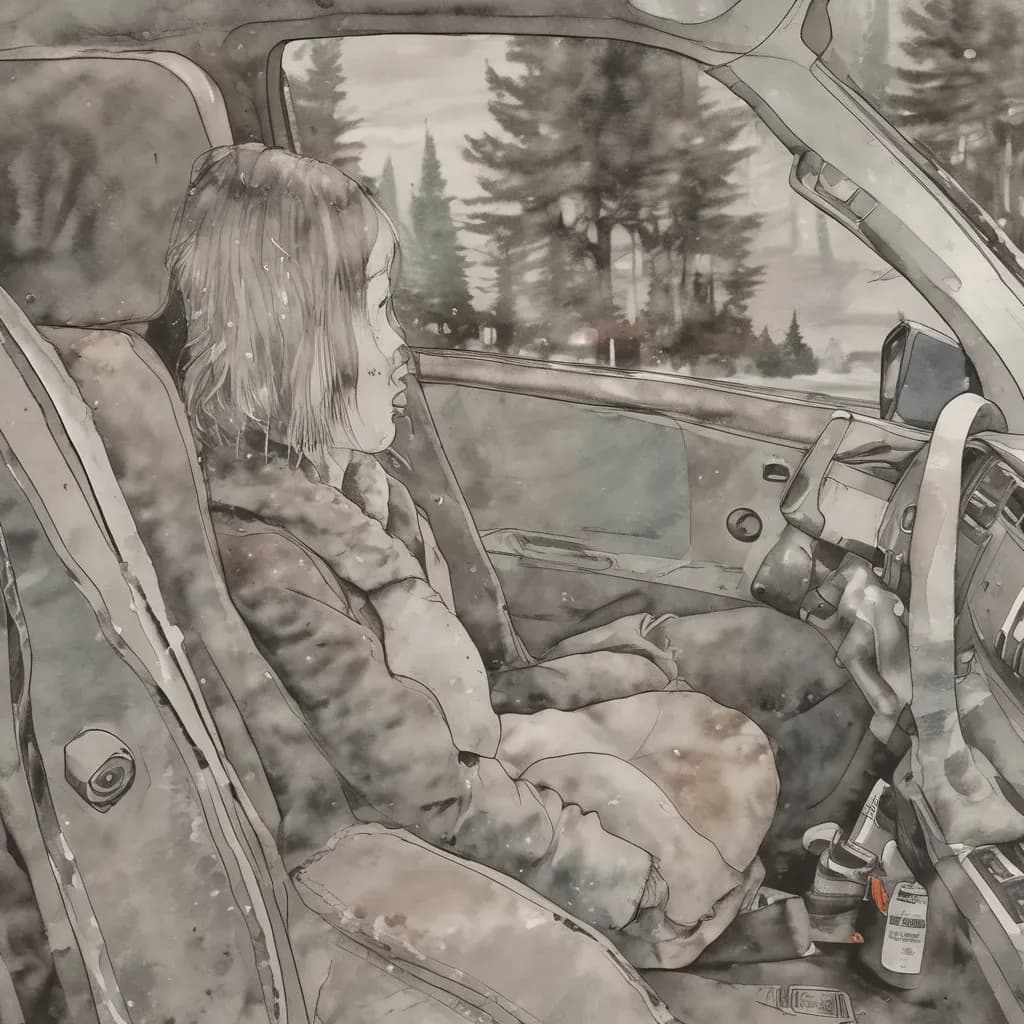
Aaron Dessner's production amplifies this quality. His signature approach, developed through years of work with The National and his folk-leaning collaborations, involves guitar figures that are simultaneously precise and melancholic, acoustic textures that evoke both intimacy and unease. Ones to Watch described the song's sound as folky in a way that expanded Abrams' already delicate vocal style rather than overwhelming it.[8] The result is something that feels like a winter landscape: beautiful, but not comforting. Familiar, but slightly threatening.
Suspended Between States
Much of the song's emotional logic turns on the idea of suspension. The narrator is not healing. She has not moved on. She exists in a kind of purgatory between the relationship she ended and the new reality she chose, unable to fully inhabit either. The imagery is of watching from a distance, of being in proximity without making contact, of action repeatedly begun and then abandoned.
This is the paralysis that "Rockland" documents so carefully. The Young Folks' review of the full project emphasized how Abrams' work deliberately refuses false resolution, preferring instead to leave listeners in the same uncertain, lost, awaiting-hope state that the songs themselves inhabit.[9] "Rockland" is perhaps the purest expression of that refusal in the collection. There is no catharsis waiting at the end. There is only the weight of being unable to move.
Threaded through the song is a specific texture of shame associated with continued attention to someone you hurt. The narrator is still monitoring, still circling, still unable to fully relinquish interest even as she understands that her presence would be unwelcome. This is uncomfortable territory. It implicates the narrator in something she cannot entirely defend, and Abrams does not try to make it palatable.
The Confessional Tradition, Turned Inward
"Rockland" arrived at a moment in popular music when the confessional singer-songwriter tradition was experiencing a significant renewal. Artists like Phoebe Bridgers, boygenius, and Arlo Parks were demonstrating that emotional honesty could coexist with sophisticated production and genuine commercial reach. What distinguished Abrams in this landscape was precisely the quality that "Rockland" exhibits: a willingness to examine her own culpability rather than positioning herself as the injured party.
The Dessner collaboration gave the song a specific sonic lineage. By working with an architect of indie-folk grandeur at a studio that had hosted some of the most celebrated recordings of the previous decade, Abrams situated herself within a tradition that valued emotional weight and textural nuance over immediacy. Stereogum noted this as part of the "professionalization" of a bedroom-pop sensibility, an embrace of craft that did not sacrifice the sense of intimacy.[10] The result was something that sounded both deeply personal and deliberately shaped.
WRBB described the broader project as a vivid road trip through different scenes and moods in Abrams' recent life, and called out the improved production diversity as evidence of artistic growth.[11] Within that road trip, "Rockland" is the stretch where the road becomes unfamiliar and the driver is no longer sure she should have come.
A Name That Cuts Both Ways
While the literal reading of "Rockland" anchors the song in a specific Maine geography and a specific post-breakup state, there is a secondary interpretation available, and it enriches the song considerably. A land of rock is a land that cannot yield, cannot be cultivated, cannot be made to grow anything new. There is something in that image that speaks to what the narrator may feel about herself: she is the difficult terrain, the place where things cannot flourish, the geography on which someone else was harmed.
This reading does not replace the literal one. The specific town matters, and the details are real and grounded. But the title floats above the specifics with a secondary dimension. The narrator is Rockland as much as she travels through it. She carries the landscape inside her, and that landscape is stony.
Some listeners have also read the song as a portrait of anxiety rather than guilt, the obsessive circling behavior belonging to a mental state rather than a moral one. Abrams has spoken openly about her own experiences with depression and anxiety, and songs about proximity-without-contact can be read through either lens. The guilt and the anxiety are not mutually exclusive. In fact, in the song's emotional logic, they appear to feed each other.
The Songs That Don't Let Go
What "Rockland" does best is hold complexity without resolving it. It gives voice to a guilt that has no outlet, a grief that has no social sanction, a longing that has no moral legitimacy. These are feelings that most people know and almost no one wants to examine publicly. Gracie Abrams examines them with unusual precision and, the real gift, without self-pity.
In the broader arc of This Is What It Feels Like, "Rockland" functions as the emotional center of gravity: the track that establishes the stakes, both human and artistic, for everything around it. It sits early in the sequence and casts a long shadow. As a statement of artistic intention, it announced a songwriter interested in the hardest questions about responsibility, feeling, and what it means to keep caring about someone you chose to hurt. That is territory she would continue to explore across Good Riddance and beyond, but here is where she first staked her claim.
The song does not forgive its narrator. It does not condemn her either. It simply stays with her, in that coastline town, outside someone's house, not quite calling, not quite leaving. That is the achievement. Some songs comfort. "Rockland" keeps you company in the dark.
References
- Wikipedia: This Is What It Feels Like (EP) — Release date, tracklist, chart performance, and production credits
- uDiscover Music: Gracie Abrams Recruits Aaron Dessner for Rockland — Announcement and context for the Dessner collaboration on Rockland
- Gracie Abrams Fandom Wiki: Rockland — Song background, place details, and lyrical summary
- NME: Five Things We Learned from Our In Conversation with Gracie Abrams — Abrams on the recording process at Long Pond, her teenage fandom of The National, and the EP as a time capsule
- Wikipedia: Gracie Abrams — Biographical overview including education, early career, and debut EP
- Bleached Is The Word: Single Review: Gracie Abrams - Rockland — Single review praising the song's self-accountability and emotional complexity
- Emertainment Monthly: Gracie Abrams New Song Rockland Will Break Your Heart — Analysis of the narrator's dual quality: terrible and relatable simultaneously
- Ones to Watch: This Is What It Feels Like Review — Album review describing Rockland's folky production and Abrams' narrative songwriting
- The Young Folks: This Is What It Feels Like Album Review — Review emphasizing the EP's refusal of false emotional resolution
- Stereogum: Gracie Abrams and the Professionalization of Bedroom Pop — Critical assessment of the EP's shift toward crafted production while maintaining intimacy
- WRBB 104.9 FM: Gracie Abrams Explores Her Fears and Doubts on This Is What It Feels Like — Review praising the EP's vivid emotional range and production diversity