Ruby Tuesday
Some breakup songs rage, and some plead. "Ruby Tuesday" does something stranger and more generous: it lets the person go. Over a slow, baroque arrangement of bowed bass, recorder and piano, Mick Jagger sings about a woman who cannot be pinned down, who drifts through life on her own terms, and whom the narrator has no hope of keeping. The ache is real, but so is the admiration.
That tension is what has kept the song alive for nearly six decades. It was the most tender thing the Rolling Stones had released to that point, and it arrived on the flip side of a single that American radio found too scandalous to play.
A song written from a wound
The story starts with Keith Richards and a model named Linda Keith. Richards met her in March 1964, when she was seventeen, at the same party where Jagger met Marianne Faithfull, and the two were together for roughly two years.[1] When the band was touring America in the summer of 1966, she left him for good, and he learned the news on his return.
Richards later described that moment as the first time he felt a deep cut, and he has been plain about the source of the song: in his words, Linda is Ruby Tuesday.[1] Accounts of what happened next vary. One retelling has her moving on to Jimi Hendrix while the band was away, and then to a poet whom Richards named in his memoir Life.[2] Richards also suggested that songwriters can take a certain consolation from writing about having been wronged.
The lyrics were his alone, which made this another first for the band.[1] That detail matters. Jagger would sing the song, but the voice inside it belongs to a guitarist who had just discovered that the person he loved did not intend to stay.
Who wrote what
The credit reads Jagger and Richards, as every Stones original of the era did, but the people in the room remember it differently. Bill Wyman has said Richards brought the seeds of the song to the studio.[1] Marianne Faithfull recalled that Brian Jones played a folk-like, nursery-rhyme tune on the recorder, that Richards asked him to repeat it, and that Richards then went to the piano to work it out.[1] Biographer Victor Bockris puts it in the middle: Richards arrived with the basic track and the words, and he and Jones finished it together.[3]
Jagger, for his part, was disarmingly candid in a 1995 interview with Rolling Stone. He called it a wonderful song with a nice melody and a nice lyric, and noted that he had written neither. He still enjoyed singing it.[3] There is something fitting in a lead vocalist interpreting a song that belongs to two other people, because the narrator himself is an observer of a life he cannot control.
The sound of the studio as an instrument
The song was recorded in November 1966 at the newly opened Olympic Studios in Barnes, during sessions Wyman remembered as the first where the band concentrated on an album as a finished product.[1] The working title was a bland placeholder, "Title 8."[1] Sources disagree on the exact dates of the sessions, and also on whether Jones or the American arranger Jack Nitzsche played the piano, which tells you how crowded and collaborative the room was.[3]
What everyone agrees on is the recorder. Brian Jones played an alto recorder that threads a countermelody through the song, and it is the part most listeners hum after the vocal has faded.[2][3] Engineer Eddie Kramer said he was amazed that Jones thought of it at all, noting that it was an instrument familiar from English school music lessons and that Jagger and Richards would never have reached for it.[1]
The bass part is nearly as unusual. Wyman fingered a double bass while Richards drew a bow across it, because Wyman, with his small hands, found a regular upright difficult to play.[1] The result is a low, woody, mournful drone underneath the choruses, with Charlie Watts and Wyman's electric bass lifting the song as it swells.[1] None of this sounds like a blues band. It sounds like a chamber group that has wandered into a pop session.
The song's genre has been labeled baroque pop, psychedelic pop and even psychedelic soul.[3] At the time, Cash Box called it a smooth ballad in the baroque style.[3] Later writers have been less sure, with one critic hearing the Stones as slightly awkward in this flowery mode.[3] Both reactions are fair. The song is a prototype of the psychedelic turn that would follow on Their Satanic Majesties Request, and it shows a band trying on a softer self.[1]
Freedom, impermanence and the refusal to possess
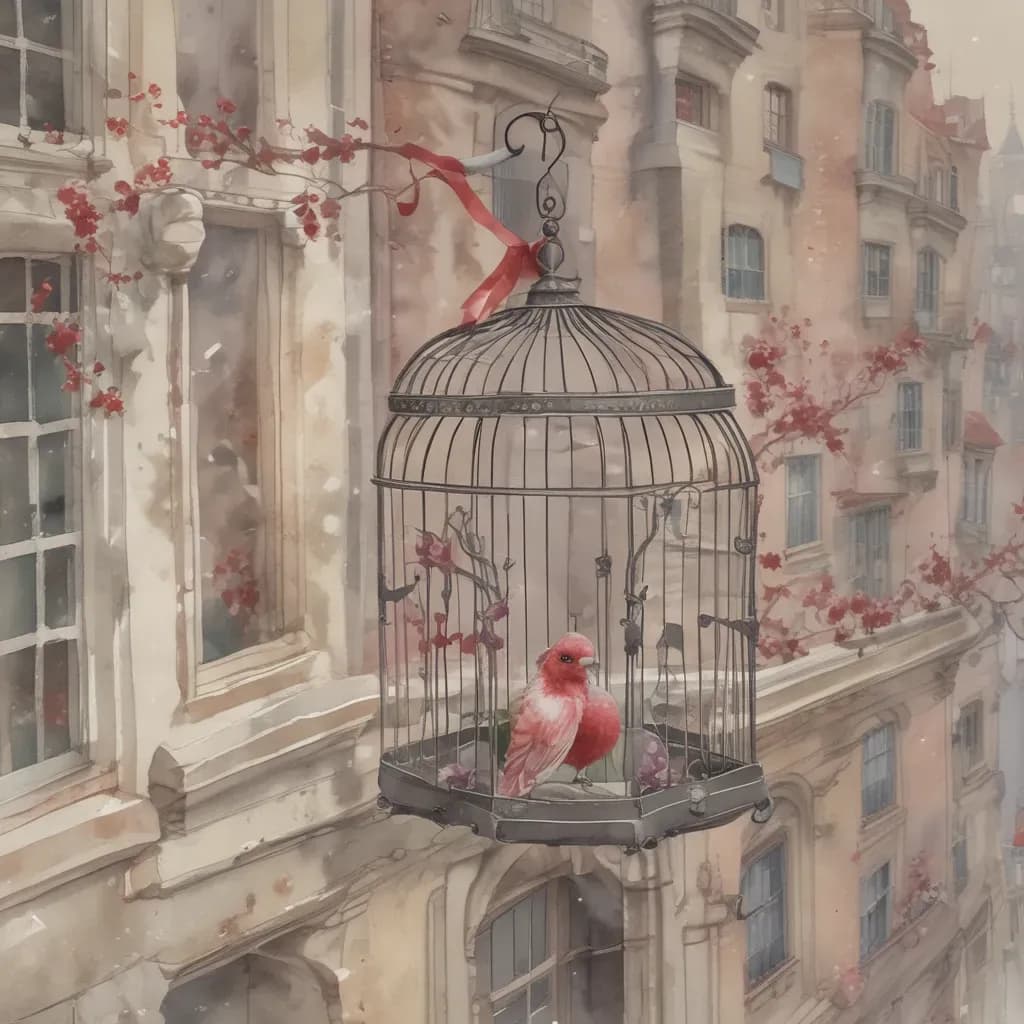
Thematically, the song is built around a contradiction. The narrator is heartbroken, yet he never asks her to stay. He describes a woman who changes with each passing day, who gives herself a new name or identity as the mood strikes, and who treats yesterday as something already gone. Her restlessness is presented as a kind of integrity rather than a flaw.
The title carries that idea. A color and a weekday make an oddly specific name that belongs to no particular family or place, and the lyric never explains it. She is less a person with a history than a figure who exists only in the present tense, which is precisely why she cannot be held.
The chorus turns the song into something close to a blessing. Rather than lament the loss, the narrator accepts that this kind of freedom is her nature and that wanting to keep her would mean wanting to change her. It is a surprisingly mature position for a man in his early twenties who had just been left, and it explains why the song feels more like a farewell than a complaint.
There is also a quieter thread about memory. The narrator's grief is not about a future that will not happen but about a past that already seems to be dissolving. He is already remembering her while she is still, in some sense, in the room. The slow tempo and the sustained bowed notes make that sensation physical, like watching a light fade.
A hit by accident
The commercial story is almost comic. "Ruby Tuesday" was released on 13 January 1967 as the B-side of "Let's Spend the Night Together."[1] American disc jockeys and Ed Sullivan objected to the A-side, and the band performed it in a censored form on Sullivan's show on 15 January, with Jagger rolling his eyes through the change.[1] Andrew Loog Oldham then pitched the record as a double A-side.[1]
Jagger said at the time that he preferred "Ruby Tuesday" and thought it might be the side everyone went for.[1] He was right. In the United States it reached number one on the Billboard Hot 100 on 4 March 1967, the band's fourth chart-topper after "Satisfaction," "Get Off of My Cloud" and "Paint It Black."[2] The racier A-side stalled at number 28.[1] In Britain, both songs peaked at number three.[1]
The album around it
The song sits on the US edition of Between the Buttons, an album it does not belong to on the British release.[2] The album itself is often called forgotten, and Jagger has been blunt about disliking it, blaming overdubbing for flattening the dynamics.[1] Yet it is also where the band stepped back from relentless touring and, as Richards put it, felt a new beginning.[4]
In that context, "Ruby Tuesday" is the album's emotional anchor. The surrounding songs lean toward music-hall whimsy and sharp-edged London observation, and this one is the sincere center. The album went to number two in the United States and number three in Britain.[4]
Other readings and afterlives
Not everyone hears a portrait of Linda Keith. Some listeners treat the character as an archetype, the free spirit of 1967 who refuses every label a man or a society offers. Others hear a coded reflection on the changing identity of the band itself, since Jones, the song's other author, was drifting out of reach just as the narrator's lover was.
The song has proved remarkably portable. Melanie took her version to number nine in Britain in 1970, and Rod Stewart's 1993 recording reached number eleven.[3] Others who have covered it include Rotary Connection, Nazareth, Julian Lennon and The Corrs.[2][3] Rolling Stone ranked the original number 310 on its list of the 500 greatest songs.[3] A restaurant chain even borrowed the name.[3]
The Stones themselves set it aside for a long time. They played it on the spring 1967 European tour, which was Jones's last, and then largely dropped it for about twenty years before bringing it back on the Steel Wheels tour of 1989.[1][3]
Why it still lands
Most songs about being left try to win an argument. This one concedes. It understands that some people are always on the way somewhere else, and that loving them means accepting the shape of their motion. That is a hard lesson, and the Stones delivered it with a recorder, a bowed bass and a singer who sounds as if he is smiling through it.
It also stands as a document of a moment when the band could be vulnerable without losing its nerve. Jones's most memorable contribution to the group's catalogue is gentle rather than loud, and Richards's most exposed lyric came from a real wound. The pairing is part of why the song endures: it is a farewell with both grief and grace in it, and it has outlasted nearly everything around it.
References
Keep reading
More by The Rolling Stones
More Baroque Pop
- Scarborough Fair/Canticle Simon and Garfunkel
- Chaos Space Marine Black Country, New Road
- Nothing Matters The Last Dinner Party
- Crazy For You Lana Del Rey
- Wouldn't It Be Nice The Beach Boys
- Surf's Up The Beach Boys