Run a Train
The Pull of the Tracks
There is a particular kind of loneliness that comes with outrunning the life you were born into. Not just leaving a place behind, but watching the version of yourself you were there fade into someone others recognize but can no longer reach. J. Cole's "Run a Train," the fourth track on his sprawling double album The Fall Off, lives entirely inside that loneliness. It is a song about momentum and distance, about the strange grief of becoming someone your oldest friends can only partially see.
A Final Statement and a Homecoming
Released on February 6, 2026, The Fall Off arrived as Cole's self-described final studio statement.[1] The release date was not arbitrary: 2-6 is the area code for Fayetteville, North Carolina, the city Cole grew up in and has returned to obsessively across his entire discography. The album's two discs organize themselves around two imagined homecomings, one at age 29, one at 39, each defined by a different emotional register. The first disc holds ambition and ego; the second, reckoning and acceptance.[1]
"Run a Train" belongs to that second homecoming. It follows directly from another track called "SAFETY," which dramatizes a plea from a childhood friend who feels abandoned, a person who misses Cole at funerals, at family gatherings, at all the unremarkable moments that form the connective tissue of a long friendship.[2] Where "SAFETY" gives that friend a voice, "Run a Train" hands the mic to Cole himself. His answer is complicated, guarded, and painfully honest.[3]
Cole has described the album's double-disc structure as a personal challenge to create his best work, the full circle of a career that began with his 2007 debut mixtape The Come Up and ends, by his own declaration, here.[4] That framing matters for understanding "Run a Train." This is not a casual track. It is a dispatch from a man who has decided to account for himself.
The Train That Runs Without Your Permission
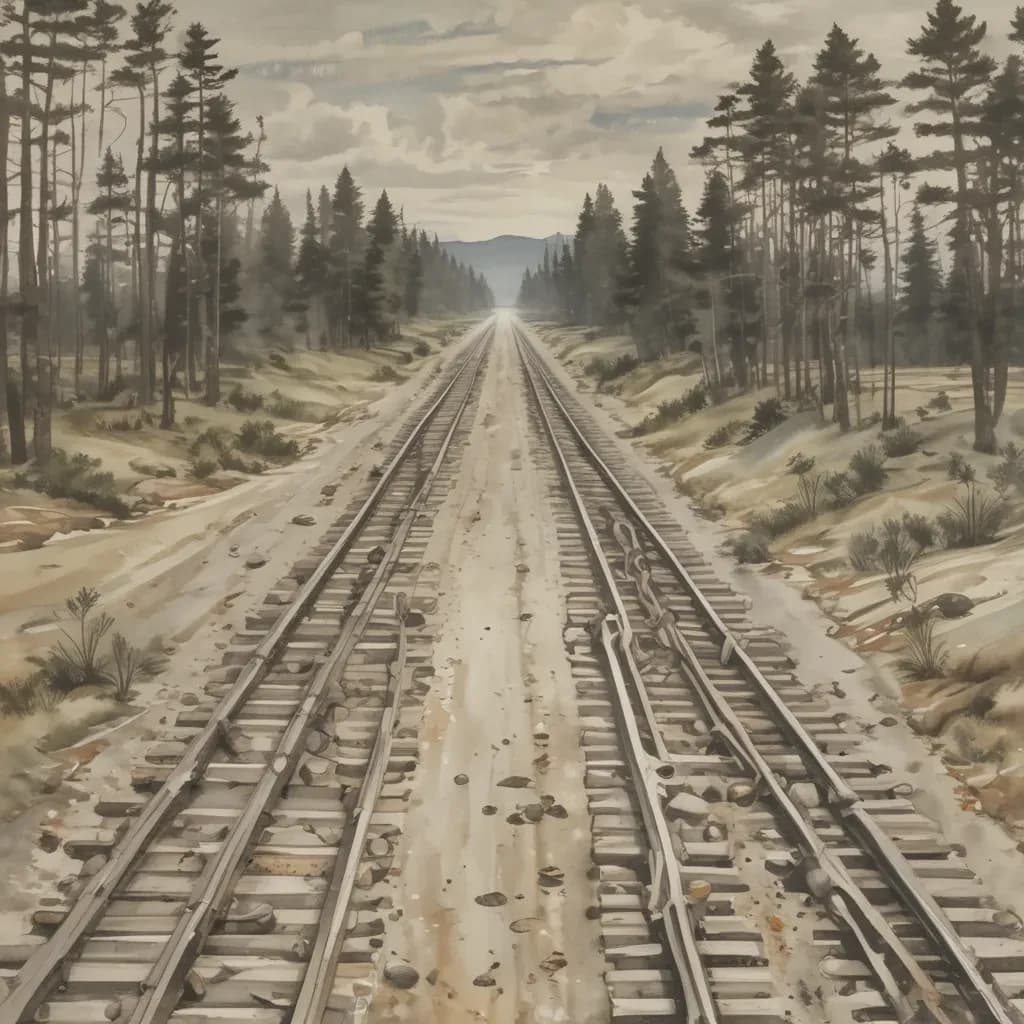
The title operates on more than one level. There is the literal reading: Cole driving through Fayetteville, running a train through streets he once belonged to, absorbing what has changed and what hasn't. But the phrase also evokes something less controllable. A train does not ask permission. It follows its tracks. The momentum of a career, of twenty years of decisions made under pressure, carries you forward whether you've consented to the direction or not.[3]
This is the song's philosophical core. Cole is not, here, celebrating his trajectory. He is examining it with the kind of clarity that comes from age and distance. He catalogues what formed him: the poverty, the proximity to violence, the survival instincts developed out of necessity. And he asks, with real heat, whether the people watching from the outside truly comprehend what any of it cost.[2]
The question is not rhetorical vanity. It is grief. The formative years that made him the artist he became are years he can no longer fully inhabit. The people who shared those years cannot fully access the person he's since become. The distance is not anyone's fault, but it is real, and Cole refuses to paper over it with nostalgia.
Two Jermaines
The song's deepest tension is one Cole has circled throughout his career without ever articulating quite so directly: the split between Jermaine Cole the person and J. Cole the public figure.[5] His friends from Fayetteville knew him before that gap existed. They knew his face, his family, his specific fears and specific hungers. Now they know his name from album credits and tour dates. The intimacy has been replaced by a kind of curatorship, and Cole is honest about his role in allowing that to happen.
This is the kind of alienation that does not announce itself. It arrives slowly: a missed funeral here, a birthday call that doesn't come, a year in which two people who once shared everything now share only a history. By the time Cole drives through Fayetteville at 39, the version of Jermaine his old friends remember has begun to feel, as he puts it in the song's emotional logic, like a historical exhibit. Present in records but gone from daily life.[2]
The Apology and Its Creative Aftermath
To understand what "Run a Train" is doing emotionally, you need to understand what preceded the album's creation. In 2024, Cole inserted himself into a public confrontation between Drake and Kendrick Lamar, releasing an aggressive response track.[6] Two days later, at his own Dreamville Festival, he pulled the track, publicly apologized, and described the episode as among the worst decisions he had ever made in his professional life.[6]
The apology was received with a full spectrum of reactions, from mockery to admiration. More importantly, it destabilized Cole's sense of his own identity within hip-hop. What kind of artist publicly backs down? What kind of man humbles himself in front of tens of thousands of people and then returns to his studio?[7] Cole has described the aftermath as an unexpected creative unlocking. Having stepped off the hypermasculine chess board of rap conflict, he found himself more free than he had been in years to write honestly about who he actually was.[7]
"Run a Train" is a direct beneficiary of that freedom. The song does not perform toughness or philosophical distance. It sits in genuine discomfort. Cole is not the protagonist of a triumph narrative here; he is a man trying to make sense of what he left behind and whether any of it is retrievable.[5]
Future as Atmospheric Truth
The collaboration with Future is its own kind of statement. Future's artistic persona is built on a beautiful, hazy fatalism, a sense that the world offers pleasures and penalties in roughly equal measure and that the appropriate response to both is forward motion. Cole's art, by contrast, is built on interrogation: stopping the motion to ask what it means.[2]
Their pairing on this track creates a productive friction. Future's melodic contributions carry a sense of movement without destination, of life churning forward regardless of whether you've made peace with where you've been. Against that atmospheric inevitability, Cole's verses feel like someone pressing a hand to the window of a moving car, trying to hold onto a view that is already receding.[3]
Neither approach is presented as correct. Together they sketch something true about how people who grew up under similar pressures can arrive at entirely different emotional strategies for survival, and how both strategies contain their own wisdom and their own costs.
Why It Resonates
"Run a Train" arrives at a moment when hip-hop is reckoning broadly with what the genre costs its practitioners. The generation of artists who came up in the 2000s and 2010s is aging into questions of legacy, authenticity, and community that the culture hasn't always had language for.[5] Cole's willingness to name the gap between who he was and who he's become, without resolving it into a tidy lesson, gives listeners permission to sit in their own unresolved contradictions.
The song also speaks to anyone who has outgrown a context they still love. Returning home and finding that the city has changed less than you have is not an experience exclusive to famous rappers. It is the quiet cost of social mobility, of education and ambition, of doing the things you were supposed to do and discovering they carry their own form of exile. Cole articulates that experience with enough specificity to make it universal.[2][4]
It also functions as one of the more honest documents of what the Drake-Kendrick episode did to Cole. The album as a whole is marked by that event's aftermath, but "Run a Train" captures the specific vulnerability that followed: a man re-examining his own mythology in real time, finding it less stable than he assumed.[8]
An Uncomfortable Alternative Reading
There is a reading of this song that is less flattering to its author. The track can be heard as an elaborate rationalization: a preemptive explanation for Cole's absence from the lives of people he claims to still love. If the train runs regardless, if the momentum of his career was always going to carry him in this direction, then the decisions he made along the way begin to look like inevitabilities rather than choices.
Cole is a precise enough thinker to have constructed this framing knowingly. Whether "Run a Train" is an honest reckoning or a self-exonerating narrative, or some unresolvable mixture of both, is something each listener has to weigh for themselves. His most devoted critics would say this ambiguity is the track's central weakness. His defenders would say it is the point.[5]
A Witness Statement
What makes "Run a Train" one of the strongest entries on The Fall Off is its refusal to arrive anywhere comfortable. Cole does not reconcile with his past or cleanly mourn it. He sits with the train in motion, looking out the window at a place that knows his name but no longer entirely knows him, and he records what he sees with the precision of someone who has learned to treat his own life as primary source material.
The song is not a resolution. It is a witness statement, delivered by a man who has learned that some distances, once opened, can be described with great clarity and still not be closed. For an album that positions itself as a final word, that honesty is exactly the right note to strike.
References
- The Fall-Off - Wikipedia — Album overview, release date, disc structure, and critical reception
- J. Cole 'Run A Train' Lyrics & Meaning - Capital XTRA — Analysis of the song's themes and its narrative relationship to 'SAFETY'
- Run a Train - Wikipedia — Song-specific information including track position and narrative function
- J. Cole Explains the Meaning Behind The Fall Off as a Double Album - The Source — Cole's own statements on the album's concept and personal significance
- J. Cole's 'The Fall Off' Is a Coming-of-Age Story - The Bradley Scout — Critical review examining the album's identity themes
- J. Cole Apologizes to Kendrick Lamar for '7 Minute Drill' - Rolling Stone — Coverage of Cole's public withdrawal from the Drake-Kendrick conflict
- J. Cole Discusses Drake & Kendrick Lamar Beef, Admits Apology Backlash Affected Him - HipHopDX — Interview on how the apology's aftermath shaped his creative approach
- J. Cole Reveals 'The Fall-Off' Tracklist - Billboard — Tracklist reveal and album context from Billboard