Sandunguea
The title is a verb. In Caribbean and Latin American Spanish, a sandunga is a kind of grace, a rolling, confident sway that belongs to the hips as much as to the attitude, and to sandunguear is to move with it. The form on the tracklist can be heard two ways at once: as a description of someone already doing it, or as an order to start. That double reading is the best way into the song.
Arca's track arrives as number 26 on the standard 34-song edition of Grand Theft Auto VI: The Album, wedged between a Fcukers cut and a Rina Sawayama cut.[1] It is a Spanish-language piece, built from chants, commands and boasts, and it treats the dance floor as a place where shame gets burned off. One caveat before going further. At the time of writing I could find no interview in which Arca explains this song, so what follows is interpretation grounded in the track's context, its credited placement and a transcription of its words, not a statement of authorial intent.
A Venezuelan producer in Vice City
Alejandra Ghersi, who records as Arca, was born in Caracas in 1989.[2] The family moved to Connecticut when she was three and returned to Venezuela when she was nine, which gave her an early double vision of two cultures that would later show up in her music.[2] She grew up on the electronic records her older brother collected, including Aphex Twin and Björk, and began making her own music in Caracas as a teenager before studying at New York University's Clive Davis Institute.[2]
From there the résumé reads like a map of the avant-garde pop world. She worked on Kanye West's Yeezus in 2013, co-produced a large part of Björk's Vulnicura, produced most of Björk's Utopia, and shaped records for FKA twigs, among many others.[2] Her own albums, from Xen and Mutant to the self-titled 2017 record with prominent vocals, built a reputation for music that sounds like a body being rebuilt in real time.[2]
The thread that matters most for this song is her Kick series. Kick I appeared in June 2020 with guests including Björk and Rosalía, and the later installments pulled in different directions, with reggaeton especially prominent on Kick II.[2] Her own framing, as I understand it from interview coverage I could not open in full, is that reggaeton counts as electronic music in its own right. A reggaeton-adjacent track in a Vice City setting is therefore not a costume. It is a return to a home language.
Why a video game album
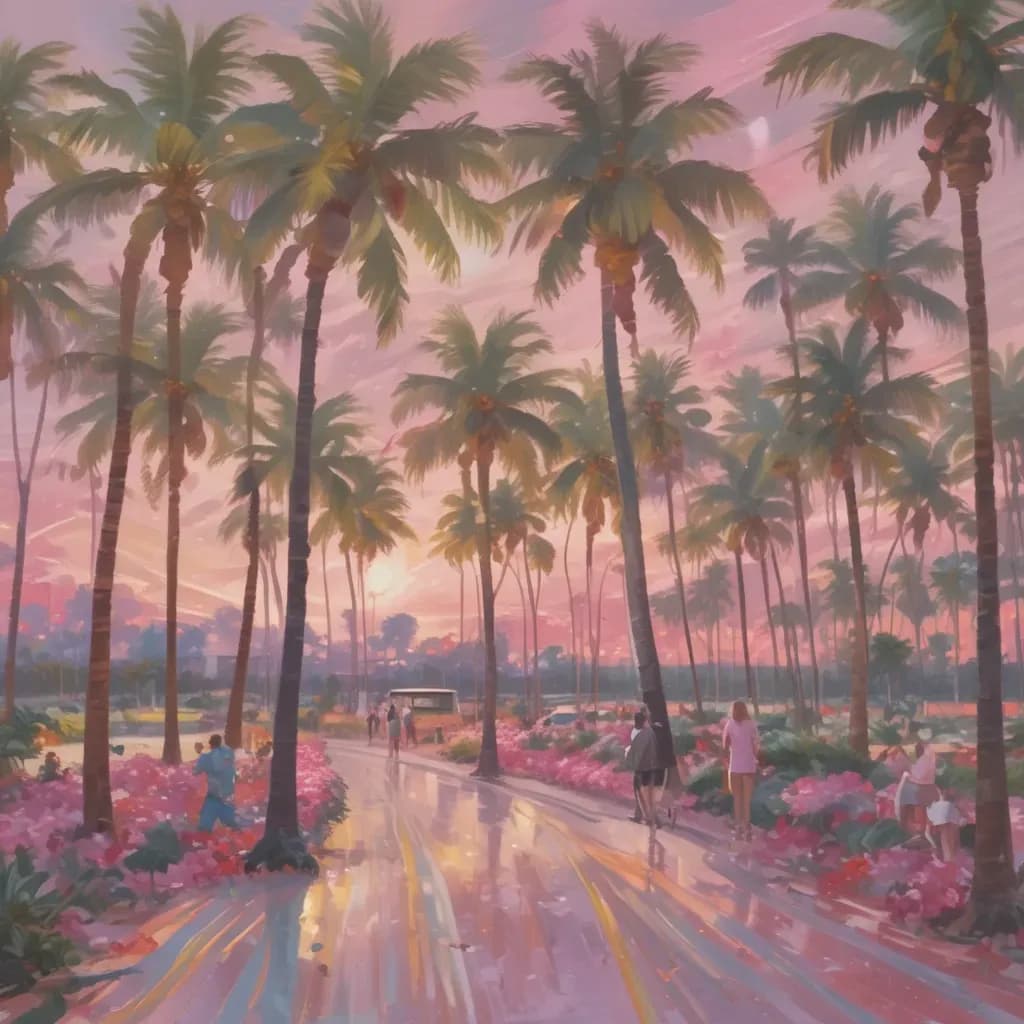
Rockstar describes the album as 34 original tracks that capture the electric energy of Vice City and Leonida, the fictional Florida at the center of the game, and calls it genre-defying.[1] The standard edition sits beside a deluxe edition that adds 23 more tracks.[1] The tracklist reached the public a few days early after images of the vinyl packaging circulated online, and trade coverage flagged Arca's name among the surprising entries.[4]
Rockstar's own page also lists an in-game radio station called Cocoteo, billed as modern Latin music with two hosts, El Martillo and La Gata.[1] The page does not say whether this song plays on it, so that link is a guess, but the fit is easy to imagine. Vice City has always been a fantasy of Miami, and Miami has always sounded like Caribbean and Latin American music colliding with club culture. An Arca song about moving through a crowd belongs naturally to that picture.
The street as runway
Read thematically, the transcription of the song is organized around a single transformation: public space becomes a stage.[3] The speaker treats the street and the dance floor as a runway, and the piece opens with a chanted call to go, which functions like a starting gun. An invitation to a partner follows, repeated until it turns from a request into a ritual.[3]
There is real swagger in this, but it is a particular kind. It is not the swagger of someone who has already won. It belongs to someone who is claiming space and dares anyone to object. For an artist who has spent her career being described as strange, difficult or too much, a song whose whole project is to be unashamed in public reads as autobiography, even if no single detail does.
Church and club
The most striking feature of the words, as transcribed, is the way sacred language sits beside physical and explicit demands.[3] Prayer, mass, faith and absolution appear in the same breath as bodily instructions. This is an old move in Latin popular music, where Catholic imagery has long been recycled as erotic metaphor, and it has special weight for an artist who grew up in Caracas.
The effect is a kind of inversion. Instead of the church forgiving the body, the body grants the absolution. Dancing becomes a sacrament, and the club becomes the one place where the speaker is allowed to be both worshipper and idol. That is a familiar idea in queer and trans club culture, where the dance floor has often served as a congregation for people who were turned away from the official one, and Arca has spoken and written about gender and identity for years.[2]
Power, play and surrender
A second layer concerns who is in charge. The speaker casts the partner as a protector or a predator and then sets herself up as royalty who also wants to be overwhelmed, handled roughly and finally forgiven.[3] Animal and predatory imagery runs through this passage, and so do food and sauce metaphors, which keep the mood playful and a little absurd rather than grim.[3]
The point of the role-play is that it stays a game. Both people know the rules, and the speaker sets them. Themes of vulnerability and control run through much of her catalogue, and here they arrive with a grin. Surrender is presented as a choice made from strength, not a loss of it.
One small image breaks the heat: flowers blooming as a sign of love.[3] It is easy to miss, but it suggests that underneath the filth and bravado the song is still about affection, about a person who is delighted by someone else and wants the feeling to be visible.
Form as meaning
The structure supports all of this. According to the transcription, the song moves from the opening chant through a repeated invitation, then a looser, jokier passage, a long stacked verse, a pre-chorus and a chant built around the title verb.[3] Near the end a run of imperatives accelerates into a fragmented, stuttering climax before the track closes on a short repeated phrase.[3]
This is the shape of a dance building to its peak and then dissolving, and it echoes Arca's habit of letting rhythms glitch and shatter just as they hit hardest. The language itself falls apart at the moment of greatest intensity, which is exactly what the body is doing in the scene the song describes. The register throughout is colloquial, Caribbean and Venezuelan, with clipped endings and street slang, which keeps the performance grounded even when the imagery turns ceremonial.[3]
Alternative readings
There are at least three other ways to hear it. The first is as a character piece. Placed in a game soundtrack, the song might be heard as the voice of someone in Vice City, a club kid or a street performer whose bravado is part of a fictional world rather than a confession. The game setting makes that reading hard to rule out.
The second is as satire. Reggaeton's stock lyrical moves (the command to dance, the boast, the sexual threat) are so familiar that a producer as self-aware as Arca could be exaggerating them to see what they look like at full volume. The religious language, pushed this far, can read as parody of both the church and the club at once.
The third is the most sincere one: that the song is simply what it seems to be, an unembarrassed celebration of desire and movement, made by an artist who has spent years being told that kind of joy was not hers to claim. It is worth remembering that the genre-defying framing on the album page does not demand that each track mean something heavy.[1] Some are allowed to be pleasure.
Why it matters
The album is a major cultural event, a soundtrack attached to one of the most anticipated games ever made, and it will reach listeners who have never heard of Arca or her Kick records.[1] For many of them, this will be an introduction to a Venezuelan producer who treats Latin club music as experimental material rather than a genre to be tidied up for export.
It also sits at an interesting moment in her career. Her 2024 and 2025 singles, including a collaboration with the Dominican rapper Tokischa, leaned further into direct, danceable Latin pop, and the Barcelona-based artist has since supported Beyoncé and Madonna on stage and in the studio.[2] A track like this one shows that move toward the mainstream without the sanding down: the commands are still strange, the climax still breaks apart, and the sacred still gets dragged to the dance floor.
Conclusion
"Sandunguea" is a song that works as a verb in more than one sense. It describes a way of moving, orders the listener to join in, and enacts the transformation it talks about, turning a sidewalk into a runway, a club into a chapel and shame into a costume that can be taken off. Because the artist has not yet explained it, listeners are free to hear it as a character sketch, a parody or a personal creed.
What seems hard to dispute is the sense of release. A song by a Venezuelan artist, in her own register of Spanish, lands in the middle of the biggest entertainment launch of the year and asks everyone present to move. That is a small act of confidence, and it is the kind that Arca has been practicing for her whole career.
References
Keep reading
More Experimental
- Clustered Around My Opening! Fire-Toolz
- Vas volant Marina Herlop
- Dream Baby Dream Suicide
- This Is How We Walk on the Moon Arthur Russell
- I Woke Up in a Fucked-Up America Lonnie Holley
- Kid A Radiohead