Sympathy for the Devil
A Man of Wealth and Taste
Few songs in rock history begin with such a brazen act of formal nerve. On the opening track of Beggars Banquet, the Rolling Stones hand the microphone to Satan. Not Satan as symbol, not Satan as metaphor (though he is both), but Satan as a self-introducing, charming, worldly narrator who claims to have been present at every atrocity Western civilization has managed to produce. He asks to be introduced. He asks you to guess his name. And by the time the song ends, the unsettling implication has landed: you already know it.
The Year Everything Burned
1968 was a year that seemed to confirm every dark theory about human nature. The Tet Offensive shattered American confidence in Vietnam. Martin Luther King Jr. was shot dead in April. Students and workers brought Paris to a standstill in May. Soviet tanks rolled into Prague in August. And on June 5, while the Rolling Stones were in the middle of recording the very song you are reading about now, Robert F. Kennedy was assassinated in a Los Angeles hotel kitchen. Mick Jagger heard the news, went back into the studio, and changed a lyric from singular to plural.[1]
That detail is worth pausing on. The song had already referenced the Kennedy assassination in some form, but RFK's murder transformed it mid-creation. The lyric was updated in real time, the ink still wet. No artistic response to 1968 felt quite so visceral or immediate.[2]
Released on December 6, 1968, Beggars Banquet was the Stones' deliberate exit from the psychedelic experiment of Their Satanic Majesties Request (1967). Recorded at Olympic Sound Studios in Barnes, London, with producer Jimmy Miller at the helm for the first time, the album returned the band to American blues and roots rock, filtering those traditions through the paranoia and political fury of an extraordinary year.[3] Author Stephen Davis described it as a sharp reflection of the convulsive psychic currents coursing through the Western world.[3]
From Bulgakov to the Samba Beat
The song's literary origins run through Mikhail Bulgakov's novel The Master and Margarita, a Soviet-era masterpiece written in the 1930s but not published in the USSR until 1966-67. The first English translation appeared in 1967, and Jagger's then-partner Marianne Faithfull gave him a copy. She later recalled introducing him to the book, discussing it at length with him, and noting that the song emerged from those conversations.[4]
Bulgakov's novel features a suave, sophisticated Devil named Woland who arrives in Stalinist Moscow and causes chaos while claiming to have personally witnessed the Crucifixion and Pontius Pilate's decision. The parallels with the song are direct and unmistakable. The narrator's opening self-introduction, his claim to have been present at Christ's moment of doubt, his aristocratic bearing: all of it flows from Bulgakov's Woland.[4][5] The novel was itself a critique of atheistic propaganda in the Soviet Union, placing a charming and undeniable Satan into the heart of a society that denied his existence. Jagger found the same irony irresistible.
Jagger also named Charles Baudelaire as a touchstone. In a 1995 Rolling Stone interview, he said the song emerged from French literary ideas, though he found it difficult to pin down the exact source.[6] He wrote the track initially as an acoustic folk piece, describing it as something like a Bob Dylan song -- the product of a period of deliberate self-education, reading poetry and philosophy in the wake of Satanic Majesties.[7]
The transformation from folk ballad to samba came from Keith Richards. He suggested a fundamental rhythm change, bringing in Ghanaian percussionist Rocky Dzidzornu on congas and cowbell, and constructing the hypnotic groove that now defines the track.[1] Jagger had recently visited Salvador, Bahia, and encountered Candomble percussion traditions; the Latin feel was intentional.[7] The result was a rhythm that, as Jagger described it, does not speed up or slow down. It locks in and pulls the listener forward without resolution or release.
The Devil's Grand Tour
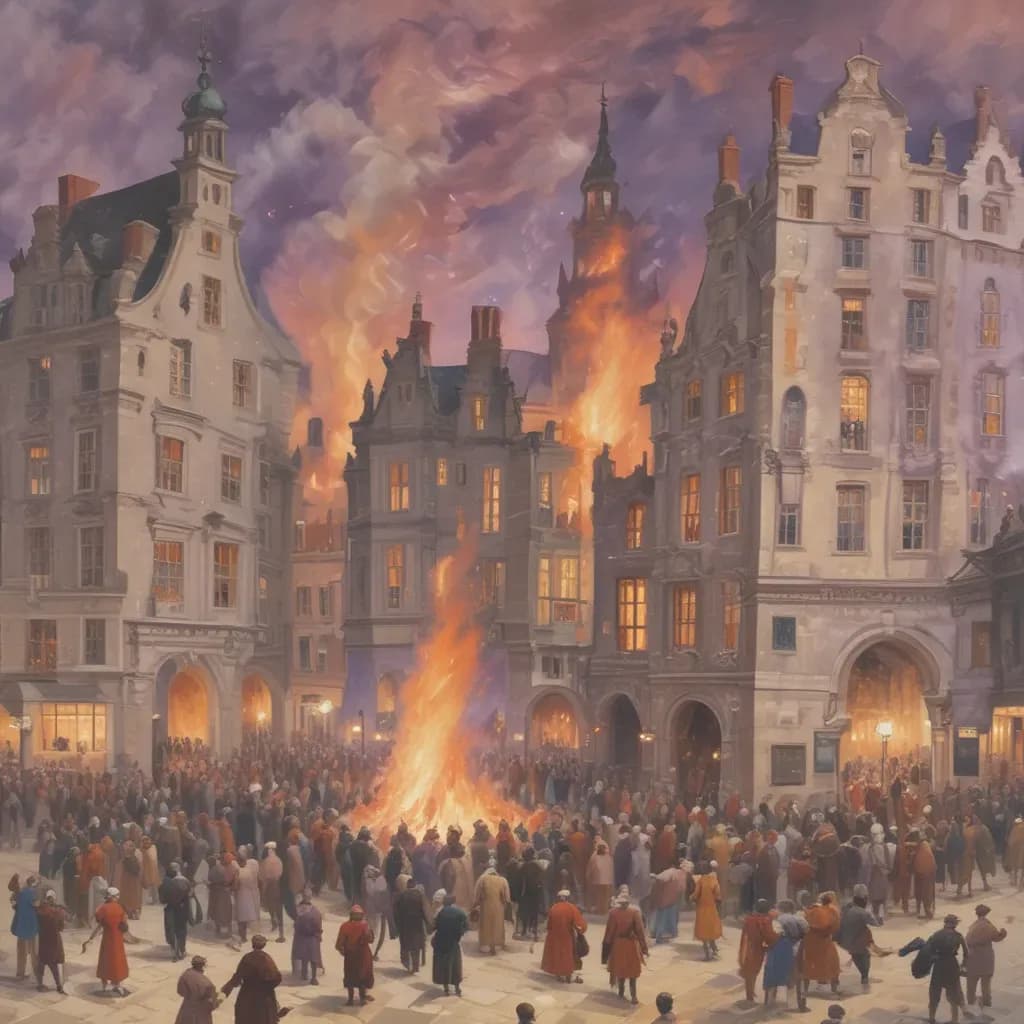
The song functions as a panoramic tour of Western history's worst moments, narrated by the figure who claims to have arranged or witnessed each one. The narrator places himself at the Crucifixion of Christ, ensuring that Pilate washes his hands and history takes the course it did. He was present at the Russian Revolution, watching the Tsar and his ministers fall and staying for the Romanov executions of 1918. He marched through the carnage of the Second World War. And then he reaches the Kennedys.[1]
Each historical reference functions not as confession but as leisurely reminiscence. The Devil is not ashamed. He is patient and urbane. He has been doing this for a very long time, and he will be doing it long after you are gone.
The shift from a singular to a plural Kennedy reference is one of the most quietly devastating moments in the song's entire history. Jagger originally wrote a reference to JFK's assassination in Dallas in 1963. When RFK was shot on June 5, 1968, Jagger updated the lyric to encompass both murders. The song caught history mid-flight, and the revision became permanent.[1][6]
The Accidental Chorus and the Studio Fire
The recording sessions at Olympic Sound Studios in June 1968 were documented by French New Wave director Jean-Luc Godard, who had come to London intending to make a film about abortion, then pivoted to the Rolling Stones after the Beatles declined his approach.[8][9] What Godard captured over approximately 32 takes was the song's evolution: from a sluggish acoustic folk number into the Latin-inflected rock track that appeared on the album.
The song's iconic backing chant arose by accident. Producer Jimmy Miller was in the engineering booth during an early vocal take, half-murmuring to himself. Anita Pallenberg noticed how the sound worked and flagged it. By the time the track was finished, the call-and-response vocalization had become the song's most recognizable non-verbal feature, pulling listeners into the performance as participants rather than spectators.[1][2]
On the morning of June 11, 1968, fire broke out in the roof of Olympic Sound Studios, attributed to a malfunctioning arc lamp from Godard's crew. The fire brigade's thorough response drenched the studio's electrical equipment. The band kept recording under an open hole in the roof.[1][8] The fire appears in Godard's footage and has since become part of the song's mythology: an accidental visual metaphor for a recording made while the world around it burned.
Godard's film was originally titled One Plus One, reflecting his Maoist interest in dialectical opposites. The film's producer, Iain Quarrier, was annoyed to find it contained no complete performance of the song, and appended the finished studio recording at the end, retitling the film Sympathy for the Devil. Godard, furious at the alteration, punched Quarrier at the premiere at the London Film Festival in November 1968.[9] The film remains one of the most significant documents of late-1960s counterculture, and the only substantial footage ever recorded of Brian Jones as a functioning member of the Stones.
Guess My Name
Jagger has been emphatic, when pressed, that the song was not intended as a celebration of Satanism. In a 1995 Rolling Stone interview, he dismissed the accusations of black magic and occult intent as silly nonsense, and expressed genuine puzzlement that a single song had generated such persistent misreading.[7]
The song's power comes from an ambiguity it refuses to resolve. The narrator is charming, witty, and historically omnipresent. He does not merely observe atrocities. He participates in them, and crucially he never acts alone. The song's central moral argument, encoded in lines that invert all conventional categories, is that criminal and saint, sinner and law-keeper, are not opposites but mirrors of each other. Evil does not arrive from outside history. It is generated through human choices and the human failure to look clearly at what is directly in front of us.[7][6]
Keith Richards captured this more precisely than most critics have managed: "If you confront him, then he's out of a job."[10] The song's repeated challenge to name the narrator is both riddle and accusation. The Devil remains powerful because people choose not to recognize him. By asking every listener to identify him, the song implicates every listener in the problem.
Hannah Arendt's concept of the banality of evil, articulated in Eichmann in Jerusalem (1963), resonates strongly here. Evil is not always monstrous or recognizable. It is often mundane, perpetrated by ordinary people who choose not to confront what is in front of them. Jagger arrived at a similar conclusion through French poetry and a Soviet novel, and encoded it in a samba groove.
Five Decades of Trouble
A persistent myth holds that Meredith Hunter was killed during the performance of this song at the Altamont Free Concert in December 1969. In fact, the song was played early in the Stones' set, was interrupted by fighting near the stage and then restarted, and Hunter was killed later during a different song altogether.[1] The myth endures because the song feels like the correct soundtrack for what Altamont became in collective memory: the moment 1960s idealism exhausted itself.
The song has since appeared in Neil Jordan's Interview with the Vampire (1994, where Guns N' Roses covered it for the closing credits), Terry Gilliam's Fear and Loathing in Las Vegas (1998), and dozens of other films and television productions that need to signal that something darkly sophisticated is at work.[1] A 2013 Mercedes-Benz Super Bowl commercial constructed an entire Faustian narrative around it. The song has been covered by Blood, Sweat and Tears, Motorhead, Ozzy Osbourne, and many others who have found its theatrical grandeur irresistible.
On Rolling Stone magazine's 500 Greatest Songs of All Time list, it has held a position in or near the top 35 across multiple editions.[10] It has accumulated over 685 million streams on Spotify.[1] More than five decades after Jagger walked into Olympic Sound Studios with an acoustic guitar and a borrowed copy of a Soviet novel, the song still sounds like an invitation to a party you are not entirely sure you should attend.
The Problem of Recognition
"Sympathy for the Devil" endures because it refuses easy resolution. It is too musically seductive to function as a straightforward warning, and too historically grounded to be dismissed as mere theater. It takes seriously the proposition that understanding evil requires getting close to it, recognizing it as charming and intelligent, acknowledging it as woven into the same human tradition that produced everything we consider good.
The devil in the song is not a monster arriving from outside history. He is a man of wealth and taste who has been here all along, patient and present, waiting to be named. That, as Jagger understood from Bulgakov's pages and Baudelaire's verse, is precisely the problem. And the samba beat, insistent and irresistible, makes the song's final argument: you cannot resist what you refuse to name.
References
- Sympathy for the Devil - Wikipedia — Recording history, personnel, chart performance, cultural impact, and correction of the Altamont myth
- Song 176: Sympathy for the Devil - 500 Songs Podcast — Detailed account of the recording sessions, the woo-woo origin, and the RFK lyric update
- Rediscovering Beggars Banquet - Albumism — Album context, critical reception, and placement in the band's career arc
- The Master and Margarita and the Rolling Stones — Detailed analysis of Bulgakov's influence and Marianne Faithfull's role in introducing Jagger to the novel
- How Bulgakov Inspired the Rolling Stones - Liden and Denz — Textual parallels between The Master and Margarita and the song's lyrics
- Behind the Meaning of The Rolling Stones' Sympathy for the Devil - American Songwriter — Jagger's 1995 Rolling Stone interview statements on the song's intent and Baudelaire influence
- The Meaning of Sympathy for the Devil Explained by Mick Jagger - Rock and Roll Garage — Jagger on the Dylan folk origins, the samba rhythm, and the song's philosophical intent
- Jean-Luc Godard and the Rolling Stones - BFI — History of Godard's film, the studio fire, and the film's premiere incident
- Why Sympathy for the Devil Is Still an Essential Rolling Stones Movie - Rolling Stone — Anniversary reassessment of Godard's film and the song's recording process
- Sympathy for the Devil - uDiscover Music — Keith Richards quotes on the song's meaning and critical standing