The Princess and the Clock
A young woman sails the world only to find herself imprisoned at the top of a tower, venerated by a society that has no idea what to do with her except worship her. This is the premise at the heart of "The Princess and the Clock," the lead single and opening track of Kero Kero Bonito's Civilisation II EP. It sounds like a legend your grandmother might half-remember, something half-Viking myth, half-Japanese folktale, vaguely familiar yet impossible to source. That is precisely the point.
A Legend of Their Own Invention
"The Princess and the Clock" was released on February 24, 2021, as the lead single for Civilisation II, a three-track EP arriving roughly sixteen months after the first Civilisation installment. The band wrote it before the COVID-19 pandemic began, but it arrived squarely in the middle of global lockdowns, when millions of people were living an involuntary version of the protagonist's fate.
Kero Kero Bonito acknowledged this timing directly in press materials: the song depicts long, lonely hours and escapist dreams that, while pre-pandemic in origin, would feel urgently familiar to listeners in 2021[1]. They described it as a song for anyone who has ever felt trapped, lost, and alone, and as a legend entirely of their own invention[2].
The Civilisation EPs marked a significant evolution in the band's ambitions. Where 2018's Time 'n' Place had turned inward toward personal memory and identity, Civilisation zoomed out to civilizational scale. Producer Gus Lobban described the project as applying the same temporal logic to human history itself, treating ancient past, contemporary crisis, and unknowable future as simultaneous reference points[3].
Civilisation II was recorded almost entirely on a Korg DSS-1, a vintage digital sampler from 1986. This was a deliberate conceptual choice: by committing to obsolete hardware, the band engaged what cultural theorist Svetlana Boym called "off-modernism," exploring the lateral potentialities of aging technology rather than chasing the latest tools[4]. The three tracks on the EP were conceived to represent past, present, and future[3]. "The Princess and the Clock," as the opening track, grounds the listener in the first of those registers: the deep time of myth.
The Tower and What It Means
The song's premise is one of involuntary elevation. The princess was never seeking a throne. She was an explorer, in motion, curious about the world beyond her home. What happens to her is not cruelty in any conventional sense but something stranger: she becomes a fixed point, a sacred object, a living symbol for a society that needs her more as myth than as person.
This is a song fundamentally about what it means to be frozen in place. The clock of the title suggests time, and time is what the princess has in endless, oppressive abundance. Years accumulate. The tower does not change. The worshippers at its base do not truly see her; they see their idea of her.
The society imprisoning her is not villainous in any cartoon sense. They genuinely revere her. This is part of what makes the song unsettling in a quiet way: the force holding the princess captive is not malice but devotion. Reviewers at Everything Is Noise flagged this as potential commentary on how zealous faith can restrict human potential and agency[5]. The prison has no lock because it does not need one. The bars are made of other people's beliefs.
Against this, the song sets the protagonist's interior life: the dreaming, the longing, the sustained imagination of freedom. Years pass and she holds onto some essential sense of herself, some restless pilot light that refuses to go out. And then one day she vanishes.
The disappearance is the crux. The band offers no explanation for how it happens. This ambiguity is productive rather than frustrating. Does she escape on her own terms, finding a door in her mind that no one else can see? Does she simply stop existing as the person she was and become the legend the society always wanted? Does something miraculous intervene? The song refuses to answer, leaving listeners to map their own version of freedom onto the blank space where the ending should be.
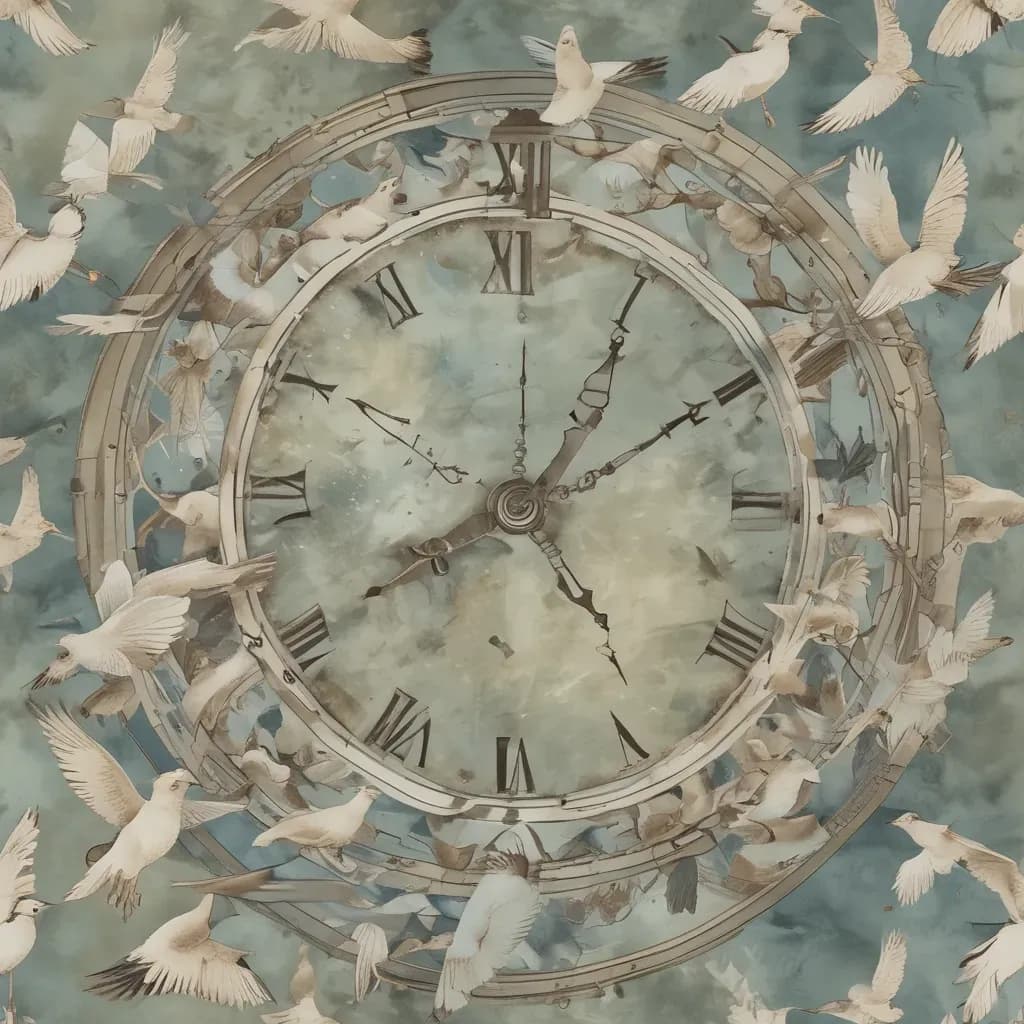
Myth as a Way of Knowing
Pitchfork's Shaad D'Souza, reviewing Civilisation II, observed that the EP meditates not on human decline as much as the fables and myths we create in order to adjust to it[6]. "The Princess and the Clock" is the most direct embodiment of that impulse: a band inventing a legend whole cloth and using it to make sense of something that straight documentary language cannot quite reach.
The Civilisation II project drew on eclectic intellectual sources. Among the five inspirations the band listed publicly was Luigi Serafini's Codex Seraphinianus (1981), an absurdist illustrated encyclopedia written in an unknowable invented script[4]. Another was ancient narrative art, specifically cave paintings and medieval tapestries as models for contemporary storytelling[4]. These are not casual references. They point to a band thinking seriously about how humans have always used image and story to metabolize experiences that resist rational framing.
The song also draws on Jon Hassell's concept of "Fourth World Music," which blends primitive and futuristic sounds, ethnic world music traditions, and electronic experimentation into something that belongs to no particular time or place[4]. The song's fairy-tale narrative operates on an analogous logic: it borrows from many traditions without belonging to any, creating the sense of a story that has always existed somewhere.
The Sound of Longing
The sonic texture of "The Princess and the Clock" reinforces its themes. Lobban's near-exclusive use of the Korg DSS-1 creates a sound that is simultaneously ancient and futuristic: primitive in its limited bit depth, yet capable of surprisingly lush, almost orchestral cascades. Polyvinyl Records and the band described the resulting music as "lost world junk pop"[7]: music that sounds like it has traveled a great distance through time to reach the listener.
The chiptune and 8-bit influences give certain passages a video game quality, reinforcing the fairy-tale register. But the ethereal synth textures that surround them pull toward something more melancholic, more genuinely strange. The overall effect does not sound cute, despite the bubblegum adjacency of much of the band's earlier work. It sounds like longing.
Sarah Midori Perry's vocals carry much of this weight. Her delivery navigates a narrow passage between detachment and ache, describing a terrible situation in a voice that remains almost eerily calm. This is a signature of Kero Kero Bonito's most affecting work: the gap between what is being described and how it is described creates its own emotional charge.
The animated music video, directed by Dan W. Jacobs and released simultaneously with the single, adds another visual register of mythmaking: bright, stylized illustration drawing on that same tradition of ancient narrative art the band cited as a core influence[4].
Lockdown, Liberation, and the Weight of Other People's Stories
Released in February 2021, roughly a year into global COVID-19 lockdowns, "The Princess and the Clock" arrived when its themes were impossible to miss. Listeners confined to apartments and houses were doing exactly what the princess does: marking time, dreaming of elsewhere, sustaining an inner world while the outer world refused to move.
NME, reviewing Civilisation II with four stars, described the EP as music where "impending doom never sounded so appealing"[8]. This captures the central paradox of Kero Kero Bonito's appeal in this era: the band is capable of making confinement and the passage of trapped time sound genuinely, warmly beautiful. Everything Is Noise called Civilisation II "utterly electrifying, life-giving, and intimate"[5]. The song achieves this by investing so fully in the protagonist's interiority that her yearning becomes the song's engine.
But the song's resonance extends well beyond pandemic metaphor. The princess's situation is an extreme version of something many people experience without any external emergency: the feeling of being held in place by forces that do not intend harm but still imprison. Social expectation, family obligation, institutional inertia, the weight of other people's projections and needs. The society at the foot of the tower means well. That is precisely what makes the tower real.
Alternative Readings
Some listeners have heard the song as a critique of celebrity culture: the famous person as a kind of princess in a tower, elevated by public adoration into something that no longer resembles the original human being at all. The society in the song worships the princess not for who she is but for what she represents to them, which is a fair description of how mass fame tends to function.
Others have emphasized a feminist reading: a female explorer whose autonomy is stripped from her by a power structure that reframes her imprisonment as honor. The word "princess" carries all its fairy-tale freight of passivity and rescue-awaiting, which the song's protagonist quietly, persistently refuses.
There is also a reading available through the Civilisation project's broader conceptual frame: humanity itself as the princess, momentarily frozen in its tower of civilization, cut off from the natural world, dreaming of a freedom it has not yet figured out how to claim. This reading sits comfortably alongside the ecological concerns that drove Civilisation I, which took climate crisis and societal collapse as its central preoccupations[3].
The Door She Found
Kero Kero Bonito built "The Princess and the Clock" from nothing, inventing a legend to carry feeling that existing language could not quite hold. This is what mythmaking is: the construction of a story specific enough to feel real and open enough to let anyone walk into it.
The song is a three-minute-and-forty-nine-second argument for the interior life. For dreaming as a form of resistance. For the possibility that the walls are not as permanent as they appear. The princess disappears at the end, and the song does not tell us where she went. That gap is not a failure of imagination. It is an invitation to supply your own.
References
- Kero Kero Bonito – "The Princess and the Clock" (Stereogum premiere) — Official band statement on the song's narrative and pandemic resonance
- Kero Kero Bonito Sail Through Indie Pop Mythology on "The Princess and the Clock" (Vanyaland) — Single premiere with band quote about the song being a self-invented legend
- Civilisation II – Wikipedia — EP overview including tracklist, release context, and the past/present/future conceptual framework
- Five Things That Inspired Kero Kero Bonito's New EP Civilisation II (Dazed Digital) — Band discusses off-modernism, Jon Hassell, Korg DSS-1, Codex Seraphinianus, and ancient narrative art as inspirations
- Kero Kero Bonito – Civilisation II review (Everything Is Noise) — In-depth review noting the song's commentary on devotion restricting agency; calls EP electrifying and intimate
- Kero Kero Bonito – Civilisation II (Metacritic) — Aggregates critical reviews including Pitchfork's observation about myth-making as a response to civilizational decline
- Kero Kero Bonito – Wikipedia — Band history, discography, and description of 'lost world junk pop' aesthetic
- Kero Kero Bonito – Civilisation II EP review (NME) — Four-star review: 'impending doom never sounded so appealing'