The River
A Question With No Easy Answer
There are songs that capture a specific moment in time, and there are songs that capture a specific truth about human experience. "The River" belongs firmly to the second category. Released in 1980 as the title track and emotional anchor of Bruce Springsteen's fifth studio album, it traces the arc of a working-class life from youthful promise through forced adulthood and into quiet, bewildering loss. The question it poses near its end has haunted listeners for more than four decades: what does it mean when a dream doesn't come true? Is it merely a disappointment, or something more corrosive?
Few rock songs of its era carry this kind of philosophical weight without feeling pretentious. "The River" carries it effortlessly, because it never reaches for abstraction. It stays stubbornly, painfully specific. That specificity is the source of its power.
A Song Written for Two Real People
Springsteen wrote "The River" in August 1979, recording it at The Power Station in New York City.[1] The inspiration was direct and deeply personal: his sister Virginia and her husband Michael "Mickey" Shave. Ginny had become pregnant during her senior year of high school and married Mickey, who worked variously as a rodeo rider and in construction.[2]
When Springsteen first performed the song publicly at the Musicians United for Safe Energy concerts at Madison Square Garden in September 1979, he introduced it simply: "This is my brother-in-law and my sister."[3] In Peter Ames Carlin's 2012 biography Bruce, Ginny confirmed the song offered a precise description of her early married life.[2] She was initially ambivalent about the song but eventually came around fully: "Now it's my favorite song."[3]
The biographical roots run deeper than one family's story, however. By 1979, Springsteen had just emerged from a grueling legal battle with his former manager Mike Appel over contract terms that had effectively blocked him from entering a recording studio for nearly a year between 1976 and 1977. He settled at significant personal cost and spent the subsequent touring cycle essentially playing to pay debts.[4] During that period, he watched peers from Freehold, New Jersey navigate marriages, children, and economic pressures that foreclosed the options they had imagined for themselves.
The song also draws a direct musical line to Hank Williams. Springsteen cited Williams's 1950 recording "Long Gone Lonesome Blues," in which a narrator goes to a river intending to end his life, only to find it has dried up. Springsteen described Williams's music as carrying a unique conflict between religious devotion and hard living, and that combination spoke to him as he wrote about the contradictions of working-class life.[5] He absorbed the dried-river image and redirected it: his narrator doesn't seek death in the river, but watches the river itself become an emblem of vanished possibility.
The recording sessions for The River stretched across 18 months. Springsteen and the E Street Band worked through hundreds of tracks, eventually settling on a double album.[4] He wanted the album to hold two moods simultaneously: the raw exuberance of a bar band playing at full throttle, and the gravity of lives constrained by economics and circumstance. His stated philosophy was that the world could be cold and unfair but that did not mean you couldn't also dance through it.[6]
Themes: Inheritance, Entrapment, and the Weight of Unfulfilled Promises
"The River" moves through time in a way that feels almost cinematic. The narrator passes from adolescence to his twenties in the span of a few verses, and each stage peels back another layer of the life he imagined versus the life he got.
The opening section establishes a world in which young men follow their fathers without question, trading high school for a trade. Class and geography function as destiny here. Springsteen draws this not as accusation but as simple fact, which makes it more unsettling than any polemic could be.[7]
The unplanned pregnancy and courthouse wedding arrive without ceremony or celebration. The narrator is not depicted as a villain or even as particularly reluctant. He simply finds himself inside a life that was decided for him by circumstance. The wedding is stripped of romance. The job follows inevitably. The sense that individual agency was never really available is built quietly into the song's structure rather than stated as grievance.[8]
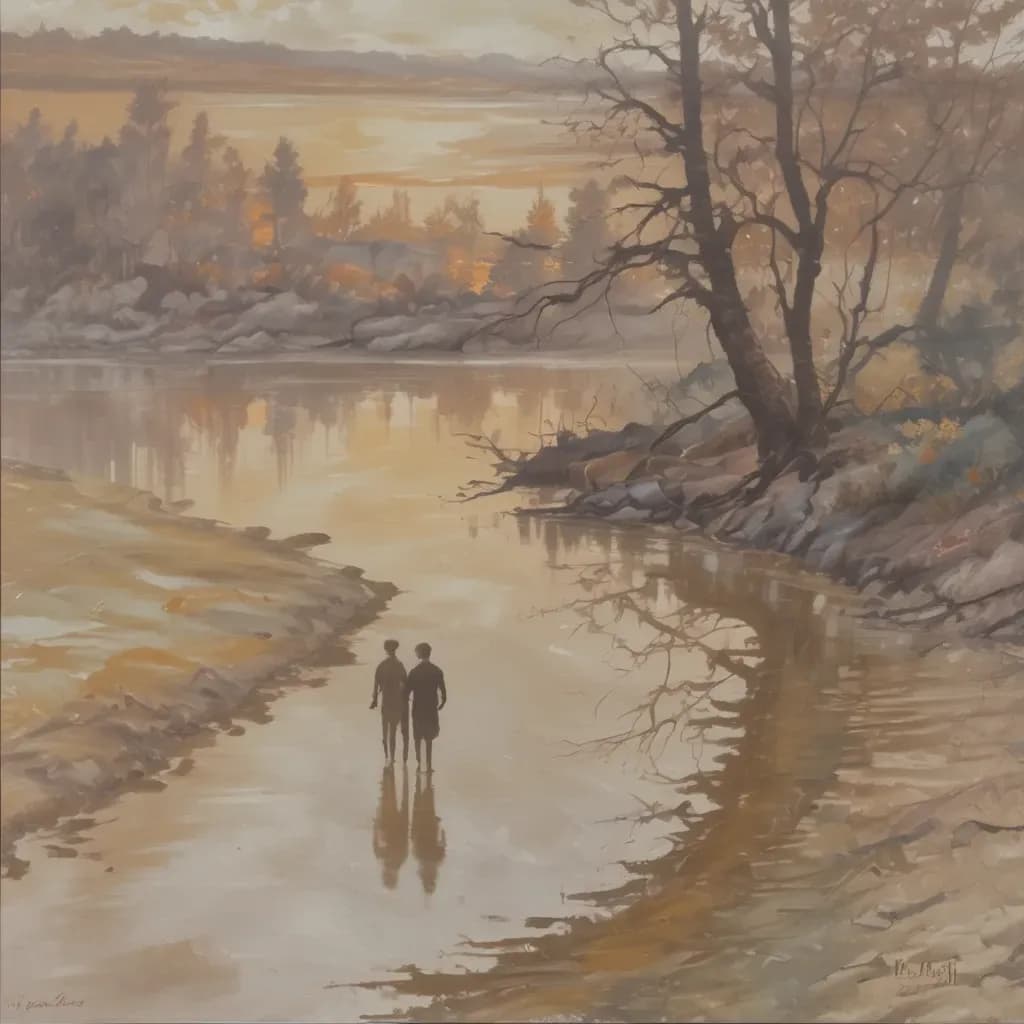
At the center of the song, the river appears as a place the narrator and his future wife used to swim as teenagers. This is the song's most tender passage: an image of pure possibility, a world before obligation arrived. The water is joyful and unconstrained. But the song does not linger there. It moves quickly into the dry, stalled present.
By the final section, the narrator describes returning alone to the riverbank. The water is gone, or might as well be. He cannot locate the feeling he once had there. The river, which had stood for freedom, for love, for the particular electricity of early life, now offers nothing.[7]
The image of the dried river was drawn directly from Hank Williams, but Springsteen transformed its meaning. Where Williams used the dried river as a blackly comic punchline, Springsteen uses it as a sustained meditation.[5] The river does not merely fail to offer escape; it fails to verify that the past was real. The narrator's closing question is not whether happiness was possible, but whether hope itself is a kind of wound.
There is also a powerful generational undercurrent throughout the song. The narrator repeats the pattern set by his father, and the cycle shows no sign of breaking. Economic and geographic circumstance trap individuals in inherited lives. This is not presented with bitterness; it is presented with a kind of exhausted clarity that is, in many ways, harder to sit with than outright anger.[8]
Cultural Resonance Across Borders and Generations
The album The River reached number one on the Billboard 200 upon release in October 1980, Springsteen's first chart-topping record.[6] Rolling Stone critic Paul Nelson called it a rock-and-roll milestone.[9] Rolling Stone would later rank the title track at number five on their list of the greatest Bruce Springsteen songs of all time.[7]
What makes the song's cultural reach remarkable is how far beyond New Jersey it traveled. Irish author Dermot Bolger wrote about hearing the album for the first time in working-class Dublin in 1980. A van driver played it, and a room full of people fell silent as they recognized themselves in the narrative. Bolger described how the song transported listeners from the particularity of one New Jersey couple into the universality of millions of couples everywhere. For him, it validated the idea that his own world of factories and working-class estates was as much the source of serious literature as any classical tradition.[10]
This universality is not accidental. Springsteen took an extremely specific story (his sister, her husband, a particular river in central New Jersey) and wrote it in a way that opened outward into emotions that exceed any single geography. The details are precise, but they function as containers for feelings that belong to a much wider human experience.
The song arrived at a moment when the optimism of earlier Springsteen anthems was beginning to ring hollow for many listeners. The late 1970s had delivered oil shocks, stagflation, and a creeping sense that the postwar prosperity that had defined American working-class life was slipping away.[11] "The River" named that feeling without editorializing about it. It did not argue for political solutions. It simply described what was happening to real people with such precision that those people recognized themselves.
Among the song's most celebrated live moments is a performance from the Los Angeles Coliseum in September 1985, in which Springsteen preceded the song with a lengthy spoken account of his relationship with his father, the Vietnam draft, and the complex emotions of that period. The performance was released on the Live 1975-85 box set and has been described as one of the most affecting moments in rock concert history.[7]
Alternative Readings
Some critics have read the song as an indictment of marriage itself, arguing that Springsteen at thirty was presenting domestic life as inherently tragic without acknowledging its rewards. One detailed analysis suggested this reading misses the emotional complexity: the narrator does not regret his wife. He mourns the conditions that transformed what should have been love and freedom into scarcity and labor.[8]
Others have focused on the generational dimension, placing "The River" in a long American literary tradition of writing about the gap between the mythology of self-determination and the reality of structural constraint. In this reading, the song is not about one couple but about what the American economy and American culture does to working people when the promises run out.
The song's closing question has attracted particular attention across decades of criticism. It refuses to resolve into either resignation or hope. The narrator does not answer his own question, and neither does the song. Springsteen himself addressed the paradox in interviews, saying he had arrived at a place where he understood that life contained contradictions and that you had to learn to live with them.[1] That acceptance, without flinching from what has been lost, is the emotional territory the song inhabits and refuses to leave.
The Song and the Life It Describes
"The River" endures not because it flatters its audience or offers consolation, but because it refuses to. It holds a specific life with complete attention and asks what happened to the dreams that life was supposed to carry. The answer it provides is not satisfying, which is exactly why it remains true.
Ginny and Mickey Shave have been married for more than forty years. They have three children and several grandchildren.[3] The song about their early hardship became, in time, her favorite song. There is something in that outcome that echoes the song's own paradox: the difficulty was real, the dreams were real, and the ending is not what either a tragedy or a triumph would require. It is something more ordinary and more lasting than either.
That is the territory Springsteen was mapping with "The River": the part of American life that falls between the anthem and the elegy, where most people actually live.
References
- The River - Songfacts — Recording details, Hank Williams influence, and Springsteen quotes about life's paradoxes
- The Song Bruce Springsteen Wrote for His Sister — Details on Ginny and Mickey as the song's direct inspiration, confirmed by Ginny and the Carlin biography
- The River Had a Happy Ending After All — Virginia Springsteen's account of the song, her marriage, and how it became her favorite song
- The River (album) - Wikipedia — Album history, recording context, legal dispute background, and place in Springsteen's catalog
- How Hank Williams Inspired The River - Far Out Magazine — Springsteen's own account of how Hank Williams' 'Long Gone Lonesome Blues' shaped the song's imagery
- When Bruce Springsteen's The River Became His First No. 1 Album — Album chart history, commercial context, and Springsteen's artistic philosophy for the record
- The River (song) - Wikipedia — Overview of song history, inspirations, live performances, and critical rankings
- Roll of the Dice: The River - E Street Shuffle — Detailed critical analysis of the song's themes, structure, and the narrator's emotional arc
- The River - Rolling Stone Album Review — Paul Nelson's 1980 Rolling Stone review calling the album a rock and roll milestone
- Bruce Springsteen's The River Spoke to My Working-Class Dublin — Dermot Bolger's Lit Hub essay on the song's cross-cultural resonance with Irish working-class experience
- The River - Classic Rock Review — Retrospective analysis of the album's place in the trilogy with Born to Run and Darkness on the Edge of Town