Through the High Wire
Walking a wire isn't just about balance. It's about belief: the conviction, in each suspended moment, that the crossing is possible, that the structure holds, and that you can trust what you think you know. "Through the High Wire," the eleventh track on James Blake's 2026 album Trying Times, opens with a striking contrast: the narrator confessing a total inability to determine what is true, set against a cool observation about people's enduring appetite for narrative. The gap between those two things, the inability to know what's real and the human hunger for a good story, is the space the entire song inhabits.
The song began during the sessions for Playing Robots Into Heaven in 2022, making it one of the older ideas in Blake's recent catalog.[1][2] By the time it was refined and released on Trying Times, his March 2026 seventh album and first independent release, its themes had only grown more resonant. In the years between its writing and its release, Blake had left a twelve-year major label deal, moved from Los Angeles back to London, rebuilt his professional infrastructure from the ground up, and made the album with his longtime partner Jameela Jamil as executive producer and creative collaborator.[3] The song landed in a world, and a personal narrative, where questions of what to trust had sharpened considerably.
"Trying Times" is built around what Blake described as the challenge of reconciling private life with what is happening outside: love as a survival strategy in a world that keeps accelerating.[4] Blake had grown openly critical of the music industry's prioritization of fame over craft, and of the internet as what he called "a scary place" driven by algorithmic outrage.[5] "Through the High Wire" addresses that landscape from an interior vantage point, tracing what it feels like to be caught between what you know and what the noise insists is true.
The Story Machine
The song's central preoccupation is with narrative itself: the way rumors accrete into accepted fact, the way small distortions grow until they bring something that was once elevated crashing down. One review noted that the track traces exactly this trajectory, depicting how whispers gather momentum and transform until they pull something from a height it can no longer sustain, and that the personal fractures this process creates mirror larger societal ones.[6] What starts as uncertainty becomes, over time, the kind of story that spreads through communities and eventually destroys.
This isn't only a political observation, though it maps cleanly onto political terrain. It reads just as clearly as a portrait of interpersonal life, of the rumors that circulate through families and friendships and workplaces. Blake spent years embedded in Los Angeles, an entertainment-industry ecosystem where narrative management is practically a profession, where the distance between whisper and headline can collapse overnight.[5] His departure from that world, and his insistence on rebuilding with a small team he described as a "chosen musical family," inflects how the song feels.[7] It comes from someone who has watched stories do damage up close.
Belief and Fragility
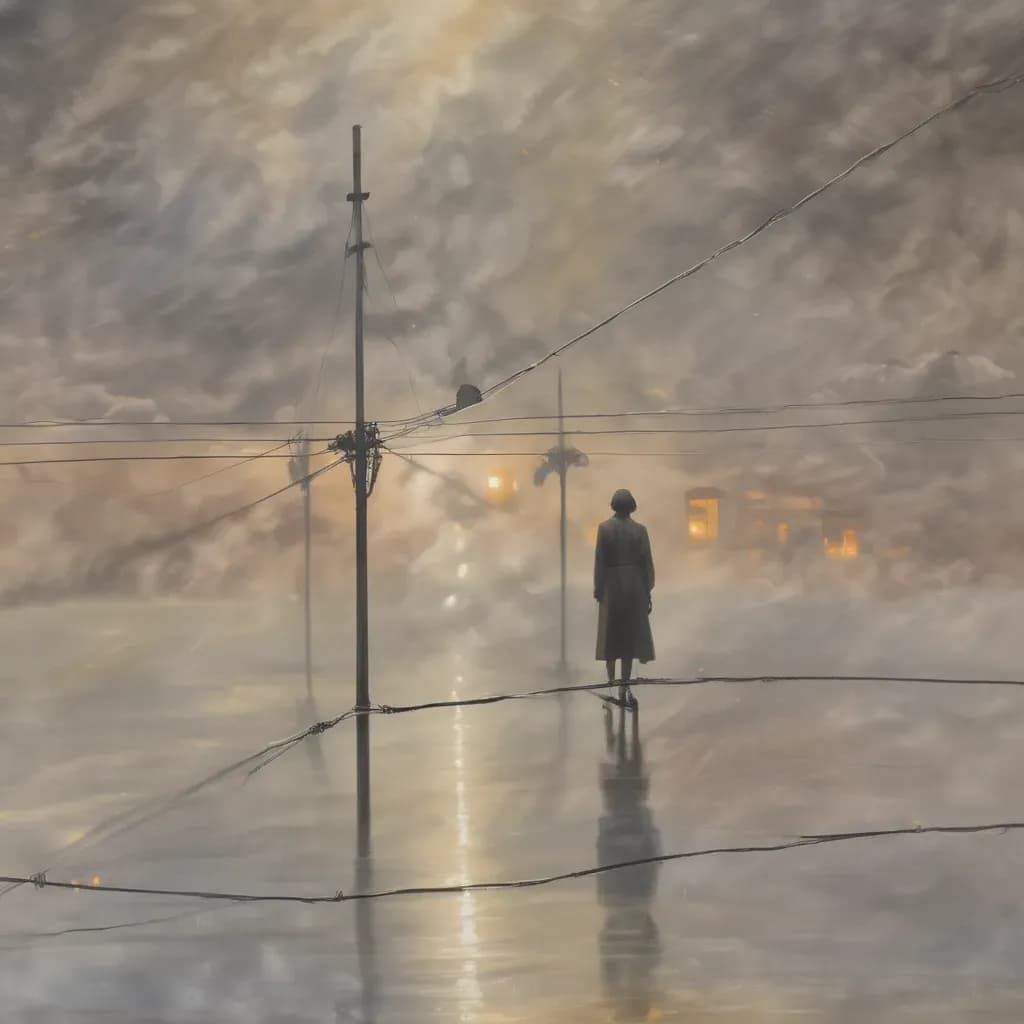
The wire itself is a beautifully chosen image. A tightrope walker needs to believe in their own balance to survive. The moment that belief falters, even slightly, even internally, the crossing becomes impossible. Blake positions his narrator at this exact precipice: uncertain what to hold onto, watching the stories multiply, sensing that the height achieved may not hold.
The production reinforces this quality. Built around sparse, echoing piano and Blake's layered vocals, the track drifts in a way that resists easy resolution. At moments the sound itself glitches, briefly distorting Blake's voice as though the song can't fully hold itself together.[8] One reviewer observed that the track "leans upward, almost hopeful, though even that hope feels conditional."[8] That conditionality is the point. This is not a song that promises a safe landing.
Where It Lives on the Album
Positioned as track eleven of thirteen, "Through the High Wire" arrives near the end of an album that has already moved through explicit grief in "Death of Love," a strikingly candid engagement with suicidal ideation in "Make Something Up," and the moral reckoning of the collaboration with UK rapper Dave on "Doesn't Just Happen." The album's title track, Trying Times, establishes the record's dual register: personal difficulty held against global anxiety. "Through the High Wire" arrives as a kind of penultimate reckoning, before the album closes on "Just a Little Higher."[1]
The social dimension of the song is overt in how it frames its imagery of collapse. The fractures that stories create between people mirror, in Blake's telling, the fractures occurring at larger scales. The personal and political are not separate here. The same mechanisms that erode trust in a relationship erode trust in institutions, communities, and shared understanding. Blake described the album as his attempt to find love amid chaos.[4] This song catches him at the moment when chaos is loudest.
An Echo Through the Wire
The title carries a pointed echo. Kanye West's "Through the Wire," recorded in 2002 just weeks after a near-fatal car crash that left his jaw physically wired shut, became one of the defining documents of survival through creative act. The literal impossibility of what West did, forcing vocal performance through physical constraint, became the song's metaphysical subject. Blake's "Through the High Wire" seems to invert the direction: rather than forcing sound through physical constraint, Blake's narrator is questioning what sounds mean, whether the stories they form are worth believing. West's song is about the will to speak. Blake's is about the crisis of listening.[2]
The framing carries additional freight given subsequent events. Blake later asked to have his production credit removed from West's "Bully," signaling a definitive break in a professional relationship that had included collaborative sessions around 2022, the same period during which this song apparently began.[2][9] Whether the title echo was intentional or ambient, it places Blake in conversation with questions of legacy, loyalty, and the stories that form around public figures, which is exactly the terrain "Through the High Wire" explores.
Why It Resonates
The song arrives in a moment saturated with concern about misinformation, narrative manipulation, and the difficulty of establishing consensus reality. Blake doesn't offer a thesis or a solution. What he offers is the phenomenology of it: what it feels like to be someone who doesn't know what to believe, watching stories move through the world faster than facts can catch them, trying to maintain balance on a wire that keeps shifting.
That restraint is what makes the song work. A more polemical artist might turn the same materials into a manifesto. Blake turns them into a mood, a weather system, something you inhabit rather than analyze. The song's three and a half minutes create a space where the listener can recognize their own uncertainty without being told what to do with it.
Conditional Hope
"Through the High Wire" is one of the quieter revelations on Trying Times, a record that contains more dramatic moments. But quiet doesn't mean minor. It sits close to the end of an album about survival, love, and the cost of paying attention to the world, and it names something the other songs circle without quite landing on: the specific loneliness of not knowing what to believe, and the ongoing effort required to keep moving anyway.
Blake has built a career on holding contradictions in the same space: the classical and the electronic, the intimate and the expansive, the personal and the social. "Through the High Wire" holds another. It acknowledges that stories are unreliable while recognizing that we cannot live without them. The wire stays up. We keep walking.
References
- Trying Times – Wikipedia — Track listing, production credits, release information, and critical reception for the album
- Through the High Wire – Kanye West Wiki — Song origins during Playing Robots Into Heaven sessions, title reference to Kanye West's Through the Wire
- James Blake Praises Jameela Jamil for Her Contributions to 'Trying Times' (Complex) — Blake on Jameela Jamil's role as executive producer and creative collaborator
- James Blake Isn't Afraid Of These Chaotic Times (Rolling Stone) — Blake describing the album as reconciling private life with what is happening outside
- James Blake escaped the major label labyrinth (Yahoo / AP) — Blake on leaving Los Angeles, the major label system, and rebuilding independently
- Album Review: Trying Times by James Blake (Shatter the Standards) — Analysis of 'Through the High Wire' and its themes of whispers, narrative, and social fracture
- The Music Is The Easy Part: An Interview With James Blake (Pigeons and Planes) — Blake on love as the center of the record, building a new team, and achieving creative flow
- Album Review: James Blake – Trying Times (Beats Per Minute) — Critical analysis of the album including 'Through the High Wire' -- production glitches and conditional hope
- James Blake Asks to Be Removed From Kanye West's 'Bully' Production Credits (Variety) — Blake's break from West's production credit, contextualizing their 2022 collaborative sessions